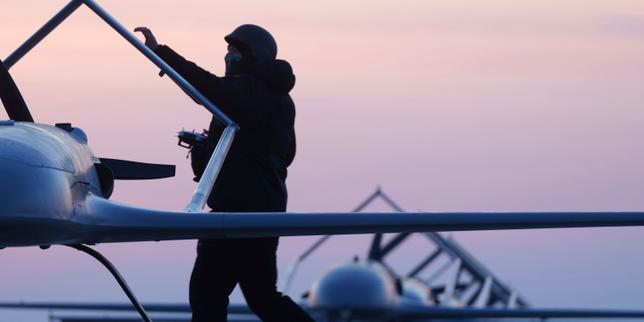
You can't protect a country that spans eleven time zones against thousands of cheap, flying explosives. Russia's massive geography used to be its greatest military shield. Today, that size is a liability. Long-range unmanned aerial systems developed by Ukraine now routinely strike targets thousands of kilometers inside Russian territory, hitting oil refineries, command posts, and strategic airfields that were supposed to be safe.
Military analysts often talk about air defense as an impenetrable dome. Reality is messier. Radar screens feature blind spots, electronic jamming creates openings, and sheer saturation exhausts missile batteries. If you throw enough low-cost flying hardware into the sky, something gets through.
The Anatomy of Long-Range Penetration
Hitting a target 1,500 or 2,000 kilometers away requires solving complex engineering problems. You need extreme fuel efficiency, reliable navigation systems that don't rely solely on jammed GPS signals, and enough structural integrity to survive long flights.
Ukraine didn't build these capabilities overnight. Over the past few years, defense initiatives scaled up domestic manufacturing to produce airframes capable of crossing half a continent. These aren't high-end military jets costing tens of millions of dollars. They are often modified light aircraft or purpose-built prop-driven machines manufactured cheaply at scale.
When hundreds of these devices move toward a target simultaneously, they overwhelm the mathematical capacity of local air defense crews. A Pantsir or S-400 system can track and destroy incoming threats, but each interceptor missile costs a fortune and takes time to reload. Drones are cheap. Interceptors are scarce. That math favors the attacker every single time.
Exploiting the Gaps in the Radar Grid
Russia deploys some of the most sophisticated anti-aircraft technology in the world, yet massive gaps remain. Radar horizons are limited by the curvature of the earth. Low-flying objects hugging the terrain slip beneath detection thresholds until it's far too late.
To make matters worse, electronic warfare works both ways. While Russian forces heavily jam communication channels near the front lines, doing so across the entire interior of the country creates massive logistical and administrative hurdles. Ukrainian operators utilize pre-programmed flight paths, inertial navigation systems, and onboard visual matching to navigate when radio frequencies are completely blocked.
Air defense networks require continuous coordination between radar operators, intelligence units, and mobile fire teams. When strikes hit multiple regions across the Urals and European Russia within hours of each other, communication loops break down. Confusion sets in. Command chains hesitate while trying to determine which targets are real threats and which are electronic decoys.
Targeting the Economic Engine
The strategy goes far beyond symbolic messaging. By focusing long-range strikes on industrial hubs, fuel depots, and manufacturing plants deep inside Russian territory, the objective is systemic attrition. Petroleum exports and domestic fuel supplies form the financial backbone of the military effort. When refining capacity drops, the economic friction increases immediately.
Protecting every single oil refinery, munitions factory, and military base across a continental landmass is economically impossible. Even if Russia repositions valuable air defense assets from other regions to cover these vital sites, doing so creates dangerous vulnerabilities elsewhere along the thousands of kilometers of active borders.
The conflict has transformed into a relentless test of industrial endurance. Technology keeps evolving on a monthly basis, with autonomous guidance systems stepping in to complete final approach maneuvers even when local jamming completely blinds human operators. As these systems become cheaper, smarter, and harder to intercept, traditional notions of territorial depth and rear-area safety are disappearing completely.