The Ghost of a Twenty-Year Promise
Deep in the halls of Brasília, the air often carries the weight of history, but rarely does it carry the weight of relief. For twenty-four years, a document has sat on various desks, gathering the metaphorical dust of three different decades. It was a deal that seemed destined to remain a phantom—a free trade agreement between Mercosur and the European Union that everyone talked about but nobody actually expected to see alive.
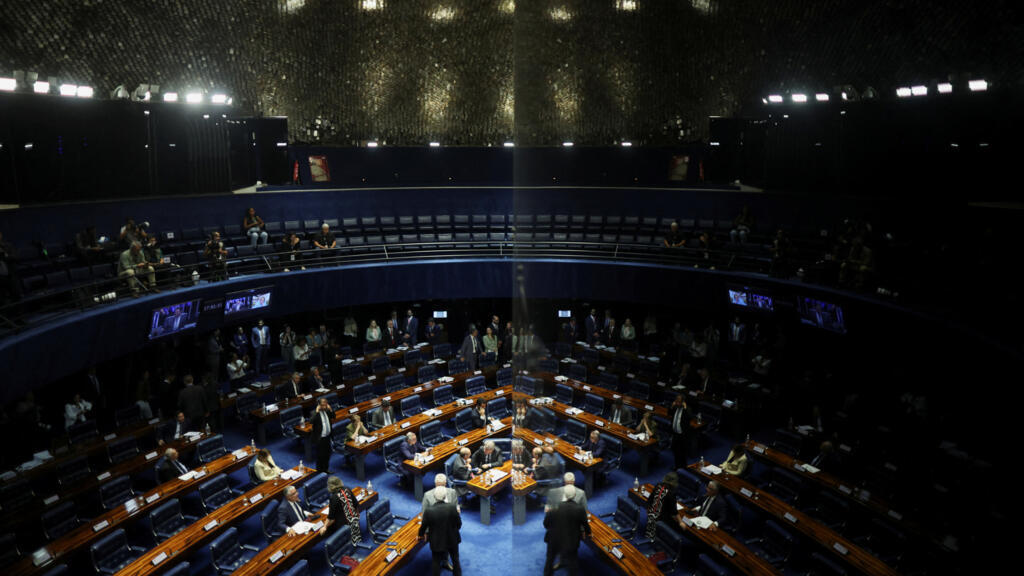
Then, the Senate floor went quiet. The votes were cast. The ratification happened.
To a news ticker, this is a line of data. To a soybean farmer in Mato Grosso or a winemaker in the French countryside, it is the tectonic plates of the global economy finally shifting under their feet. This isn't just about tariffs or quotas. It is about a handshake that took a quarter of a century to complete.
The Human Cost of a Border
Consider a hypothetical exporter named Elena. She runs a medium-sized firm in Porto Alegre, specialized in high-end leather goods. For years, Elena has looked at the European market like a forbidden garden. She knows her quality beats the mass-produced alternatives. She knows the artisans she employs deserve a global stage. But the moment her products hit the docks in Rotterdam, they are hit with a wall of taxes that make them luxury items for the ultra-rich rather than competitive goods for the middle class.
Elena represents the "invisible stakes." When we talk about "ratification," we are actually talking about Elena being able to hire five more people. We are talking about the survival of a craft that has been passed down through her family for eighty years.
The European Union represents a market of over 450 million consumers. Mercosur—comprised of Brazil, Argentina, Paraguay, and Uruguay—brings nearly 300 million more to the table. When these two blocs finally lock gears, they create one of the largest free-trade zones on the planet. But for two decades, the gears were jammed by a single, recurring word: Protectionism.
The Friction of the Old World
Why did it take so long? The answer isn't found in economics textbooks as much as it is found in the soil.
European farmers, particularly in France and Ireland, feared an influx of Brazilian beef and agricultural products. They saw the vast plains of South America not as a partner, but as a threat that could undercut their livelihoods. On the flip side, Brazilian industrialists feared that German machinery and French luxury goods would flood their markets, drowning out local competition before it had a chance to swim.
It was a stalemate of fear.
To bridge this gap, the deal had to become more than just a ledger of imports and exports. It had to become a pact about how we treat the earth. The environmental concerns—specifically the protection of the Amazon—became the fulcrum upon which the entire deal balanced. Europe demanded guarantees that trade wouldn't come at the cost of the lungs of the planet. Brazil, under shifting political leadership, had to prove it could be a responsible steward while still feeding the world.
A New Geography of Power
The world has changed since this deal was first whispered about in 1999. Back then, the internet was a novelty, and the global supply chain felt like a straight line. Today, the world is fragmented. Trade wars between giants like the U.S. and China have left mid-sized economies scrambling for stability.
By ratifying this deal, Brazil is doing more than lowering the price of wine and car parts. It is choosing a side. It is signaling that it belongs to a rules-based international order. In a time of rising walls, this is a deliberate, calculated move to tear one down.
Think about the sheer scale of the removal of duties. We are talking about the elimination of tariffs on over 90% of goods traded between the two blocs. For Brazil, this means easier access for its orange juice, coffee, and sugar. For the EU, it means a massive opening for its chemicals, pharmaceuticals, and clothing.
But the real magic happens in the "rules of origin" and the "standardization." Suddenly, a certificate of quality issued in São Paulo carries weight in Berlin. The bureaucratic red tape that acts as a hidden tax on every transaction is beginning to dissolve.
The Risk of the Unfamiliar
We should be honest about the uncertainty. Not every business is an Elena. Some companies have survived only because they were shielded by high import walls. For them, the ratification is a ticking clock. They have a limited window to modernize, to innovate, and to find a way to compete with a factory in Munich or a design house in Milan.
This is the creative destruction of the open market. It is painful. It is messy. It creates winners who celebrate in high-rise offices and losers who wonder how they will pivot their family business.
The Senate's move is a gamble on the talent of the Brazilian people. It is an assertion that, given a level playing field, the South American giant can out-compate the Old World. It is a rejection of the idea that Brazil should remain a "country of the future" forever, never quite arriving at the present.
Beyond the Ink
When the pens were put down, the work didn't end. Ratification is a beginning, not a finale. There are still layers of implementation, legal adjustments, and the slow, grinding process of aligning two vastly different regulatory environments.
However, the psychological barrier has been breached. The message sent to global investors is clear: the road to South America is open, and it is paved with international standards and mutual cooperation.
The deal is a mirror. It reflects our desire for a world that is more connected, even when that connection is difficult to manage. It reminds us that geography is no longer destiny, and that a twenty-year-old dream can, with enough political will and compromise, become a reality that changes the price of the food on your table and the tools in your hand.
The long road from 1999 has finally reached its destination. Now, the real journey begins.
One day, Elena will walk through a boutique in Madrid and see her leather bags on the shelf. She won't think about the Senate subcommittees or the technical Annexes of the Mercosur agreement. She will simply look at the price tag, see that it is fair, and know that her work has finally found its way home.
The ink is dry. The gates are open. The world just got a little bit smaller.
Would you like me to analyze how this deal specifically impacts a particular industry, such as the automotive sector or sustainable agriculture?


