Paper trails tell us more about history than marble monuments ever could. Right now, a stack of ink-stained pages is proving that exact point by commanding a staggering price.
A massive collection of 688 handwritten notes by Mahatma Gandhi recently sold for $1.69 million, translating to roughly Rs 16.20 crore, at a Saffronart auction in India. That figure breaks records, making it the highest price ever paid for an Indian historical document at auction. But the real story isn't just about the money. It's about why these specific words matter so much right now.
The Story Behind the Ink
You might wonder why anyone would pay millions for old notes. These weren't random grocery lists or political drafts. Gandhi wrote these daily reflections between 1944 and 1946 for a very specific reason.
His close associate and fellow freedom fighter, Anand T Hingorani, suffered the devastating loss of his wife, Vidya. To pull his friend through the grief, Gandhi committed to sending a daily handwritten message of spiritual guidance, comfort, and discipline.
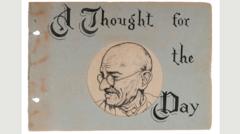
Imagine receiving a daily letter from one of history's most influential figures while you are mourning. Day after day, Gandhi put pen to paper. He addressed heavy topics like truth, non-violence, self-restraint, labor, and the search for God. These intimate daily dispatches were eventually compiled into a book called "A Thought for the Day". Having the raw, original manuscripts surface together creates a rare window into Gandhi's private mind during a turbulent era of Indian history.
What the Auction Actually Included
The headline-grabbing notes were part of a larger 86-lot auction titled "Gandhi: From the Collection of Anand T Hingorani". The Hingorani family preserved these archives for decades. The lot featured rare letters, manuscripts, photographs, and personal items spanning over twenty years.
Auction houses see high-value memorabilia cross blocks all the time, but historical documents of this scale rarely stay in private hands for long without drawing intense global attention. Thankfully, Saffronart confirmed that the buyer chose to remain anonymous while keeping the manuscript inside India. That detail matters to historians who worry about national heritage being scattered across foreign private collections.
Why People Still Care About Gandhi's Handwriting
We live in an age of instant digital communication where permanent records barely exist. Ephemeral chats vanish. Emails get deleted. Seeing physical handwriting from a historical icon anchors us to reality. Gandhi's shaky yet deliberate script represents a tangible link to an era defined by immense sacrifice and moral clarity.
When a collection like this commands nearly $1.7 million, it signals a massive shift in how collectors value primary sources. People are tired of sanitized history textbooks. They want the raw, unedited proof of human thought.
If you ever get the chance to view original historical manuscripts in a museum or archive, skip the audio guide and just look at the physical strokes. You will see hesitation, pressure, and emotion baked right into the paper. That is something digital screens can never replicate.


.webp)
