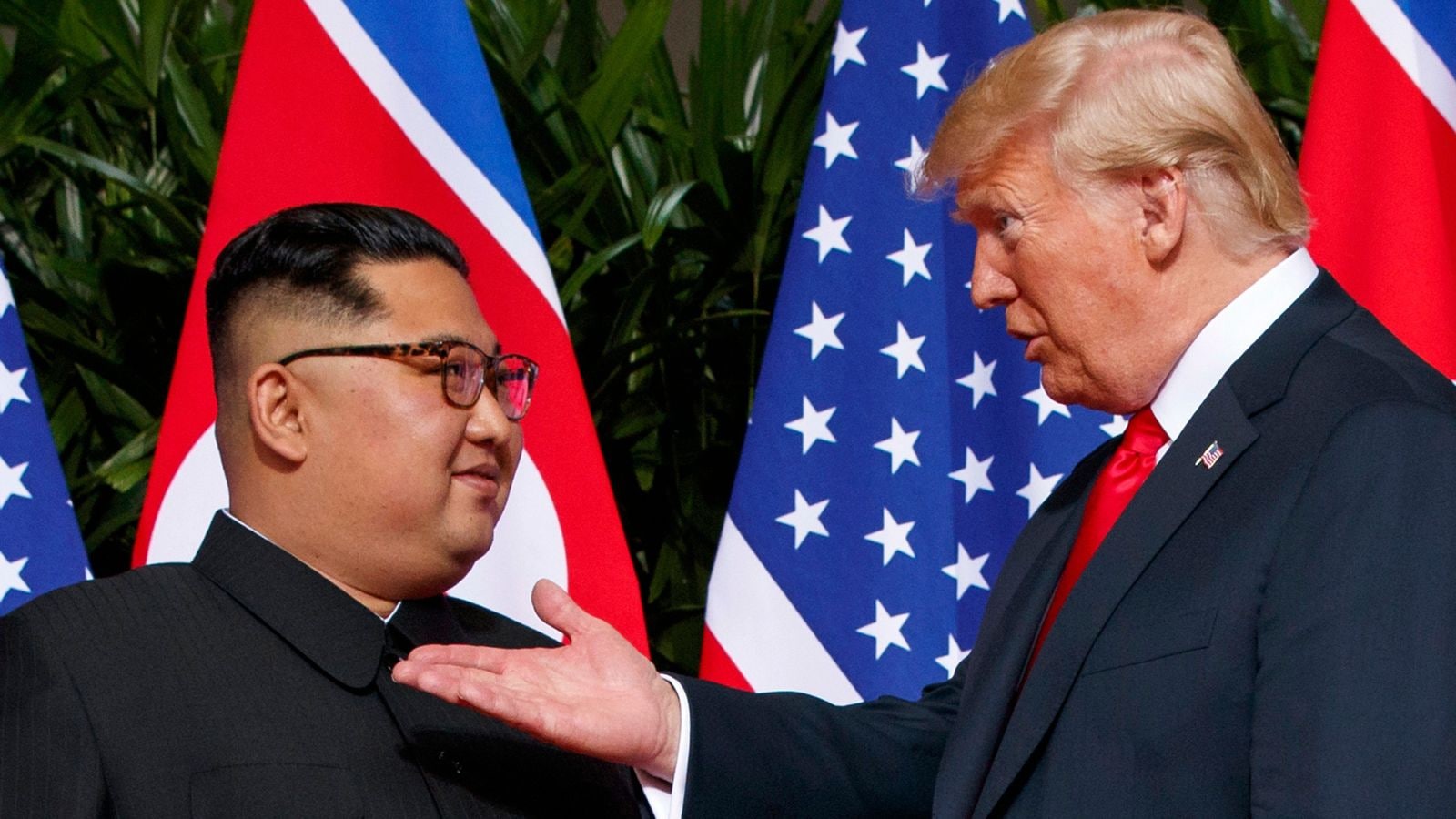
The Foreign Policy Media Machine Is Trapped in 1993
Every time a American president mentions meeting the North Korean regime, foreign policy analysts cycle through the exact same worn-out script.
They dust off their standard talking points about "legitimizing dictators," warn about "granting unearned concessions," and obsess over process rather than power dynamics.
The coverage of Donald Trump floating a potential meeting with Kim Jong Un during an Asia trip is classic theater. Cable news pundits treat high-stakes summitry like a middle school popularity contest where simply sitting across a table constitutes a massive geopolitical victory for Pyongyang.
They are fundamentally wrong.
The belief that US presidential face time is a precious commodity North Korea craves above all else ignores thirty years of hard strategic data. North Korea did not build an intercontinental nuclear arsenal just to get a photo opportunity in Hanoi or Singapore. They built it to ensure regime survival and force a complete shift in the Pacific balance of power.
Treating head-of-state meetings as reward tokens rather than leverage execution tools is why American diplomacy in Northeast Asia has failed for three decades straight.
The Flawed Premise of Unearned Legitimacy
Let us dismantle the core misconception driving Washington’s foreign policy establishment: the idea that holding a summit "gives away the farm" before receiving denuclearization commitments.
This stance assumes Kim Jong Un sits in Pyongyang desperate for American approval.
He is not.
Kim controls a closed, highly militarized state backed by a functional nuclear triad and explicit economic lifelines from Beijing and Moscow. The Kim dynasty survived the collapse of the Soviet Union, catastrophic domestic famines, and decades of international sanctions.
The diplomatic currency of an American presidential handshake carries far more weight in Washington policy salons than it does in Pyongyang command bunkers.
+-------------------------------------------------------------------------+
|                  THE DIPLOMATIC REALITY MISMATCH                       |
+-------------------------------------------------------------------------+
| MAINSTREAM ASSUMPTION                  | STRATEGIC REALITY              |
+----------------------------------------+--------------------------------+
| Summits are rewards for good behavior.  | Summits are raw power plays.   |
|                                        |                                |
| Photo-ops legitimize Kim Jong Un.      | Kim's nuclear arsenal provides |
|                                        | his domestic legitimacy.       |
|                                        |                                |
| Process and protocol dictate success.  | Leaders-level force breaks     |
|                                        | bureaucratic stagnation.       |
+----------------------------------------+--------------------------------+
When analysts panic over floated summits, they confuse diplomatic protocol with strategic leverage.
Working-level talks with North Korea have a 100% failure rate across five consecutive presidential administrations. Career diplomats in Pyongyang are bound by rigid internal terror structures; they have zero authority to negotiate on nuclear posture.
If you do not deal directly with the single decision-maker in North Korea, you are not negotiating. You are engaging in high-priced administrative theater.
Top-Down Diplomacy Is Not a Flaw—It Is the Only Working Mechanism
I spent years watching Washington think tanks draft massive, multi-stage "roadmaps to denuclearization." Every single one relied on a bottom-up model: send working groups, establish bilateral committees, draft non-binding frameworks, and gradually build up to a ministerial signature.
It sounds responsible on paper. In practice, it fails every time.
Lower-level North Korean officials are terrified of making concessions that could get them purged upon return to Pyongyang. As a result, working-level meetings stall, devolve into ideological lectures, and eventually break down over minor procedural disagreements.
Direct, leader-to-leader interaction bypasses the calcified national security apparatuses on both sides.
When a US president steps into the room with Kim, the entire dynamic shifts from bureaucratic posturing to direct leverage execution.
- Bypassing bureaucratic delay: Eliminates months of posturing by lower-level actors who lack the authority to alter nuclear policy.
- Forcing immediate decisions: Puts direct pressure on the sole power holder in Pyongyang rather than his emissaries.
- Exposing actual red lines: Reveals what the regime actually values versus what its state media claims it values.
Does top-down diplomacy carry high risks? Absolute risk.
Without exhaustive preparation, a leader can get outplayed or walk into a strategic trap. But claiming top-down summitry is inherently dangerous while defending a thirty-year history of failed bottom-up negotiations is pure cognitive dissonance.
Sanctions Are a Broken Instrument
The mainstream reaction to any floated North Korea meeting always includes a demand for "more enforcement" and "stricter sanctions."
This relies on the belief that economic pain will eventually force the Kim regime to give up its nuclear shield.
It will not.
To understand why, you must understand the structural design of the North Korean economy and its modern geopolitical alliances.
  +--------------------------------------------------------------------+
  |                    THE SANCTIONS FAILURE CYCLE                     |
  +--------------------------------------------------------------------+
  |                                                                    |
  |  [ US Imposes Maximum Pressure ]                                   |
  |             │                                                      |
  |             ▼                                                      |
  |  [ North Korea Adapts & Diverts Resources to Military ]           |
  |             │                                                      |
  |             ▼                                                      |
  |  [ China & Russia Provide Backdoor Economic Lifelines ]           |
  |             │                                                      |
  |             ▼                                                      |
  |  [ Regime Survival Intact; Nuclear Program Escalates ]             |
  |                                                                    |
  +--------------------------------------------------------------------+
Sanctions fail against North Korea because the regime does not operate on a Western consumer-driven model. The ruling elite absorbs the economic cost while passing 100% of the deprivation down to the civilian population, which has no mechanism to vote them out or stage a successful revolt.
Furthermore, the geopolitical environment has permanently shifted.
China and Russia no longer cooperate with Western enforcement efforts at the UN Security Council. Moscow explicitly trades oil, technology, and military support for North Korean munitions. Beijing views a nuclear-armed, stable North Korea as a necessary buffer against US forces in South Korea.
Doubling down on a sanctions regime that has been completely neutralized by Great Power competition is not strategy. It is institutional laziness.
The Uncomfortable Truth About Denuclearization
Here is the truth no politician in Washington wants to state on record: North Korea will never fully denuclearize.
Asking Pyongyang to voluntarily surrender its nuclear weapons is like asking an insurance policy holder to burn down their house to prove they believe in fire safety.
They saw what happened to Saddam Hussein in Iraq after he abandoned his weapons programs. They watched Muammar Gaddafi in Libya hand over his nuclear components only to be overthrown and killed a few years later.
Kim Jong Un views nuclear warheads not as bargaining chips to be traded for grain or sanctions relief, but as his absolute guarantee against state destruction.
+-------------------------------------------------------------------------+
|                  THE HARD CHOICES FOR US POLICY                         |
+-------------------------------------------------------------------------+
| OPTION A: REJECT MEETINGS              | OPTION B: PRAGMATIC REALISM    |
+----------------------------------------+--------------------------------+
| - Demand complete denuclearization     | - Accept nuclear state status  |
|   first.                               |   de facto.                    |
| - Result: Arsenal expands without      | - Focus on freeze, testing     |
|   oversight or limits.                 |   bans, and ICBM caps.         |
| - Risk: Sudden escalation during       | - Result: Managed containment  |
|   periods of military tension.         |   and threat reduction.        |
+----------------------------------------+--------------------------------+
The real debate is not between "getting Kim to give up his nukes" and "failing."
The real debate is between unmanaged proliferation and pragmatic threat containment.
Insisting on total, verifiable, irreversible denuclearization as a precondition for high-level talks guarantees that North Korea keeps expanding its operational warheads, refining its solid-fuel ICBMs, and advancing its submarine-launched missile tech completely unhindered.
Direct leader-level engagement that focuses on cap-and-freeze agreements, testing moratoriums, and crisis-communication channels is not "appeasement." It is basic strategic sanity.
How to Conduct Summit Diplomacy Without Getting Played
If an American president is going to meet Kim Jong Un on an Asia tour, they must dump the conventional diplomatic playbook and execute a cold, transactional operational model.
1. Kill the Public Spectacle
The core flaw of previous summits was the demand for massive production value. Red carpets, live broadcast signings, and theatrical walkouts feed media cycles, but they destroy strategic flexibility.
Hold quiet, high-stakes sessions focused on explicit military concessions. If a photo-op happens, it should be an afterthought attached to a binding operational protocol, not the primary deliverable.
2. Swap "Denuclearization" for "Threat Management"
Stop demanding immediate disarmament. Frame negotiations around concrete, verifiable risk-reduction steps:
- An absolute ban on solid-fuel ICBM test launches targeting the American mainland.
- A verified halt to fissile material production at primary facilities.
- Establishment of direct, hard-line military communications to prevent accidental nuclear escalation.
In exchange, offer targeted, reversible concessions—such as specific sanctions waivers or adjustments to regional force postures that do not compromise core alliance structures.
3. Use the Meeting to Drive a Wedge in the China-Russia-NK Axis
The biggest geopolitical threat to Western interests is not just Pyongyang's missile inventory; it is the formalization of the military alliance between North Korea, Moscow, and Beijing.
Summits should be designed to exploit the natural friction between these powers. China does not want a hyper-aggressive North Korea pulling massive US naval assets into the Western Pacific. Russia wants cheap artillery shells and distraction.
Direct US-NK communication unsettles both Beijing and Moscow by proving Pyongyang can deal directly with Washington whenever it wants.
The Real Danger Is Strategic Paralysis
The media will keep fixating on who smiles first, who shakes hands longer, and which diplomatic norms were broken during a presidential trip to Asia.
Ignore the commentary.
Diplomacy is not a performance intended to validate moral superiority. It is a tool to manage deadly force in an unpredictable world.
Refusing to engage the leader of a nuclear-armed state because you dislike his regime or fear bad headlines is not strength. It is negligence.
If floating a meeting opens a channel to cap an ICBM program, freeze nuclear testing, or disrupt a growing Eurasian military bloc, an American president should take that shot every single time.
Stop treating summits like awards. Start using them like weapons.

