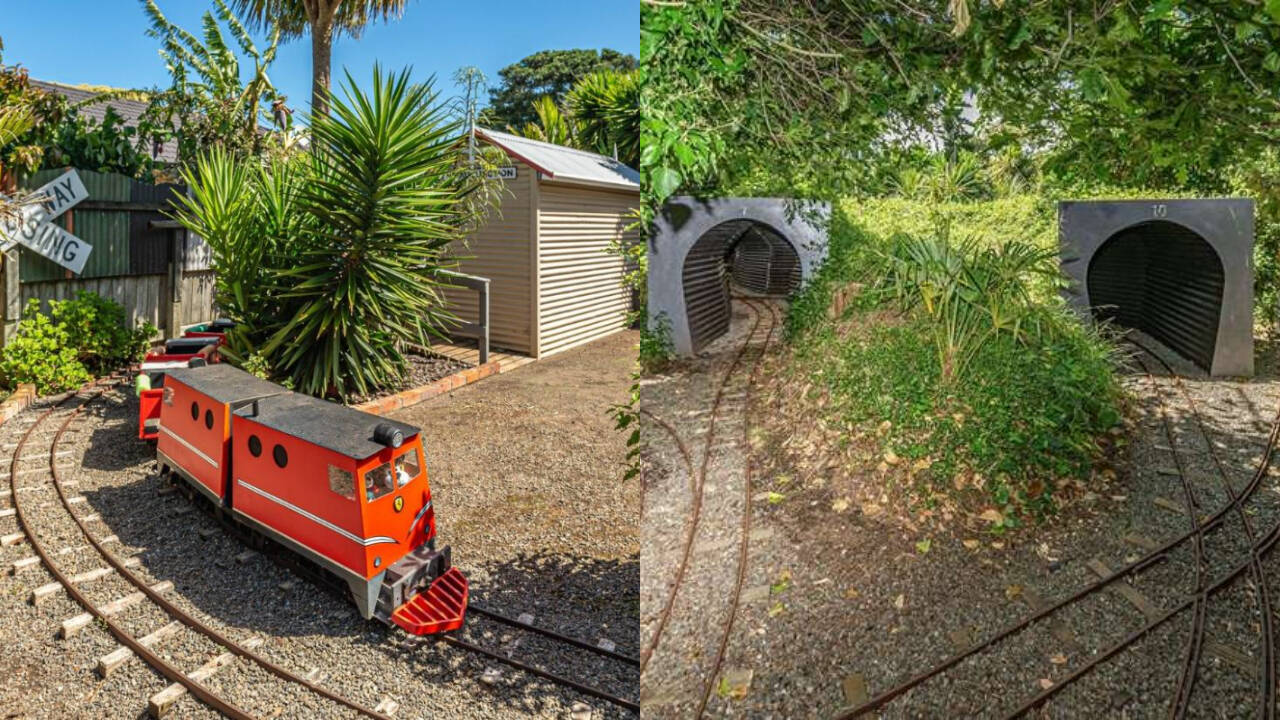
Rust smells like old pennies, wet grass, and the passage of time. If you kneel close enough to the ballast, you can smell it—the microscopic shedding of iron on iron, the tiny, violent friction of wheels that weigh ounces holding a world together.
Most people measure a life in square footage. Bedrooms. Bathrooms. Proximity to good schools and arterial highways. We calculate our existence in drywalls and mortgage installments, trading forty years of morning alarms for a deed that fits inside a filing cabinet. We think we own the ground beneath us. We are wrong.
Consider a backyard in New Zealand.
Not just any backyard. A canvas of earth measuring 370 meters of winding, looping, gravity-defying steel track. Ten hand-carved tunnels bored through stubborn clay. Two arched timber bridges spanning invisible chasms of ornamental ferns. A working signal system. A miniature diesel-style locomotive that hums to life with the turn of a brass key, pulling passenger carriages designed for adults who refuse to let childhood die in an office cubicle.
For eleven years, a man woke up, drank his coffee, and went out to build a universe.
Time moves differently when you are bent double over a rail gauge.
An hour vanishes while you are filing down a millimeter of brass to ensure a smooth transition across a turnout switch. Your knees ache. Your fingers grow calloused, stained with grease and outdoor silicone. The neighbors probably thought he was eccentric. In a world obsessed with velocity, optimization, and quarterly returns, a grown man spending more than a decade laying down miniature railway ties looks like a glitch in the simulation.
What is the point of a train that goes nowhere?
That is the question asked by people who have never stood at the edge of an embankment and watched a brass engine emerge from a dark, dripping tunnel into the golden afternoon light. They want utility. They want return on investment. They want a pristine lawn free of industrial clutter.
They do not understand obsession.
Obsession is the anchor that keeps us from drifting away into the grey haze of modern conformity. It is the refusal to accept that the world as it is given to us is enough. When you build a miniature railway by hand, every curve is a negotiation with gravity and landscape. If the grade is off by a fraction of a degree, the locomotive stalls, its tiny wheels spinning helplessly against the slick steel. You cannot fake it. You cannot outsource it to an app. You have to get back on your knees, rip up the ballast, and lay the track again until it sings.
Eleven years. Four thousand days.
That is a marriage. That is a child growing from a toddler into a towering teenager who rolls their eyes at their father’s obsessions before secretly sneaking out to drive the engine when the neighbors aren't looking. That is seasons shifting—frost turning the rails white in the crisp southern winter, summer sun baking the creosote until the air smells like a mid-century railway yard.
Then comes the day of the listing.
The real estate agent arrives with a wide-angle lens and a clipboard. They talk about capital gains, indoor-outdoor flow, and marketable acreage. They take photos of the kitchen, the neutral-toned bedrooms, the modern heat pump. And then, almost as an afterthought, they photograph the tracks. The headline goes live on the internet: New Zealand man sells home with 370m miniature railway after 11 years of work.
Clicks pour in. The internet does what it does best: it marvels, it shares, it types heart-eyes emojis, and then it scrolls away to the next dopamine hit.
To the internet, it is a quirky headline. A fun weekend read.
To the man who laid those ties, it is an amputation.
How do you pack up eleven years of your soul into cardboard boxes? How do you explain to a prospective buyer that the slight dip in the track near the oak tree isn't a defect, but the exact spot where you dropped your favorite wrench in 2018 and decided to build a retaining wall around your mistake? How do you price the thousands of hours spent in absolute silence, wrestling with your own thoughts while the miniature wheels clicked beneath your fingers?
You don't. You can't.
We look at sales like this as endings. We assume the ledger is balanced when the paperwork clears at the solicitor's office and the keys change hands. But the true legacy of the 370-meter track was never the iron or the timber. It was the hours
The Man Who Laid Down Eleven Years of Track in His Backyard
lifestyle
press
The metal never stops humming in your bones once you spend a decade bending it.
Imagine waking up to the smell of creosote and damp earth every single morning for eleven years. For most people, a backyard is a patch of green to be mowed on a Saturday and forgotten by Sunday evening. It is grass. It is a patio set that gathers pollen. It is a boundary line between you and the neighbor’s barking dog. But for one man in New Zealand, a backyard was not a plot of land. It was a blank parchment, waiting for steel.
Eleven years is a long time to spend looking down. It means your knees remember the exact angle of damp soil at dawn. It means calluses form, shed, and reform until your hands feel less like skin and more like the seasoned timber of an old tie.
He didn’t just build a model. He built an empire of miniature velocity.
Three hundred and seventy meters of track wound its way through his property, threading between rosebushes, looping past the vegetable garden, and diving under custom-built wooden trestle bridges that looked like they had been lifted straight out of a nineteenth-century mountain pass. Every curve was hand-laid. Every tiny spike was driven home with a specialized hammer and a breath held in check.
People talk about hobbies as if they are pastimes, lightweight distractions to fill the dead hours between the end of the workday and the glow of the television screen. They treat hobbies like a soft sweater you pull on when the wind gets cold. This was not a sweater. This was an anchor.
Consider the sheer scale of the math involved. Three hundred and seventy meters translates to over twelve hundred feet of scaled steel. That is the length of four football fields, compressed into a residential section, scaled down so that a miniature locomotive can chuff its way through the petunias. Scale modeling at this level is an exercise in stubborn obsession. It requires the patience of a watchmaker and the engineering mind of a civil contractor. You have to account for thermal expansion. You have to calculate drainage so a sudden downpour doesn't wash your entire railway system down into the storm drain. You have to think about ballast size, track gauge tolerances, and the relentless, creeping advance of weeds that view your masterpieces as fertile ground for a hostile takeover.
The man worked in silence, mostly. Neighbors watched from over the fence. At first, they probably thought it was a phase. A midlife project that would stall out when the winter rains set in or when the novelty wore off. But the winter rains came and went. Summers baked the soil into cracked clay. And still, he was out there, hunched over the ballast, aligning a joint with the precision of a surgeon.
Time changes a man who builds things piece by piece.
When you spend eleven years shaping a world, you start to live in two realities. There is the real world of bills, grocery lines, and political headlines—fast, messy, and largely uncontrollable. And then there is the micro-world. In the micro-world, every problem has a mechanical solution. If a train derails, it is because a rail is out of gauge by a fraction of a millimeter. You fix it. You turn the screw. You tap the rail. Order is restored.
There is an intoxicating comfort in that kind of control.
By the time the project was complete, the railway wasn’t just a feature of the yard. It was a living, breathing ecosystem. Miniature signal lights changed color. Tiny switches clicked mechanically as levers were pulled. Steam locomotives, fired by coal and miniature boilers, puffed real white smoke into the crisp air, smelling faintly of burnt oil and hot metal.
Then came the day that happens to every creator who pours their soul into an inanimate object.
The "For Sale" sign went up.
Houses are bought and sold every day. Kitchens are judged by their granite countertops. Bathrooms are inspected for water pressure. Real estate agents use words like "curb appeal" and "turnkey condition" to describe spaces stripped of human narrative. But how do you price a man's obsession? How do you put a square-foot value on eleven years of sore backs, blistered thumbs, and quiet triumphs witnessed only by local birds?
When the listing hit the market, the miniature railway became the star. Prospective buyers didn't just walk through the house; they stood at the edge of the lawn, transfixed, watching a five-inch gauge locomotive pull a string of tiny passenger cars around a sweeping bend. Suddenly, the property wasn't just real estate. It was a portal.
It forces you to ask a strange, uncomfortable question. What are we actually building with our lives?
Most of us leave behind spreadsheets, email threads, and memories that fade like old photographs in a sunny window. We accumulate things that break and are thrown away. We consume. We scroll. We scroll until our eyes burn and the hours dissolve into the static of the screen.
This man left behind a landscape that moves. He left behind a legacy of iron and steam, buried in the green grass of a New Zealand suburb.
Someone else will buy the house now. They will sit on the back deck with a cup of coffee in the morning and watch the dew evaporate off the steel rails. They will hear the faint, high-pitched whistle of a tiny engine echoing off the back fence. They will inherit a world that someone else dreamed into existence, one millimeter at a time.
And the tracks will keep holding the weight, long after the hands that laid them have moved on to something else.