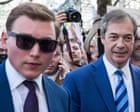
The camera captures the flash, the grin, and the raised pint. Nigel Farage stands before the microphones, the self-appointed voice of the forgotten British worker, railing against a political elite that he claims has sold out the country. The crowd roars. But if you shift your gaze just a few feet to the left, standing just beyond the bright edge of the stage lights, you will see a different kind of man.
He wears immaculate tailoring. He possesses an aristocratic pedigree. His name is George Cottrell. If you liked this post, you should check out: this related article.
To the public, he is invisible. To the Electoral Commission, he is technically a non-entity, categorized by Reform UK lawyers as merely an "unpaid volunteer" with no formal position. Yet, he is everywhere. When Farage was doused in a milkshake in Clacton-on-Sea, Cottrell was right beside him, wiping away the dairy. When Farage flew to Abu Dhabi to watch the Formula One and hold meetings, Cottrell was in the private suite. When Farage stays in London, he rests his head inside a sprawling, five-story Georgian townhouse near Buckingham Palace rented by Cottrell.
This is not a story about a political party. It is a story about the unseen gravity that pulls the levers of modern populism, and how a convicted American felon became the indispensable architect of a British political movement. For another angle on this story, refer to the latest update from Associated Press.
The Ghost in the Back Office
Step inside a political campaign, and you expect to find idealistic young volunteers, bad coffee, and clipboards. But the modern political machine requires something far heavier: security, global transport, and digital infrastructure.
Consider how an insurgent party scales up overnight. It does not happen through grassroots donations alone. It happens because someone quietly builds a scaffolding underneath it.
The Sunday Times revealed the depth of this architecture. Before the general election, Cottrell personally funded a fleet of social media staff—three dedicated handlers—to curate Farage’s digital persona. He bankrolled private security details to keep the leader safe on the trail. He handed out business cards bearing the Reform UK logo, listing his own name alongside Farage’s official email address.
When confronted with these details, the response from the Reform hierarchy was swift and practiced. Robert Jenrick, acting as the party's financial spokesperson, stepped forward to explain that these were merely personal gifts between old friends. Because the funding for the staff, the security, and the London townhouse was provided before Farage was officially sworn in as a Member of Parliament, the party argues that no rules were broken. It was just one mate helping another.
But the sheer scale of the operation strains the definition of casual friendship. A five-story townhouse near the palace is not a spare mattress on a friend's floor. Paid digital staff are not casual volunteers helping with a leaflet drop.
A Portrait of "Posh George"
To understand why this relationship matters, you have to look at who George Cottrell actually is. Born into immense wealth, raised on the exclusive Caribbean island of Mustique, and educated at Malvern College—until he was expelled for illegal gambling—he is the absolute antithesis of the working-class voters Reform UK aims to represent.
His nickname in political circles is "Posh George." He is a man comfortable with risk. He once lost $20 million in a single night of high-stakes poker, yet walked away to play another day. He made a fortune by piggybacking on professional betting syndicates, and later admitted to a career spent designing aggressive offshore tax avoidance schemes across Panama, Switzerland, and Andorra.
His life took a dark turn in 2016. While traveling with Farage to the Republican National Convention in the United States, federal agents intercepted Cottrell at Chicago’s O’Hare International Airport. The IRS had been watching him. Undercover agents in Las Vegas had posed as drug traffickers looking to clean millions in illicit cash. Cottrell, believing he was dealing with real cartel assets, walked them through the intricate mechanics of shadow banking.
He was indicted on 21 federal counts, including money laundering, extortion, and blackmail. Ultimately, he struck a deal, pleading guilty to a single charge of wire fraud, and spent eight months in an Arizona federal prison.
For most political figures, an associate with that baggage would be toxic. They would be erased from the Christmas card list, let alone the backstage VIP area. But in the world of anti-establishment politics, traditional rules do not apply. Farage has previously described Cottrell as being "like a son" to him. Tatler reported that Cottrell sometimes refers to Farage as "Daddy," while Farage can occasionally be found making coffee in Cottrell’s kitchen.
The Ethics of the Invisible Gift
The true problem lies in the structural blind spots of British democracy.
Our political financing laws are built on an old-fashioned assumption: that influence travels through transparent channels. We look at official party donations, which are capped and logged. But what happens when the support bypasses the party Treasury entirely?
Imagine a hypothetical local business owner trying to run for council. They must meticulously record every hundred pounds spent on printing and venue hire. Now contrast that with a national figurehead whose daily existence—his security, his transportation, his luxury housing, his digital megaphone—is entirely insulated by a wealthy benefactor. If those gifts are classified as "personal," they slip through the net of public disclosure.
The Liberal Democrats have now petitioned the parliamentary standards commissioner to investigate the arrangement, joining a wider probe into a separate £5 million gift from crypto billionaire Christopher Harborne. The Labour Party has demanded Farage clarify what they term his "financial dependence" on a convicted criminal.
Farage’s defense is a familiar anthem. He calls the scrutiny an "establishment hit job" designed to protect a cozy consensus. He bets that his voters will look at the headlines, shrug, and see it as just more noise from a media elite that hates him.
He might be right. To a voter struggling to pay their mortgage or waiting months for an NHS appointment, the technicalities of parliamentary declaration forms feel abstract and irrelevant. They care about the message, not the man paying for the microphone.
But the invisible stakes are immense. When a political movement relies on the private generosity of a shadow financier to function, the public loses the ability to ask a fundamental question: Who does this politician actually answer to?
The rallies will continue. The music will play, the flags will wave, and the leader will speak with practiced passion. But as the applause rings out, the man in the tailored suit will still be standing in the wings, quietly watching the stage he helped buy.