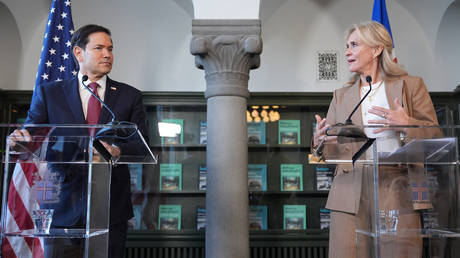
The Arctic is no longer just a quiet wasteland of ice and polar bears. It is the new chessboard for global superpower competition, and Washington knows it. US Secretary of State Marco Rubio touched down in Reykjavík on a mission that goes far beyond routine diplomatic glad-handing. Fresh off a high-stakes security pact with Denmark and Greenland, Washington is rapidly redrawing its northern defense strategy. Yet, smoothing things over with Iceland requires more than just talking about shared values. It demands addressing real local anxieties about aggressive American posturing in the High North.
Fixing the Damage Left by Social Media Stunts
You can't pretend local politics don't matter when you show up in a proud, independent island nation. Before Rubio even packed his bags, the diplomatic atmosphere was tense. Donald Trump had recently stirred outrage across Iceland by sharing maps and digital mock-ups hinting at ambitions over Greenland, alongside tone-deaf jokes from the newly appointed US ambassador about making Iceland the fifty-second state. If you found value in this piece, you should check out: this related article.
Icelandic Foreign Minister Þorgerður Katrín Gunnarsdóttir didn't just smile for the cameras. She made her government's displeasure known directly to the American embassy. When Rubio arrived in Reykjavík, his primary job was damage control. He had to reassure Icelandic leadership that defense cooperation wouldn't mean a unilateral American takeover. Rubio walked a fine line during his meetings, emphasizing that any future security enhancements would happen strictly with Reykjavík's consent.
Why Iceland Matters Now More Than Ever
Most people forget that the US military completely pulled out of its permanent base at Keflavík back in 2006, assuming the post-Cold War era meant permanent peace in the North Atlantic. That assumption looks naive today. Russian submarine activity has spiked dramatically, and Chinese commercial and scientific ambitions in the Arctic are expanding year by year. For another perspective on this story, check out the latest coverage from The New York Times.
Iceland sits right in the middle of the GIUK gap—the Greenland, Iceland, and United Kingdom corridor. If any hostile power wants to move surface ships or submarines from Arctic bases into the broader Atlantic, they have to pass right through this choke point. Rubio's push to shore up ties with Iceland isn't about reliving Cold War glory days. It's about plugging a massive hole in Western early-warning and maritime tracking networks.
The Greenland Fallout and Regional Realities
The timing of Rubio's trip wasn't accidental. It came directly on the heels of a US-Denmark-Greenland agreement designed to lock down security infrastructure on the world's largest island. Greenland is rich in critical minerals and occupies prime real estate for space defense tracking at Pituffik Space Base. But you cannot manage Greenland without factoring in Iceland. The two territories share deep historic, economic, and cultural bonds.
When Washington cuts a deal in Nuuk or Copenhagen, Reykjavík expects a seat at the table. Local security experts in Iceland have pointed out that any militarization or buildup on Greenland inherently shifts the burden and the strategic calculus for Iceland. Rubio had to convince Icelandic officials that the new northern architecture benefits them instead of turning their backyard into a volatile tripwire.
Balancing Defense With Economic Realities
Rubio also spent significant time pushing commercial, energy, and technology ties during his brief European tour. Defense agreements don't survive long-term public scrutiny if they ignore economic partnership. Iceland wants reliable high-tech investments, secure digital infrastructure, and stable trade channels, especially as supply chains shift away from authoritarian adversaries.
The underlying message from Reykjavík was clear. Partnership is welcome, but coercion is a non-starter. Rubio ultimately downplayed the political noise, pivoting hard toward mutual defense history and shared democratic priorities. Whether this charm offensive completely heals the friction caused by erratic rhetoric remains to be seen. The Arctic ice is melting fast, and the geopolitical chill is only getting started.