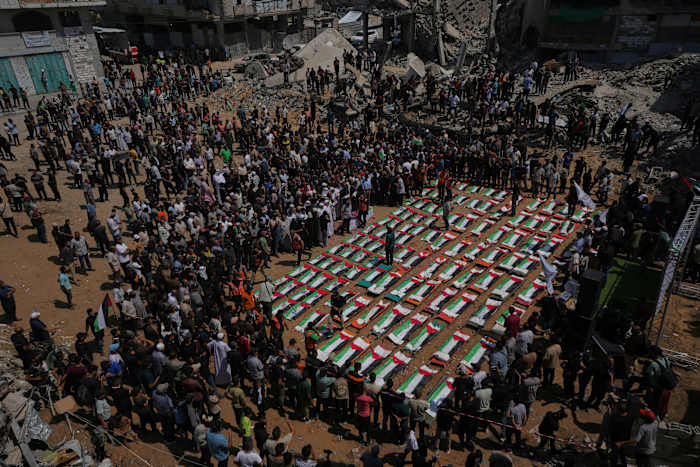
Nearly three years after an airstrike flattened a residential block in Gaza City, rows of coffins wrapped in Palestinian flags finally lay ready for burial. Mourners gathered to lay to rest 112 members of the Abu Sharia and Al-Hasayna families. These victims were killed on November 23, 2023, just one day before an initial humanitarian truce took effect.
For families across the enclave, this mass funeral wasn't just a single event. It exposed the grim reality of what happens when thousands remain trapped beneath collapsed infrastructure with almost no heavy machinery to clear the way.
Why Recovering Bodies Takes Years In Gaza
You might wonder why it takes years to pull victims from destroyed buildings. The answer comes down to a catastrophic lack of basic heavy equipment.
When the airstrike destroyed the residential compound in the Sabra neighbourhood back in late 2023, initial rescue attempts were improvised. Neighbors and surviving relatives dug through smoldering concrete and twisted metal using bare hands and basic tools. They managed to recover about 40 bodies right away.
The rest stayed down there. They remained entombed because ongoing security restrictions and severe blockades kept excavators and cranes out of the territory.
It wasn't until a fragile ceasefire allowed rescue operations to expand that Gaza's Civil Defence could return to the site. Working over a two-week period totaling roughly 136 hours of intense labor, crews used equipment partially supported by the International Committee of the Red Cross to sift through the debris.
The technical report from the recovery operation makes for brutal reading. Out of the 112 bodies recovered, teams identified 40 children, 38 women, and seven people with physical disabilities.
The Scale Of What Remains Unaccounted For
This single recovery operation highlights a much larger crisis across the strip. Thousands of people remain missing under the rubble.
According to Gaza health ministry records, at least 7,400 people are officially reported by relatives as buried beneath collapsed buildings. Officials note that the actual number is likely much higher. Entire extended families were wiped out in single blasts, meaning no surviving relatives are left to file missing persons reports.
The physical toll matches the psychological burden. Relatives describe the agonizing wait as an extension of the trauma. Finding a body, even years later, provides a rare sense of closure in a landscape defined by loss.
Even after the latest 136-hour dig in the Sabra neighborhood, Civil Defence supervisors noted that another 157 bodies at that specific site remain unreachable under the deep layers of concrete. Without specialized hydraulic equipment and steady fuel supplies, search operations crawl forward at an unsustainable pace.
Humanitarian agencies continue to push for unrestricted entry of heavy machinery, pointing out that recovering human remains is an essential part of post-conflict basic human dignity. Until those tools arrive in larger numbers, mass funerals for victims of early-war strikes will remain a painful and recurring reality for families digging through the past.
Mourners Gather for Mass Funeral of 112 Palestinians in Gaza
This video report captures footage and eyewitness perspectives from the mass funeral held in Gaza for the 112 victims recovered from the 2023 strike rubble.
http://googleusercontent.com/youtube_content/1