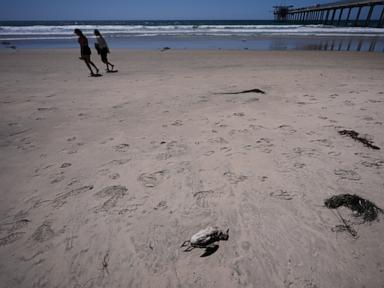
The media loves an ecological apocalypse. When thousands of common murres or cassin's auklets wash up dead on the beaches of California, the narrative writes itself. Headlines scream about marine heatwaves, anomalous warm blobs, and impending El Niño events as if they are unprecedented executioners wiping out innocent wildlife.
The mainstream narrative is fundamentally flawed.
The lazy consensus among environmental journalists, and even some well-meaning conservationists, is that every mass mortality event is a tragedy signaling the collapse of our oceans. They treat the baseline of the natural world as a static, peaceful utopia where populations remain perfectly stable year after year.
That utopia does not exist. It never has.
Mass seabird die-offs are not a freak system error. They are a feature of a highly dynamic marine ecosystem, acting as a brutal but necessary culling mechanism that ensures the long-term survival of the species. When we over-pathologize these events, we misunderstand the very mechanics of evolution and population dynamics.
The Myth of the Stable Baseline
Ecologists have tracked marine anomalies for decades. The intense warming events in the Northeast Pacific, often referred to as the Blob, undeniably shift pelagic food webs. Warmer waters mean less nutrient-rich lipid-dense copepods and fewer krill. The forage fish that seabirds rely on, like anchovies and sardines, either migrate to deeper, cooler waters or see their own populations plummet.
Starvation follows. The birds wash ashore, emaciated.
The immediate reaction is panic. Millions of dollars are funneled into rescue centers to rehabilitate a few hundred starving birds. Petitions demand immediate intervention. But looking at this through a wider lens reveals a completely different reality.
Before a massive die-off occurs, populations frequently experience historic highs. During benign oceanographic years, when cold-world upwelling is strong, resources are artificially abundant. Seabird productivity skyrockets. Forage fish numbers explode. Species like the common murre breed with astonishing success, pushing their total population numbers far beyond what the ecosystem can sustain on an average timeline.
The ocean is not a stable ecosystem. It operates on multi-year cycles of boom and bust, driven by the Pacific Decadal Oscillation and El Niño Southern Oscillation.
When a marine heatwave hits, it does not destroy the population. It corrects it.
The heatwave acts as a resource ceiling. It rapidly strips away the surplus population that accumulated during the fat years. The birds that die are overwhelmingly the young, the inexperienced, the weak, and the genetically compromised.
If every individual survived every climate fluctuation, the resulting overpopulation would permanently deplete forage fish stocks, leading to a far more catastrophic, systemic collapse of both the predators and the prey. The die-off prevents a larger disaster.
The Fatal Flaw in Active Intervention
I have spent years analyzing wildlife management strategies and watching organizations burn through resources trying to fight natural cycles. The urge to intervene is driven by optics, not science.
Imagine a scenario where wildlife agencies successfully manage to supplement the diet of wild seabirds during a major marine heatwave. They deploy floating feeding stations or restrict commercial bait fisheries entirely to leave every single anchovy for the birds.
The immediate result seems positive. Survival rates tick upward. The press celebrates.
The long-term result is a genetic disaster.
By shielding the population from environmental stress, you actively select for vulnerability. You allow individuals with lower foraging efficiency, poorer diving endurance, and weaker immune systems to pass on their genes. When the next inevitable climate shift occurs, the entire population is less resilient, less adaptable, and far more susceptible to a total wipeout.
True ecological resilience is forged in high-stress environments. Data from historical colony counts shows that while seabird populations plummet sharply during intense El Niño years, their recovery phase is remarkably steep once cool upwelling returns. The surviving individuals are the elite foragers. They are the ones capable of finding alternative prey, diving deeper, or migrating further. They pass these superior traits to the next generation.
By trying to smooth out every wrinkle in the climate cycle, well-intentioned observers risk turning wild, resilient species into conservation-dependent populations that cannot survive without permanent human life support.
Dismantling the Predictable Questions
Whenever you challenge the consensus on environmental crises, you run into the same set of defensive questions. Let us address them with data, not emotion.
Are these heatwaves entirely natural or amplified by human activity?
This is the wrong question to focus on. Even if anthropogenic factors increase the frequency or intensity of marine heatwaves, the biological mechanism of population regulation remains identical. Species adapt to stress through selective pressure. If the environment changes, the selective pressure intensifies.
Attempting to freeze the ecosystem in a specific 1970s baseline state is an exercise in futility. The ocean changes. Populations must change with it, or they go extinct. Mass mortality events are the exact mechanism by which that genetic adaptation occurs in real-time.
Can we afford to lose thousands of birds at once?
Yes. Seabirds are classic K-strategists in terms of longevity, but they have a surprising capacity to bounce back when conditions optimize. A healthy ecosystem requires high mortality to function properly. The dead birds themselves do not vanish into a void; their carcasses feed beach scavengers, detritivores, and terrestrial nutrient cycles, moving vital marine nitrogen back onto land.
The fixation on individual animal welfare completely blinds people to macro-level ecosystem functions. An individual bird dying of starvation is a miserable event on a micro scale. On a macro scale, it is data. It is the ecosystem reallocating scarce resources to the most viable organisms.
The Cost of the Wrong Focus
The obsessive focus on high-profile, highly visible crises like beach-cast seabirds actively distracts from the boring, systemic issues that actually threaten marine life.
A marine heatwave is temporary. It passes. The upwelling returns. The birds recover.
What they cannot recover from is the permanent destruction of nearshore breeding habitats due to poorly planned coastal development. They cannot recover from localized chemical pollution that bioaccumulates up the food chain, disrupting their endocrine systems long before a heatwave even forms. They cannot recover from invasive predators like rats and feral cats destroying entire nesting colonies on offshore islands where the birds have no evolutionary defenses.
Fixing a broken seawall or eradicating rats from an island is difficult, unglamorous work. It does not get the same viral engagement as a photo of a dead bird on a sandy beach accompanied by a warning about the climate crisis.
We pour emotional capital and financial resources into mourning natural population corrections while ignoring the structural human interventions that actually strip these species of their ability to rebound.
Stop looking at the ocean through a lens of fragile sentimentality. Nature is a brutal calculator. The mass die-offs off the coast of California are not a sign that the ocean is dying. They are proof that the ocean is still working exactly the way it is supposed to, ruthlessly sorting the viable from the unviable to ensure that the species survives the next thousand years.