The Ritual of the Riot
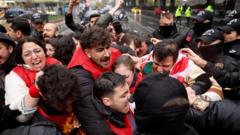
Standard news outlets are running the same headline today. You’ve seen it: "Turkish Police Arrest 500+ at May Day Rallies." The narrative is predictably flat. It paints a picture of a sudden, chaotic crackdown on democratic expression. It treats the clashes at Taksim Square as a spontaneous combustion of state power versus "the people."
This view is lazy. It’s wrong. It misses the structural reality of Turkish politics.
In Istanbul, May Day isn't a protest. It’s a choreographed performance of sovereignty. When the Turkish interior ministry bans access to Taksim Square, they aren't trying to stop a parade; they are enforcing a boundary that defines the state’s physical authority. When protestors march anyway, they aren't expecting to reach the square. They are there to harvest the social capital of being arrested.
Both sides are following a script that has been written in blood and tear gas since 1977. To call it a "crackdown" implies a deviation from the norm. This is the norm. It is the engine of Turkish political identity.
Taksim as a Sovereignty Test
Western observers obsess over the right to assemble. They view Taksim Square through the lens of urban planning or civil liberties. This is a fundamental misunderstanding of Turkish geography.
Taksim is not a park. It is a symbol of the secular republic's heart, and under the current administration, it has become the ultimate test of who owns the street. The state doesn't block the square because it fears 500 union workers. It blocks the square because the act of blocking it constitutes the state’s power.
If the government allowed the march, the mystery of their control would vanish. If the protestors didn't try to break the line, their relevance would evaporate. The 500 arrests are not a failure of democracy; they are the "cost of doing business" for both the AK Party and the opposition syndicates.
The Economy of the Arrest
Let’s talk about the math.
Reporting the number of detainees is the most common way to measure "repression." But in the Turkish context, these numbers serve a different purpose for the activists.
- Credentialing: An arrest at a May Day rally in Istanbul is a gold-standard credential for leftist political upward mobility.
- International Signaling: High arrest counts trigger automatic EU and US State Department "concerns," which are the only remaining levers the fragmented Turkish opposition has left.
- Internal Cohesion: Nothing builds a movement like a shared night in a holding cell.
I have spent years watching political movements burn through millions of dollars in "awareness campaigns" that achieve nothing. A single afternoon of high-intensity friction with the Çevik Kuvvet (Riot Police) generates more media impressions and internal loyalty than a decade of white papers.
The state knows this. They provide the friction. The protestors provide the bodies. It is a symbiotic relationship masked as a conflict.
Stop Asking if it’s Legal
People always ask: "Is the ban on Taksim Square legal?"
This is the wrong question. In a hybrid regime, legality is a fluid commodity. The Turkish Constitutional Court has previously ruled that the ban violates the right to assembly. The government ignores it. Why? Because in the hierarchy of power, administrative control beats judicial theory.
If you are looking for "justice" in a May Day rally, you are looking for a ghost. These events are about de facto power—what you can actually do on the ground. The government proves it can seal a city of 16 million people. The protestors prove they can still find 500 people willing to take a baton for a cause.
The Nuance of the "Crackdown"
The media loves the word "crackdown." It suggests a frantic, desperate government.
Look at the logistics. Closing the metro, deploying 40,000 officers, and erecting kilometers of steel barriers is not a frantic move. It is a massive display of logistical competence. It is a signal to the broader public—the millions watching on TV—that the state is the only entity capable of total mobilization.
The 500 people arrested are the "acceptable losses" in a much larger branding exercise. For the government, the optics of an empty, silent Taksim Square are worth the PR hit of a few hundred detainees. It projects "Order" (Huzur), which is the currency the Turkish electorate actually trades in.
The Strategy of Managed Conflict
If you want to understand the future of Turkish politics, stop reading the arrest tallies. Start looking at the containment zones.
The government actually offers alternative spaces for rallies, like Yenikapı. The protestors refuse them. Why? Because a rally in a legal zone is a rally that doesn't matter. It has no teeth. It has no friction.
We are seeing a shift from "total suppression" to "managed conflict." The state doesn't want to disappear these 500 people; it wants to process them. It wants to show that it can absorb the blow, process the dissent, and wake up the next morning with the square still under its thumb.
The Professionalism of Protests
I’ve seen organizations blow their entire yearly budget on digital ads when they should have been training their ground game for days like this.
True political influence in high-pressure environments isn't about "winning" the day. It's about outlasting the state's attention span. The current Turkish opposition is trapped in a cycle of performative martyrdom. They show up, get arrested, and wait for the international press to tweet.
It’s a dead-end strategy.
If the goal is actual political change, the focus shouldn't be on the 500 people in the back of the police vans. It should be on the millions of people who stayed home because they value the "order" of the closed metro over the "chaos" of the protest.
The state is winning the psychological war not by being "cruel," but by being predictable. They have turned the most radical day of the year into a scheduled bureaucratic event.
The real tragedy isn't that 500 people were arrested. It's that the arrest has become part of the routine. When rebellion is baked into the government's calendar, it's no longer a rebellion. It's an audition.
The police go home. The activists go to court. The barriers stay up. And the square remains empty, precisely as the state intended.
Stop treating the May Day arrests like a news event. Treat them like a status report on a stalemate that neither side is actually interested in breaking.