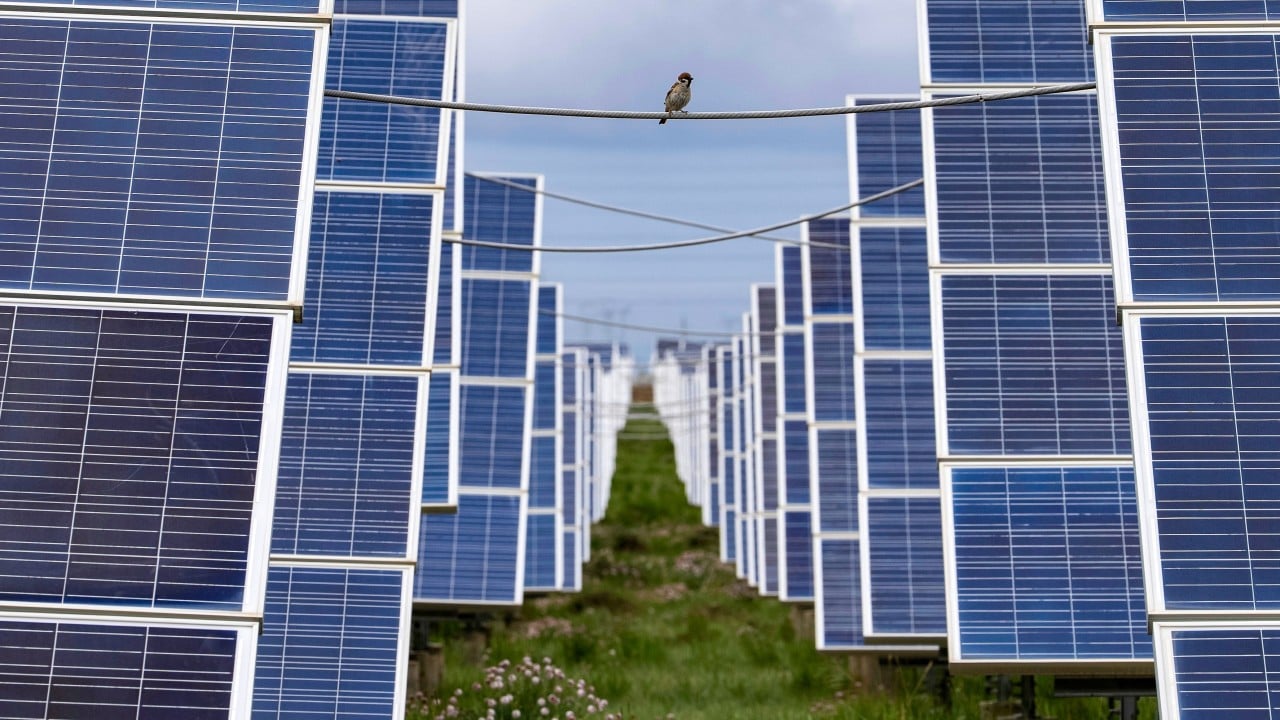
Decarbonization schedules routinely model energy transitions as zero-sum shifts from hydrocarbon extraction to photon harvesting, treating the physical terrain as an abstract, frictionless plane. Empirical tracking across 2,344 administrative counties in China between 2014 and 2023 exposes the structural flaw in this assumption. Aggressive state-mandated photovoltaic scaling correlates directly with localized contractions in avian biodiversity indices. For every single standard deviation increase in local solar policy intensity, regional bird diversity contracts by 2.10 percent. This friction identifies an optimization failure in clean energy deployment: the spatial footprint of utility-scale solar infrastructure frequently displaces complex ecological niches under the administrative banner of green growth.
To understand this dynamic, analysts must deconstruct the mechanics of land conversion driving the phenomenon. Photovoltaic installations demand expansive contiguous surfaces, transforming heterogeneous terrain into homogenized industrial zones.
The Mechanics of Land-Use Displacement
The displacement mechanism operates through direct habitat conversion rather than operational mortality from panels. When regional planners execute state-directed Five-Year Plans for renewable capacity, the physical siting process prioritizes logistical access, grid proximity, and flat topography. These criteria overlap heavily with high-productivity ecologies such as arable croplands and temperate grasslands.
The structural sequence unfolds through three distinct phases:
- Habitat Fragmentation: Continuous tracts of foraging and breeding grounds are bisected by security fencing, access roads, and inverter stations, isolating sub-populations.
- Vegetation Homogenization: Native floral strata are cleared or chemically suppressed beneath panel arrays to prevent shading and fire hazards, eliminating primary food sources for insectivorous and granivorous avian species.
- Edge Effects: Industrial human activity alters microclimates, noise baselines, and predator-prey dynamics along the boundaries of the installation.
These factors concentrate in wealthier and non-desert administrative zones. Arid regions with low baseline biodiversity absorb large utility footprints with minimal ecological disruption, whereas temperate and agricultural counties suffer severe structural losses because every square kilometer of converted land displaces a dense network of specialized species.
The Trap of Inferior Greening
Standard environmental reporting often fails to capture these losses because metrics rely on macro-level observations of vegetation density. Quantitative tracking frequently utilizes the Leaf Area Index to measure green biomass accumulation over time. Regions hosting new solar farms often register rising index scores due to post-construction landscaping, weed proliferation, or minimal vegetative recovery beneath arrays.
This creates an analytical illusion designated as inferior greening. While total greenness metrics may remain stable or increase, the ecological carrying capacity collapses. A monoculture of managed grass or invasive weeds yields high chlorophyll index values while failing to support the trophic webs required by diverse avian communities. The physical structure of the habitat has been degraded even as satellite-derived greenness indicators report nominal environmental improvement.
Avian populations serve as sensitive bio-indicators because their mobility and metabolic demands reflect systemic changes across multiple trophic levels. When broad-scale energy policies drive land conversion without accounting for biodiversity valuation, benefit-cost analyses systematically understate the true social and natural capital costs of infrastructure deployment.
Strategic Repositioning for Dual-Objective Infrastructure
Resolving the structural conflict between atmospheric carbon reduction and terrestrial habitat preservation requires a complete overhaul of the spatial allocation model. Current policy frameworks treat siting optimization as a secondary constraint, subordinate to raw gigawatt generation targets.
Future infrastructure planning must institute three operational mandates to eliminate the biodiversity penalty:
- Ecological Zoning Prioritization: Mandate that utility-scale photovoltaic expansion be legally restricted to degraded lands, brownfield sites, and low-productivity deserts where baseline fauna density is minimal.
- Trophic-Inclusive Impact Assessments: Replace gross surface greenness tracking with biodiversity baseline audits that measure multi-species persistence before construction permits are issued.
- Agrivoltaic Integration: Scale dual-use frameworks where panels are elevated to permit agricultural cultivation or native pasture grazing underneath, maintaining structural continuity for local species.
Clean energy deployment can proceed without degrading natural capital only when spatial planning incorporates ecological carrying capacity as a hard constraint rather than a post-construction afterthought.