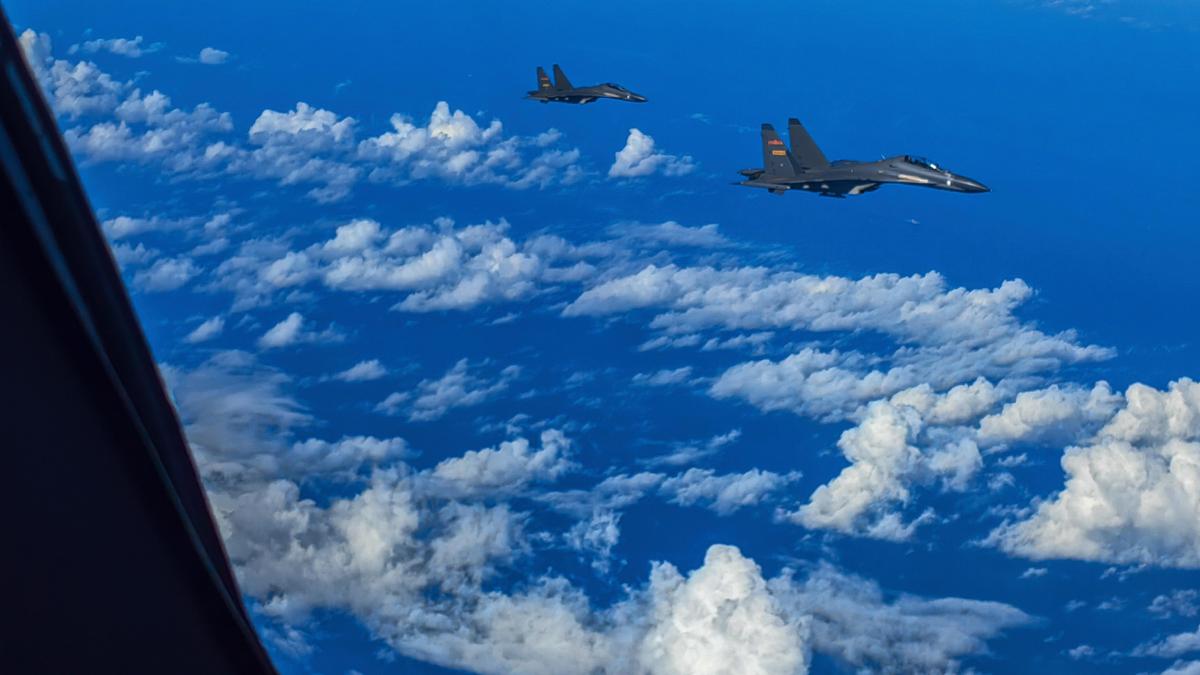
The resumption of large-scale People’s Liberation Army (PLA) flight operations near Taiwan signifies a transition from sporadic signaling to a systematic, high-cadence attrition model. Analysis of recent flight paths and sortie compositions suggests that these maneuvers are no longer merely diplomatic protests. They function as a deliberate stress test of Taiwan’s Air Defense Identification Zone (ADIZ) and a calibration exercise for multi-domain coordination. Understanding this escalation requires deconstructing the operational objectives into three distinct functional layers: tactical exhaustion, intelligence harvesting, and the normalization of presence.
The Triad of Operational Objectives
Military aviation activity of this scale serves a multi-layer strategic purpose that transcends simple intimidation. When 30 or more aircraft cross the median line or enter the ADIZ within a 24-hour window, they execute a synchronized set of tasks designed to degrade the defender's readiness.
1. The Attrition of Response Readiness
Every intercept launched by the Republic of China Air Force (ROCAF) carries a quantifiable cost in airframe hours and pilot fatigue. The PLA utilizes a high-volume, low-predictability flight schedule to force a "response dilemma" on Taiwanese commanders. If the ROCAF intercepts every incursion, they accelerate the maintenance cycles of their F-16V and Mirage 2000-5 fleets. If they refrain from intercepting, they risk allowing the PLA to establish a new "baseline" of proximity, effectively shrinking the functional reaction time for a real-strike scenario.
The cost-asymmetry is stark. The PLA can cycle through a much larger pool of airframes (J-10, J-16, H-6) across multiple theater commands, whereas the ROCAF is constrained by a finite number of high-performance interceptors and a bottlenecked supply chain for parts.
2. Electronic Order of Battle (EOB) Mapping
Large-scale flights are rarely composed solely of fighter jets. The inclusion of Y-8 and Y-9 electronic warfare (EW) and signals intelligence (SIGINT) platforms is a critical variable. These aircraft loiter on the periphery of the strike groups to record the radar signatures, frequencies, and response times of Taiwan’s ground-based air defense systems, such as the Sky Bow (Tien Kung) and Patriot batteries.
By forcing Taiwan to "paint" incoming aircraft with fire-control radar, the PLA builds a comprehensive library of the island's electronic defenses. This data is essential for developing effective jamming profiles and anti-radiation missile targeting for future contingencies.
3. Normalization and the Salami-Slicing of Sovereignty
The "long absence" mentioned in recent reports was likely a tactical pause for maintenance or weather-related training cycles, not a shift in policy. The return to high-volume flights re-establishes the "New Normal" post-2022. By making these incursions a routine occurrence, the PLA aims to desensitize both the Taiwanese public and the international community to the presence of Chinese military assets in sensitive corridors. This erodes the psychological barrier of the median line, transforming a once-hard boundary into a porous zone of contested control.
Structural Composition of the Flight Packages
The sophistication of the "strike packages" utilized in recent sorties reveals a shift toward integrated combat capabilities. Analysis of the platform mix provides insight into the specific mission profiles being rehearsed.
- Air Superiority Escorts: J-11 and J-16 fighters typically lead the formations. Their role is to provide a screening force, simulating the suppression of enemy air defenses and engaging local interceptors.
- Maritime Strike Capabilities: The presence of H-6 bombers, often equipped with YJ-12 anti-ship missiles, indicates a focus on denying access to the Bashi Channel and the waters east of Taiwan. This is a rehearsal for "anti-access/area denial" (A2/AD) operations intended to prevent external intervention.
- Force Multipliers: KJ-500 Airborne Early Warning and Control (AEW&C) aircraft act as the "brain" of the formation, coordinating the different elements and providing a long-range picture of the battlespace that exceeds the organic radar range of individual fighters.
The Strategic Shift to the Eastern Flank
A significant development in recent large-scale operations is the increased frequency of flights that circumnavigate the southern tip of Taiwan to operate off the eastern coast. Historically, the central mountain range provided a natural barrier, and the eastern side was considered a "safe zone" for ROCAF assets.
The PLA’s ability to sustain operations in the Philippine Sea and the western Pacific effectively removes this sanctuary. This creates a 360-degree threat profile. Taiwan must now distribute its limited air defense assets across the entire perimeter of the island, rather than concentrating them on the western front facing the Taiwan Strait. This geographic expansion of the gray zone directly increases the complexity of Taiwan’s integrated air and missile defense (IAMD) operations.
Technological Barriers and Data Limitations
While tracking data from Taiwan's Ministry of National Defense (MND) provides a high-level overview, several variables remain opaque to public analysis.
- Subsurface Integration: It is highly probable that these air operations are synchronized with People’s Liberation Army Navy (PLAN) submarine movements. Air-sea coordination is the most difficult military discipline to master, and these flights likely provide a communication and data-link umbrella for assets operating below the surface.
- Cyber-Kinetic Synchronization: Large-scale flights are often accompanied by increased probing of Taiwan’s civilian and military networks. The intent is to overwhelm the command-and-control (C2) infrastructure with a deluge of both physical and digital inputs simultaneously.
- Maintenance Deficits: The true state of the ROCAF’s airframe fatigue is a closely guarded secret. However, the age of the Mirage fleet and the delayed delivery of new F-16C/D Block 70s create a "capability gap" that the PLA is actively exploiting.
The Cost Function of Persistent Pressure
The sustainability of Taiwan's defense posture depends on its ability to transition from a reactive "intercept-every-flight" model to a tiered response strategy. The current trajectory suggests that the PLA will continue to increase the complexity and duration of these flights to achieve three specific failure points in the Taiwanese defense system:
- Mechanical Failure: The point where airframe maintenance cannot keep pace with the sortie rate, leading to a permanent reduction in available aircraft.
- Human Error: The point where pilot and controller fatigue leads to a tactical mistake that could trigger an unwanted kinetic escalation.
- Fiscal Exhaustion: The point where the cost of fuel, parts, and personnel for air defense begins to cannibalize the budget for long-term modernization and asymmetric capabilities.
The return of these flights is not a return to the status quo; it is an escalation of a long-term campaign to achieve victory without a single shot being fired. The objective is the total erosion of the defender's will and capacity through the relentless application of superior mass and resources.
To counter this, the strategic priority must shift toward persistent, unmanned surveillance and land-based missile systems that do not require the high-cost deployment of manned interceptors for every gray zone event. Reducing the reliance on "metal-on-metal" intercepts preserves the ROCAF’s elite assets for high-end conflict while maintaining the integrity of the ADIZ through automated and ground-based denial. Success in this environment is measured not by how many planes are intercepted, but by how much combat power is preserved for the moment it is actually needed.