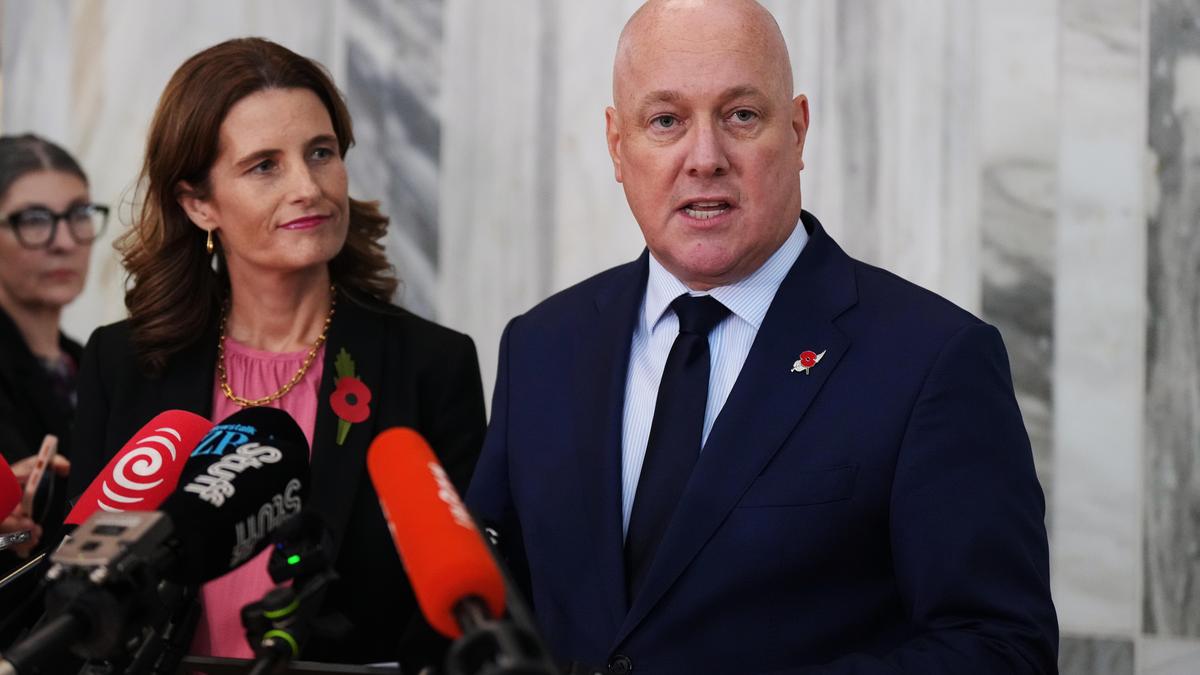
The failure of a vote of no confidence against Prime Minister Christopher Luxon serves as a clinical demonstration of the structural rigidities inherent in New Zealand’s Mixed Member Proportional (MMP) system. While the opposition framing focuses on narrative shifts and public dissatisfaction, the actual outcome was mathematically predetermined by the coalition’s governing agreements. To understand the survival of the Luxon ministry, one must move past the headlines and analyze the three specific pillars of institutional insulation that protect the current government from legislative collapse: seat-count certainty, the fiscal veto, and the cost of premature dissolution.
The Mathematical Insulation of Coalition Agreements
The fundamental reason the confidence motion failed lies in the explicit "Confidence and Supply" clauses embedded within the agreements between National, ACT, and New Zealand First. In a unicameral parliament with 123 seats, a simple majority of 62 is the threshold for survival. The current coalition commands 68 seats.
The coalition's stability is not based on ideological alignment but on a transactional equilibrium. Each junior partner (ACT and NZ First) has secured policy concessions that are contingent upon the government remaining in power. Therefore, a vote against the Prime Minister by a coalition partner would represent a literal destruction of their own policy gains. This creates a "Locked-In Majority" where the probability of a successful confidence motion remains near zero unless a total breakdown of internal communication occurs.
The opposition’s strategy in such motions is rarely to win the vote, which is a known impossibility, but to force a public record of alignment. By compelling every coalition member to vote with the Prime Minister, the opposition seeks to tether junior partners to controversial executive decisions, hoping to erode their distinct brand identities before the next electoral cycle.
Fiscal Consolidation as a Survival Mechanism
The Luxon government’s survival is inextricably linked to its aggressive fiscal consolidation strategy. By framing the national budget through the lens of "wasteful spending" versus "front-line services," the administration has created a defensive perimeter around its economic management.
This mechanism functions through three specific levers:
- The Operational Efficiency Directive: By mandating 6.5% to 7.5% savings across government departments, the administration signal-flashes fiscal discipline to its core donor and voter base. This justifies the rejection of opposition claims regarding "underfunding" by redefining the metric of success from input (dollars spent) to output (perceived efficiency).
- Tax Bracket Indexation: The delivery of promised tax cuts acts as a "delivery milestone." For a government built on the promise of economic competence, failing to pass these would be the only realistic trigger for a loss of confidence from within its own ranks.
- Capital Allocation Shifts: Redirecting funds from cancelled infrastructure projects (like the iREX ferry project or light rail) into a National Land Transport Fund provides the coalition with "tangible evidence" of shifting priorities, which satisfies the ACT party’s demand for austerity while maintaining National’s focus on roading.
The friction point for this strategy is the gap between fiscal metrics and service delivery. If the "efficiency gains" result in a quantifiable decline in health or education outcomes before the tax relief is felt by the median voter, the government faces a "Credibility Gap" that no confidence vote can fix.
The Friction of Premature Dissolution
A successful vote of no confidence typically triggers one of two events: the formation of a new government that can command a majority, or a snap election. Neither of these outcomes currently serves any party in the New Zealand parliament, including the opposition.
The Labour Party is currently in a phase of leadership consolidation and policy redevelopment. Forcing an election now would catch the opposition in a state of "strategic under-preparedness." Under MMP, the "Cost of Entry" for a new government involves months of negotiation and the drafting of complex multi-party agreements. The current political climate suggests that a snap election would likely return a similar seat distribution, leading to a "Circular Deadlock."
Furthermore, the New Zealand First party acts as a "Kingmaker with a Dead-Hand Switch." Winston Peters has historically demonstrated that his party’s leverage is highest when they are inside a government. Exiting that government via a confidence vote would be a form of political self-immolation that lacks a clear path to returning to power in a different configuration.
Legislative Pathing and the RMA Reform
The government's legislative agenda, particularly the Fast-Track Approvals Bill and the repeal of the Resource Management Act (RMA), functions as the "Glues of Governance." These policies are the primary interest of the coalition’s backbenchers and financial stakeholders.
Strategic analysts must view the Confidence Vote not as an isolated event, but as a "Stress Test" for the legislative pipeline. As long as the Prime Minister can maintain the flow of these high-priority bills, the internal discipline of the 68-seat bloc will remain intact. The opposition’s ability to disrupt this flow is limited by the "Urgency" mechanism, which the Luxon government has utilized more frequently than its predecessors to bypass select committee scrutiny.
The use of "Urgency" creates a "Velocity Bonus" for the executive branch, allowing them to pass legislation before public or legal opposition can coalesce. However, this carries the risk of "Quality Degradation" in the law-making process, potentially leading to judicial reviews that could embarrass the government later in the term.
The Risk Hierarchy of the Luxon Ministry
While the parliamentary vote was a non-event, the government faces three specific risks that could undermine its authority over the next 24 months:
- Inflationary Persistence: If the Reserve Bank of New Zealand is forced to maintain high interest rates longer than the Treasury forecasts, the "Economic Recovery" narrative becomes a liability. The government’s tax cuts could be perceived as inflationary, creating a direct conflict with their stated goal of price stability.
- The Treaty Principle Conflict: The ACT party’s push for a Treaty Principles Bill represents a "Structural Fault Line." National has indicated it will support the bill to the select committee stage but no further. This creates a "Terminus Point" for the coalition's unity. If David Seymour (ACT) perceives this as a betrayal, the price of his continued "Confidence and Supply" will increase significantly.
- Social License Erosion: The repeal of smokefree legislation and changes to Maori ward voting rights have mobilized a segment of the population that was previously disengaged. If the "Protest Momentum" translates into a sustained drop in polling for the National Party (currently hovering in the mid-30s), internal party polling may trigger a leadership review—a far more common way for New Zealand PMs to be removed than a floor vote.
Strategic Recommendation for Institutional Monitoring
Investors and political observers should ignore the performative theater of the debating chamber and focus on the "Coalition Management Committee" meetings. The true health of the government is measured by the delta between ACT’s policy demands and National’s implementation speed.
The primary indicator of an impending collapse will not be an opposition motion, but a "Legislative Logjam" where a minor coalition partner begins to abstain from minor procedural votes. Until such behavior is observed, the Luxon ministry should be viewed as a stable, high-conviction executive with a clear mathematical mandate to proceed with its structural realignment of the New Zealand economy. The focus must remain on the May Budget and the subsequent "Value for Money" reviews as the definitive benchmarks for the administration’s longevity.