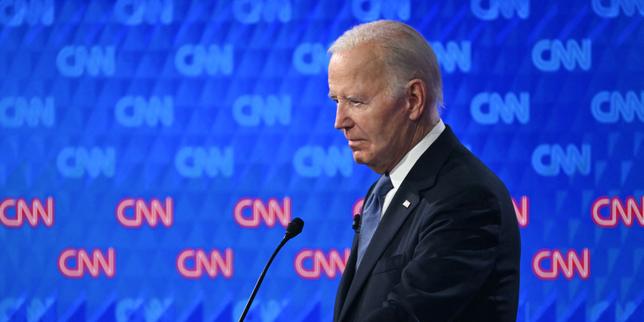
The June 27, 2024, presidential debate between Joe Biden and Donald Trump was not an isolated public relations failure; it was a systemic collapse operating at the intersection of acute cognitive performance degradation, institutional risk mismanagement, and immediate narrative contagion. When First Lady Jill Biden later disclosed her initial fear that the President was suffering an acute cerebrovascular event—a stroke—during the broadcast, she unwittingly formalized the ultimate risk-assessment metric for the event. The performance was so far outside the baseline of expected executive function that close observers immediately skipped political critique and defaulted to clinical crisis management.
Analyzing this event requires removing partisan rhetoric and applying a rigorous structural framework. The incident provides a stark case study in how hidden physical vulnerabilities can trigger catastrophic institutional liquidation. By dissecting the failure into its component parts—the physiological baseline breakdown, the structural vulnerabilities of the debate format, and the mechanics of immediate institutional panic—we can map precisely how a single 90-minute window fundamentally altered the trajectory of the American presidency.
The Tri-Factor Physiological Breakdown
The primary vulnerability of the debate performance lay in a compounding physiological failure. Executive presentation under high stress requires the synchronization of neurological processing, vocal projection, and motor control. On June 27, all three systems failed simultaneously, creating an optics vacuum that could not be repaired.
Three distinct physiological variables intersected to create this failure mode:
- Acute Upper Respiratory Fatigue: The official White House explanation cited a severe cold. In a standard corporate or political environment, a respiratory infection reduces vocal amplitude and increases cognitive processing latency. For an octogenarian executive, the metabolic cost of fighting an active infection directly saps the energy reserves required to maintain high-alert cognitive focus for a continuous 90-minute window.
- Vocal Cord Freeze and Dysphonia: The raspy, barely audible tone that characterized the opening minutes was a structural bottleneck. Sound projection relies on subglottic air pressure and vocal fold vibration. The combination of illness-induced inflammation and stress-induced muscle tension locked the vocal apparatus, instantly signaling physical frailty to the audience before any policy positions were articulated.
- Cognitive Retrieval Latency: The most damaging moments occurred when semantic retrieval stalled. In high-pressure debates, working memory must access complex data sets while filtering out auditory and visual distractions. The freezing episodes—most notably during an early answer on national debt and healthcare—represented a temporary breakdown in the brain’s executive function network, leaving trailing, incoherent phrases that invited the worst possible medical interpretations.
This was the catalyst for Jill Biden’s internal panic. To an intimate observer trained to watch for signs of neurological decline, the sudden dropping of the jaw, the vacant gaze, and the loss of verbal coherence matched the classic presentation of an ischemic event. The fact that it was later attributed to exhaustion and a virus does not change the structural reality: the administration’s gatekeepers allowed their principal to enter a high-stakes environment with zero operational margin for error.
Format Asymmetry and the Failure of Tactical Mitigation
The Biden campaign entered debate negotiations with specific structural demands designed to mitigate risk. They secured a studio closed to a live audience, automated microphone muting to prevent interruptions, and a early summer date meant to establish a baseline before the convention season. This strategy backfired completely due to a profound misunderstanding of format asymmetry.
The campaign assumed that removing a live audience and muting microphones would penalize Donald Trump by neutralizing his ability to leverage crowd energy and disrupt the flow of conversation. Instead, these constraints created a highly controlled, sterile environment that acted as an analytical clean room.
Without the auditory noise of cross-talk or crowd reactions, the television viewer’s attention was concentrated entirely on the split-screen visual and the raw audio feed of the individual speaking. When Trump’s microphone was muted, the camera remained on Biden, capturing every expression of apparent confusion or physical stiffness in high definition. The muted microphone policy actually protected Trump from his own worst impulse—constant interruption—and forced the audience to focus on Biden's solo performance.
The structural design of the debate stripped away the protective scaffolding that normally surrounds a modern president. There was no teleprompter, no option for a retake, and no staff intervention available once the cameras went live. The format demanded a level of sustained, unassisted cognitive endurance that the principal's physical state could not deliver.
The Mechanics of Immediate Narrative Contraction
In political communications, a negative performance can typically be spun, reframed, or diluted through counter-programming. However, certain events achieve what mass-communications theory calls "narrative closure"—a state where the evidence is so vivid and unambiguous that it completely validates a pre-existing, negative counter-narrative.
For three years, the dominant opposition line against the Biden administration was the allegation of cognitive and physical decline. The administration had successfully managed this risk by limiting unscripted media exposure, utilizing short walks to Marine One, and reliance on prepared remarks. The June 27 debate instantly converted this abstract political attack into a visible, undeniable reality for millions of viewers.
The speed of the resulting institutional panic can be mapped through a classic feedback loop:
[On-Screen Physical/Cognitive Failure]
                 │
                 ▼
[Immediate On-Target Media Validation]
                 │
                 ▼
[Donor and Delegate Capital Strike]
                 │
                 ▼
[Institutional Liquidation of the Candidacy]
The first phase was visual shock. The second phase occurred in real-time on digital platforms, where journalists, strategists, and commentators across the political spectrum reached an immediate, rare consensus: the performance was disqualifying. This eliminated the possibility of a coordinated defense; surrogate talking points disintegrated because the visual evidence was too stark to deny.
The third phase was the capital strike. Political campaigns operate on donor capital and institutional compliance. Within hours of the broadcast, major financial backers closed their checkbooks, recognizing that the product they were funding had suffered a terminal market failure. When institutional investors in a political movement withdraw their capital, the candidacy becomes financially unviable, regardless of delegate counts or primary victories.
The Cost Function of Institutional Insulation
The deeper structural failure exposed by Jill Biden's post-debate revelations lies in the hazard of institutional insulation. In high-stakes organizations, a protective bubble naturally forms around the chief executive. While designed to optimize efficiency and shield the leader from unnecessary friction, this bubble frequently filters out critical feedback and distorts reality for the inner circle.
The inner circle—composed of family members, long-time aides, and senior strategists—became victims of incremental normalization. They observed the President's gradual physical slowing over years, adjusting expectations and defensive measures in small, manageable increments. Because they adapted to the decline day by day, they failed to realize how jarring that accumulated decline would appear to an outside world that had not seen the President in an unscripted, prolonged setting for months.
This created a massive valuation gap between the internal team’s perception of readiness and the market’s actual reaction. The strategy team committed the ultimate analytical error: they confused their ability to manage the President's schedule with his actual capacity to perform under maximum stress without support systems.
The Strategic Path Toward Institutional Realignment
When an organization faces an existential failure of this magnitude, standard crisis communications are useless. You cannot spin a structural collapse; you can only execute a controlled liquidation or a radical reorganization. The ultimate withdrawal of Joe Biden from the 2024 ticket was the logical, unavoidable consequence of the data points established on June 27.
For senior leadership across any high-risk sector—be it governance, finance, or geopolitics—the definitive lesson of the June 2024 debate is the absolute necessity of objective, external metric validation. Organizations must implement independent red-teaming mechanisms that operate outside the influence of loyalty networks. When internal assessments suggest an executive is fit for a high-risk venture, but the objective data—such as stress testing, latency metrics, and physiological endurance—points to a systemic vulnerability, the objective data must overrule institutional optimism.
The administration’s failure to act on these indicators prior to June 27 forced a chaotic, high-risk mid-campaign replacement process. Future institutional strategies must prioritize early, data-driven off-ramps over emotional allegiance to prevent a single point of physical failure from jeopardizing the entire enterprise.