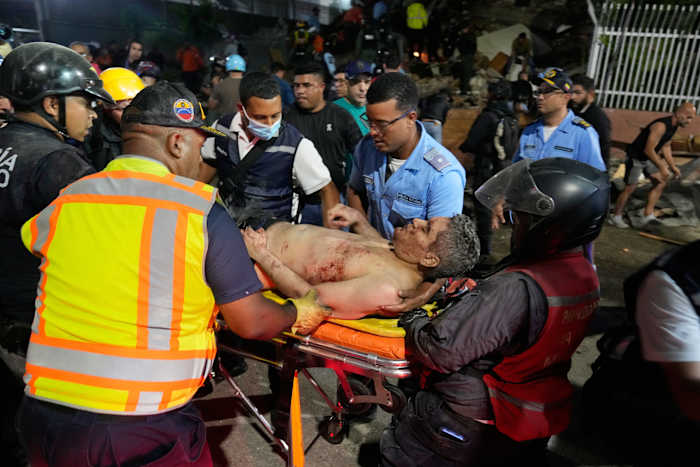
The announcement of immediate US humanitarian, medical, and search-and-rescue assistance to Venezuela represents more than a diplomatic gesture; it is a complex logistical operation intersecting with highly volatile geopolitical variables. Standard reporting frames these deployments through a purely humanitarian lens, focusing on the intent to alleviate suffering. A rigorous operational analysis, however, reveals that the efficacy of emergency aid in contested territories depends on a tri-part matrix: security protocols, supply chain velocity, and institutional friction. Without addressing these underlying mechanisms, the declaration of intent cannot reliably translate into measurable field outcomes.
The success of this mobilization hinges on navigating a highly restricted operational environment. When a government deploys critical assets—ranging from Urban Search and Rescue (USAR) teams to specialized medical units—into a region marked by domestic instability, the primary bottleneck is rarely resource availability. Instead, the limiting factor is the operational interface between the donor state, international intermediate bodies, and the recipient nation's domestic infrastructure.
The Tri-Part Matrix of Hostile-Environment Aid Allocation
To evaluate the probability of successful aid delivery, the deployment must be broken down into three independent variables. Each variable introduces specific failure modes that planners must mitigate.
[Donor Resource Mobilization] ➔ [Access and Transit Corridors] ➔ [Last-Mile Distribution Networks]
            │                               │                               │
    (Velocity Bottleneck)         (Sovereignty Friction)           (Interception Risk)
1. Velocity of Resource Mobilization
The initial phase relies entirely on domestic readiness frameworks. The United States Agency for International Development (USAID), specifically the Bureau for Humanitarian Assistance (BHA), operates via pre-positioned stockpiles and pre-arranged standing agreements with search-and-rescue entities, such as the Fairfax County (VA-TF1) and Los Angeles County (CA-TF2) tasks forces.
The logistical timeline follows a rigid operational sequence:
- T+0 to T+12 Hours: Activation of the Disaster Assistance Response Team (DART) and initial cargo manifest finalization at pre-positioned hubs (e.g., Miami, Florida).
- T+12 to T+24 Hours: Securement of overflight rights and military-to-civilian transport integration.
- T+24 Hours onward: Ingress into the theater of operations.
The bottleneck during this phase is not material scarcity but bureaucratic throughput. Procuring specialized medical equipment requires strict compliance with international transport regulations regarding hazardous materials (e.g., lithium batteries in medical diagnostic tools, pressurized oxygen tanks).
2. Sovereignty Friction and Ingress Corridors
The secondary phase introduces geopolitical friction. Humanitarian aid cannot legally cross sovereign borders without explicit state consent, or a specific United Nations Security Council mandate overriding local authority—the latter being statistically improbable given historical veto patterns on Venezuelan affairs.
When a political figure announces immediate deployment, the statement often precedes formal diplomatic clearance. This creates an operational paradox. If the host nation perceives the aid as a Trojan horse designed to undermine domestic authority or validate claims of state failure, the border becomes an absolute barrier. Aid assets are then forced into a holding pattern in adjacent territories, primarily Colombia or the Caribbean islands of Aruba and Curaçao. This holding pattern rapidly degrades the utility of time-sensitive assets, particularly search-and-rescue teams whose historical viability curve drops sharply after 72 hours post-incident.
3. Last-Mile Distribution and Leakage Minimization
The final variable is the internal distribution mechanism. Once cargo clears the port of entry, the donor nation loses direct chain of custody unless military personnel are deployed on-site—an action that changes the classification of the mission from humanitarian assistance to military intervention.
To maintain neutrality and ensure cargo reaches intended demographics, operations must rely on non-governmental organizations (NGOs) and international bodies like the International Committee of the Red Cross (ICRC) or United Nations agencies. The operational risk here is twofold:
- Logistical Diversion: The appropriation of medical supplies and food by state or non-state armed actors to reinforce patronage networks.
- Infrastructural Failure: The physical inability of local transport networks (due to fuel shortages, degraded road conditions, or grid failures) to move material from tarmac to clinic.
Quantifying the Friction Coefficient
The efficiency of the proposed US deployment can be modeled by evaluating the Friction Coefficient ($F_c$), where operational velocity ($V$) is degraded by political resistance ($R_p$), infrastructural decay ($I_d$), and security threats ($S_t$). The relationship is defined as:
$$F_c = \frac{R_p \times I_d \times S_t}{V}$$
When $R_p$ is maximized—as is typical in polarized diplomatic environments—the overall friction coefficient rises exponentially, reducing the effective volume of aid delivered per unit of time regardless of the total capital allocated by the US government.
To counter a high friction coefficient, strategic planners utilize specific operational alternatives.
Air Bridges vs. Maritime Corridors
Maritime transport offers superior volumetric capacity but suffers from severe velocity deficits and high vulnerability to port-side bureaucratic delays. A standard container ship requires functioning port cranes, stable electricity, and secure offloading zones.
Air deployment via C-17 Globemaster III or civilian charter aircraft optimizes velocity but limits total payload. Air assets are highly dependent on runway integrity and aviation fuel availability at the destination. If the target airports lack refueling capabilities, aircraft must carry double the fuel load, directly reducing the maximum allowable weight for humanitarian cargo.
| Metric | Aerial Deployment (C-17 Platform) | Maritime Deployment (Standard Cargo) |
|---|---|---|
| Time to Target | 4–8 Hours | 3–5 Days |
| Payload Capacity | ~77,500 kg per sortie | Multi-ton container capacity |
| Infrastructure Reliance | High (Runway length, ATC stability) | Extreme (Deep-water berths, crane power) |
| Vulnerability to Blockade | Moderate (Airspace denial risks) | High (Naval/Port authority restrictions) |
The Non-Governmental Buffer System
Because direct state-to-state aid delivery faces intense political resistance, the operational blueprint must leverage third-party buffers. Organizations like the Pan American Health Organization (PAHO) serve as neutral execution mechanisms. By routing US-funded medical supplies through PAHO or UNICEF channels, the donor state minimizes the political signaling of the aid, thereby lowering the political resistance factor ($R_p$).
This strategy carries inherent structural trade-offs. The integration of international bureaucracies introduces a layer of administrative overhead that slows down the deployment cycle. Decisions that take minutes within a centralized military command structure require days of committee clearance when routed through multinational frameworks. Furthermore, tracking the end-use of supplies becomes significantly more opaque, increasing the variance in accountability metrics.
Strategic Allocation of Medical Material
Medical aid must be tailored precisely to the nature of the crisis to prevent supply-demand mismatches on the ground. Deployments typically categorize medical assets into Interagency Emergency Health Kits (IEHK).
An IEHK is designed to meet the priority health needs of a population missing access to primary care. The allocation strategy must differentiate between acute trauma intervention (essential if the aid response is triggered by a sudden-onset natural disaster) and chronic supply stabilization (required if the crisis is an acceleration of long-term economic collapse).
Sending advanced trauma equipment into a region lacking basic sterilization capabilities or consistent electrical power is an operational error; the equipment sits idle while basic infection-prevention supplies run out. The tactical priority must favor low-technology, high-utility consumables: clean water purification tablets, broad-spectrum antibiotics, basic surgical consumables, and rehydration fluids.
The Operational Play
The announcement of immediate US aid to Venezuela should not be evaluated as a self-executing mandate, but as the initiation of a high-stakes logistical negotiation. The critical path forward requires a sequential, three-stage operational play:
- Establishment of an Off-Shore Logistics Hub: Secure immediate staging grounds in Curaçao to decouple resource accumulation from ingress permission. This eliminates domestic storage bottlenecks and allows for rapid sorting of materials while diplomatic negotiations occur.
- De-flagging Cargo: Transition the identity of the material from US-branded pallets to neutral, international identifiers managed by global bodies. This directly lowers the political cost for local authorities accepting the cargo.
- Phased Ingress via Non-State Actors: Initiate delivery using small-scale, distributed networks (local NGOs and religious charitable frameworks) rather than centralized state distribution networks. This mitigates the risk of large-scale systemic interception and ensures that even if main logistics arterial routes are blocked, secondary distribution remains functional.