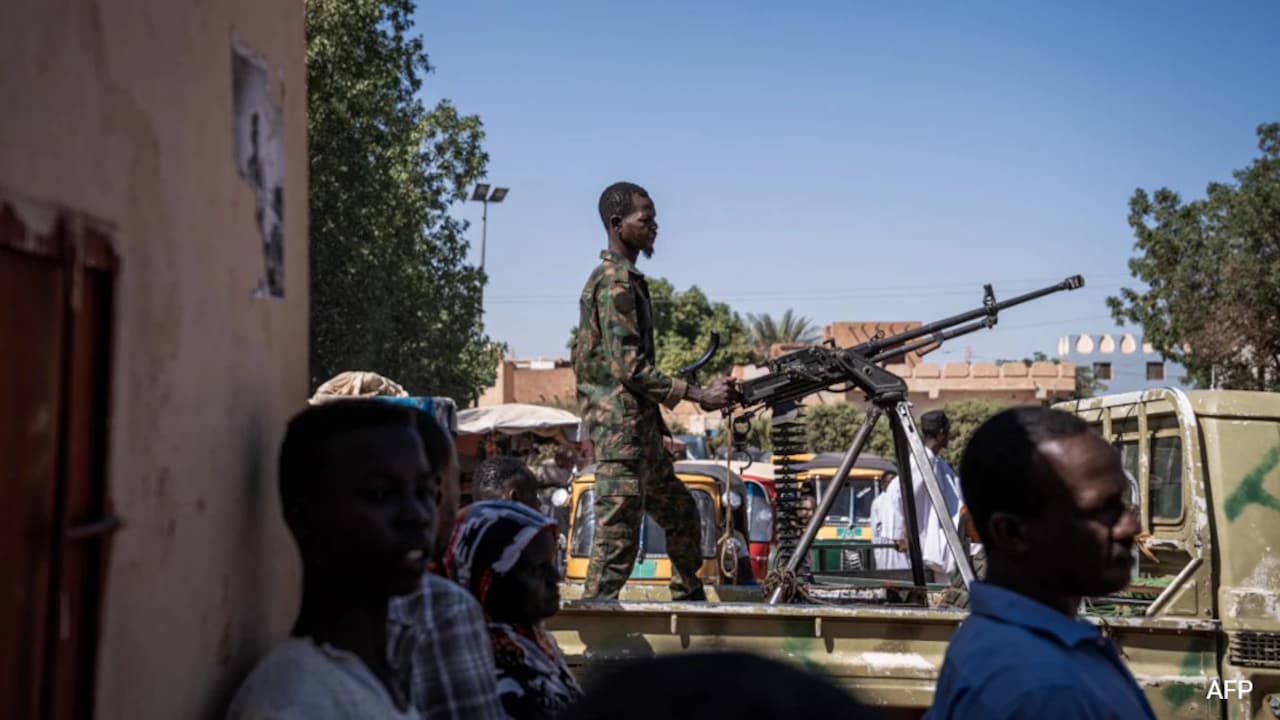
More than 1,000 civilians lost their lives to drone strikes in Sudan during the first five months of 2026 alone. This staggering figure represents a profound shift in the country's civil conflict, transforming the skies into a persistent, automated threat for those on the ground. The soaring casualty count highlights how cheap, imported unmanned aerial vehicles (UAVs) have fundamentally altered the mechanics of the war between the Sudanese Armed Forces (SAF) and the Rapid Support Forces (RSF). What was once a ground-based war of attrition has evolved into a high-tech proxy conflict, driven by foreign technology and a complete breakdown of international arms embargoes.
Understanding this crisis requires looking past the raw statistics to examine the specific supply chains and tactical shifts that made this bloodshed possible. The sudden spike in civilian deaths is not an accidental byproduct of conventional warfare. It is the direct result of a deliberate, calculated integration of low-cost, high-consequence technology into urban battlefields.
The Architecture of an Airborne Crisis
The skies over Khartoum, Omdurman, and the Darfur region are no longer controlled by traditional fighter jets. Instead, they are crowded with smaller, quieter, and far more insidious weapons. For the average civilian, the first sign of an impending strike is often a faint hum, followed seconds later by a devastating explosion.
The rapid escalation in fatalities stems from a fundamental change in how both factions approach urban combat. In the early stages of the war, heavy artillery and indiscriminate shelling caused the majority of non-combatant casualties. Today, remote operators stationed hundreds of miles away orchestrate the destruction. These operators frequently target crowded marketplaces, makeshift medical clinics, and civilian displacement camps under the guise of neutralizing enemy positions.
The precision promised by drone manufacturers has proven to be a grim myth in the Sudanese theater. While a modern UAV can technically target a specific vehicle or building, the intelligence guiding these strikes is notoriously flawed. Operators rely on outdated data, unverified field reports, or simply loose definitions of what constitutes a military target. When a munition hits a dense residential neighborhood, the distinction between a combatant and a civilian vanishes instantly.
The Foreign Pipelines Feeding the Conflict
Sudan does not possess the domestic industrial base required to design or manufacture advanced aerial weaponry. Every single drone terrifying the population arrived via illicit international supply networks that operate with near-impunity.
Investigation into the wreckage of these devices reveals a complex web of foreign state and non-state actors. The Sudanese Armed Forces have increasingly relied on loitering munitions and attack drones supplied by Middle Eastern and North African patrons, who view the SAF as a bulwark against regional instability. Conversely, the Rapid Support Forces have secured a steady influx of commercial quadcopters modified to carry mortar shells, alongside sophisticated tactical drones smuggled through neighboring African nations.
These supply lines rely heavily on dual-use technology. A commercial drone designed for agricultural surveying or cinematic photography can be converted into a lethal weapon with a simple 3D-printed drop mechanism and a modified grenade. This commercial availability makes the enforcement of traditional arms embargoes nearly impossible. International borders in the region are porous, and shipping manifests are easily doctored to list lethal hardware as benign electronics or industrial machinery.
The Failure of Global Oversight
The United Nations and various international monitoring bodies have repeatedly warned about the weaponization of Sudan's airspace. Yet, the flow of components has not slowed. The global community's response has been hampered by diplomatic gridlock and a lack of enforcement mechanisms on the ground.
Sanctions targeting specific military commanders do little to disrupt international black markets. As long as foreign networks find financial or geopolitical incentives to back either side, the cargo planes and desert convoys will continue to deliver fresh batches of hardware to the front lines.
The Psychological Toll of Persistent Surveillance
The impact of this drone campaign extends far beyond the immediate physical destruction. The constant presence of UAVs has inflicted deep psychological trauma on millions of Sudanese citizens who are unable to flee the conflict zones.
Living under a sky that fields constant threats alters the basic rhythms of daily life. Markets open at irregular, unpredictable hours to avoid gathering large crowds that might attract an operator's attention. Schools, or what remains of them in makeshift community centers, operate in perpetual fear. The sound of a distant engine is enough to empty a street in seconds, sending families scrambling into concrete structures that offer little real protection against modern explosives.
This state of constant terror serves a tactical purpose for the warring factions. By making normal life impossible, each side seeks to erode the social fabric of territories controlled by their opponent, effectively using the civilian population as a lever to exert political and military pressure.
Accountability in an Era of Remote Warfare
Assigning responsibility for these deaths is exceptionally difficult due to the anonymous nature of remote warfare. When a traditional airstrike occurs, radar tracking and pilot communications leave a verifiable trail. When a small, expendable drone strikes a crowded square, tracing the origin of the flight back to a specific command structure requires forensic capabilities that currently do not exist within Sudan.
Both the SAF and the RSF routinely deny targeting civilians, frequently blaming the other side or attributing the blasts to stray artillery. This lack of accountability creates a dangerous vacuum where commanders feel emboldened to authorize increasingly risky strikes without fear of future prosecution for war crimes.
International legal frameworks are struggling to keep pace with this technological reality. The laws of armed conflict demand proportionality and distinction, principles that are systematically ignored when an operator presses a button based on a grainy, low-resolution video feed thousands of feet above a city.
The ongoing tragedy in Sudan serves as a stark warning about the future of global conflict. When cheap, lethal automation meets a complete absence of international accountability, the civilian population invariably pays the highest price. The numbers from the first half of 2026 are not just a statistical anomaly. They represent the new baseline for modern, unmonitored proxy warfare.