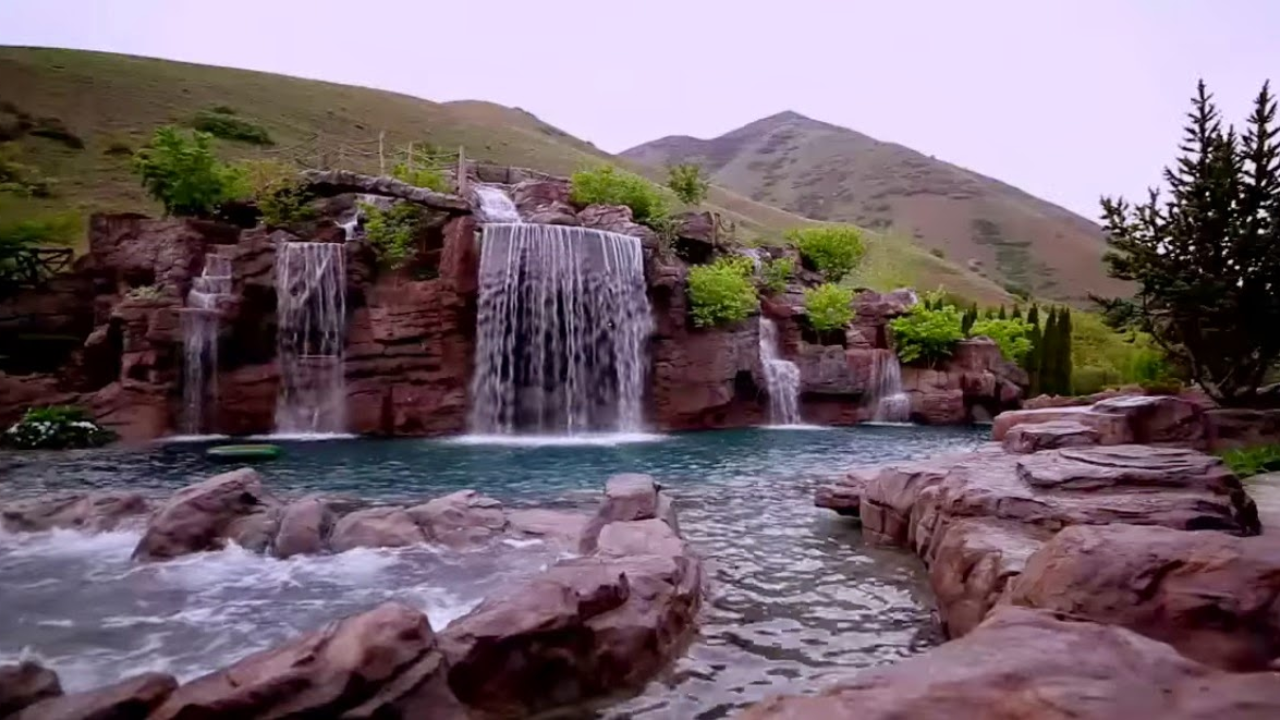
Headline stories about a two-million-dollar backyard pool featuring a ninety-foot rock formation and an underwater diving tunnel sell clicks through spectacle rather than systems thinking. Treating a residential aquatic structure as a single capital event misses the real economic and engineering story: capital expenditure is only the entry ticket, while hydrostatic loads, water turnover rates, seasonal thermal loss, and hyper-local buyer demand dictate the true cost of ownership. To evaluate a project of this scale rigorously, this article maps how sensational residential stories oversimplify complex builds and lays out an analytical blueprint built on The Three Pillars of Extreme Residential Pools, The Cost Function of Aquatic Mega-Builds, and Cause-and-Effect Chain Reactions.
Deconstructing the Sensationalist Narrative
Coverage built around a two-million-dollar price tag and dramatic features—such as a towering artificial mountain and a submerged tunnel—relies on anchoring and novelty bias. Readers anchor on the headline dollar figure and assume that spending more automatically produces superior engineering or proportional home equity. In reality, residential construction rarely scales linearly once a project crosses standard gunite pool territory into custom civil engineering, structural rockwork, and specialized aquatic safety equipment.
Standard lifestyle reporting tends to compress months or years of engineering trade-offs into three flat claims: a big budget equals luxury, dramatic aesthetics equal value, and novel features work out of the box. That framing skips the mechanisms underneath. A ninety-foot artificial peak or boulder wall is not just scenery; it is a wind-exposed, freeze-thaw-exposed structural mass that requires geotechnical footing, waterproofing membranes, and pump head pressure capable of lifting water vertically without starving circulation elsewhere. Similarly, an underwater tunnel shifts a backyard pool from a recreational basin into a confined aquatic space, introducing entrapment hazards, visibility requirements, bulkhead or acrylic loading considerations, and strict rescue protocols.
Where exact project records are absent from a headline summary, rigorous analysis separates known physical and economic mechanics from educated hypotheses about a specific build. We know as a matter of civil engineering and residential real estate economics that extreme custom amenities narrow the buyer pool and carry ongoing operational liabilities. We can only hypothesize—without verified engineering drawings, municipal permits, or utility bills—how much of a hypothetical two-million-dollar budget went to excavation and structural steel versus architectural rock coatings, filtration skids, or site access in Utah's climate.
The Three Pillars of Extreme Residential Pools
Analyzing an extreme backyard build requires separating the project into three interdependent systems. Weakness in any single pillar compromises the other two.
Structural and Geotechnical Engineering
Large-scale water features exert immense static and dynamic forces. Water weighs roughly 62.4 pounds per cubic foot, meaning even moderate depth increases across a large footprint create substantial lateral thrust against retaining walls and floor slabs. In regions with expansive soils, steep grades, or seasonal freeze-thaw cycles—conditions frequently encountered across Utah—differential ground movement can crack rigid shells or shear plumbing penetrations.
Vertical rockwork adds a distinct structural layer. Whether constructed from structural steel framing with shotcrete/gunite sculpting or stacked heavy stone, tall features must resist wind overturning moments, seismic loads, and thermal expansion. Subsurface drainage behind retaining walls and rock formations is just as critical as the visible surface; trapped groundwater creates hydrostatic uplift that can pop an empty or partially drained shell out of the ground.
Hydraulics, Filtration, and Life Safety
A backyard pool with a scuba tunnel and elevated waterfall cannot run on a basic residential pump and skimmer loop. Total dynamic head rises sharply when water is pumped to high elevations for cascades or routed through complex geometry, tunnels, and grottos. If flow velocity drops in dead zones or submerged passages, dissolved sanitizer depletes unevenly and biofilm or algae can establish out of sight.
Turnover rate—the time required to circulate the entire water volume through filtration and sanitization—becomes a major sizing constraint as volume grows. High bather loads, organic debris from outdoor rockwork, and warm water temperatures accelerate chlorine demand and disinfection byproduct formation. Adding an underwater tunnel elevates life-safety engineering from a checkbox to a core design requirement: line-of-sight obstructions, entrapment risks, air-pocket misconceptions, and confined-space rescue access must be engineered out rather than patched over with signage.
Microclimate and Operational Economics
Outdoor water bodies exchange heat and moisture continuously with the surrounding air. Evaporation is the dominant heat-loss mechanism in most climates, driven by air temperature, wind speed, relative humidity, and water-to-air temperature differentials. Arid or semi-arid mountain climates with low humidity and brisk winds can drive substantial evaporative water loss and sharp nighttime cooling, forcing heating systems to work overtime if the pool is used outside peak summer months.
Operating a large, feature-heavy pool also creates recurring non-energy costs. Filter media replacement, commercial-grade or heavy-duty variable-frequency pumps, chemical dosing, sensor calibration, structural sealants on rockwork, and specialized inspection or maintenance labor accumulate year after year.
The Cost Function of Aquatic Mega-Builds
Rather than treating a headline figure as a single lump sum, a strategy consultant models extreme residential pools through a total cost of ownership (TCO) cost function:
$$\text{TCO} = C_{\text{capex}} + C_{\text{site}} + \sum_{t=1}^{n} \left( C_{\text{energy},t} + C_{\text{chem/maint},t} + C_{\text{risk/ins},t} \right) - R_{\text{resale},n}$$
In this formulation:
- $C_{\text{capex}}$ represents core basin construction, specialized features (rock formations, tunnels, lighting, automation), and mechanical plant equipment.
- $C_{\text{site}}$ captures site-specific friction: rock or hardpan excavation, crane and heavy-equipment access, retaining walls, utility upgrades, and permitting delays.
- $C_{\text{energy},t}$ covers electricity for high-head circulation pumps, booster pumps, lighting, and thermal energy for heating across year $t$.
- $C_{\text{chem/maint},t}$ reflects sanitizers, pH/alkalinity balancing, water replenishment, routine servicing, and periodic component replacements over $n$ years.
- $C_{\text{risk/ins},t}$ accounts for umbrella liability coverage, safety barriers, and compliance upgrades tied to non-standard aquatic features.
- $R_{\text{resale},n}$ denotes the net value preserved or recovered at property sale after $n$ years, which is rarely equal to initial spend.
Why Headline Numbers Distort Comparisons
Two projects with identical budgets can have completely different cost functions. One owner may spend heavily on hidden infrastructure—deep bedrock excavation, reinforced retaining walls, oversized heat exchangers, and redundant filtration—reducing long-term failure rates and operating bottlenecks. Another owner may concentrate spending on visible theatrics—expansive artificial rock faces and novelty passages—while under-sizing thermal insulation, automated chemical control, or service access around tight crevices.
Furthermore, a single headline number hides marginal cost spikes. Going from a standard depth to a deep diving well or tunnel does not just add cubic feet of water; it multiplies excavation difficulty, concrete thickness, rebar density, dewatering effort during construction, and safety engineering complexity.
Cause-and-Effect Chain Reactions Most Coverage Misses
Sensational stories treat features as isolated trophies. In physical and financial systems, every major design choice triggers downstream chain reactions.
The Thermal and Evaporation Cascade
Adding a tall waterfall or cascade over rockwork increases surface area and aerates water as it drops. While aeration can help strip certain volatile compounds, cascading water also accelerates evaporative cooling and raises water pH by driving off carbon dioxide. Higher pH reduces the effectiveness of free chlorine at a given concentration, prompting higher chemical dosing to maintain equivalent sanitizing power. Simultaneously, heat lost to evaporation and night air must be replaced by heaters or heat pumps—a sharp trade-off when someone wants comfortable water in cool mountain air.
The Maintenance Access Bottleneck
Dramatic rock formations and tunnels look natural precisely because they avoid sterile, rectangular geometry. Yet irregular crevices, overhangs, and submerged passages create inspection and cleaning blind spots. Leaves, mineral scale, and organic film accumulate where standard robotic cleaners cannot reach and where maintenance technicians cannot easily stand or see. Over time, hidden wear on waterproofing coatings, underwater luminaires, or return fittings turns minor maintenance into costly draining, rigging, or confined-space work.
The Real Estate Liquidity Trap
In residential real estate, high-cost, hyper-specific improvements face diminishing marginal utility among future buyers. A buyer shopping a multi-million-dollar home may love luxury finishes, yet balk at a massive backyard footprint consumed by a specialized pool and rock mountain. Some households view an extreme pool with a diving tunnel as a dream lifestyle asset; others see an insurance headache, a safety concern for children or guests, a high monthly utility bill, or an expensive demolition project if they want a flat lawn or sports court.
This creates a classic liquidity and valuation mismatch. Appraisers and market comparables anchor on neighborhood norms and broad buyer appeal rather than idiosyncratic construction invoices. Even in affluent markets, over-customization can narrow the pool of willing buyers and lengthen time on market, meaning recovery at resale is frequently a fraction of original outlay.
How Homeowners and Analysts Should Evaluate Extreme Builds
Applying disciplined evaluation prevents costly surprises whether you are budgeting a custom project, underwriting a luxury property, or analyzing a viral real estate story.
- Audit site constraints before sketching aesthetics. Map soil conditions, slope stability, groundwater, setback rules, crane access, and electrical/gas capacity first. Many budget blowouts start when dramatic visuals are drawn before geotechnical realities are tested.
- Separate capital cost from multi-year operating load. Model five- and ten-year costs for heating, pumping, water makeup, chemicals, and specialized maintenance. Ask how operating costs behave in shoulder seasons, not just mid-summer.
- Engineer safety and serviceability into the geometry. Evaluate sightlines, entrapment risks, emergency egress, lighting, and access for cleaning and repairs before pouring concrete or spraying rock coatings. If a feature cannot be safely inspected and maintained, its lifecycle cost is understated.
- Stress-test resale against local buyer depth. Compare the proposed footprint and maintenance profile against neighborhood expectations. Ask whether the feature broadens appeal to typical buyers in that price tier or caters only to a tiny niche.
- Distinguish verified facts from marketing claims. When reading headlines or reviewing contractor proposals, separate documented engineering specs, load calculations, and operating estimates from promotional descriptions and unverified assumptions.
Limitations of This Analytical Framework
No single framework captures every variable in custom construction or real estate. Exact cost ratios shift dramatically across climates, municipalities, labor markets, and material supply chains, and proprietary builds rarely disclose full line-item ledgers. Resale outcomes are also shaped by broader macroeconomic conditions, interest rates, and shifting buyer preferences that no static formula can predict with certainty. Finally, engineering analysis informs risk and cost trade-offs, but licensed structural engineers, aquatic safety specialists, and local code authorities remain essential for any physical build.
Strategic Recommendation for High-Stakes Buyers and Builders
If you are planning or evaluating an extreme residential aquatic build, anchor the design on modular operational efficiency and broad spatial adaptability rather than maximum spectacle. Demand transparent engineering trade-offs—specifically thermal loss modeling, hydraulic turnover calculations, clear maintenance access, and realistic multi-year operating budgets—before committing capital to monumental features like towering rockwork or underwater tunnels. The highest-performing luxury assets are not the ones that shock onlookers once in a headline; they are the ones that run predictably, stay safe and maintainable for decades, and preserve buyer appeal when market conditions change.