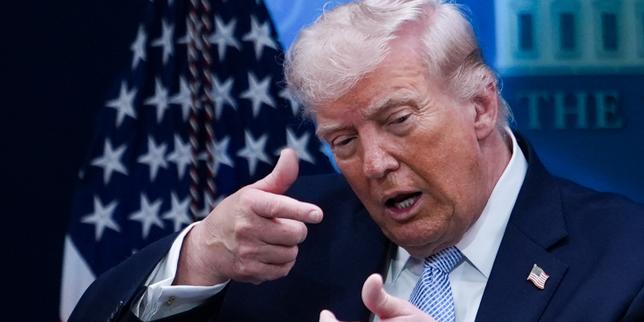
The debate regarding Donald Trump’s cognitive health has moved from the fringes of political discourse to the absolute center of the American electoral process. Observers point to his increasingly erratic rhetoric, frequent confusion of names, and rambling anecdotes as evidence of a decline that goes beyond mere political theater. While his supporters dismiss these lapses as "weaving"—a stylistic choice to connect disparate ideas—medical professionals and political analysts are sounding alarms about the stability of the man who seeks to regain control of the nuclear codes. This is not just a matter of partisan bickering. It is a fundamental question about the baseline requirements for the most powerful office on earth.
The Evolution of the Presidential Gaffe
Political figures have always stumbled over their words. Ronald Reagan faced scrutiny in his second term, and Joe Biden’s verbal slips were a cornerstone of Republican attacks for years. However, the nature of Trump’s recent linguistic detours suggests a different pattern. We are seeing a transition from simple misstatements to a loss of cohesive narrative.
When a candidate confuses Nikki Haley with Nancy Pelosi repeatedly during a scripted rally, it indicates a failure in retrieval memory. This is not the same as a stutter or a temporary "tip-of-the-tongue" moment. In the high-stakes environment of international diplomacy, these lapses can have catastrophic consequences. The presidency demands a level of mental acuity that allows for the processing of complex, often contradictory intelligence data in real-time. If the executive cannot distinguish between key players or maintain a linear train of thought, the entire administrative structure begins to lean on unelected advisors to fill the gaps.
The Goldwater Rule and the Breaking of Medical Silence
For decades, the American Psychiatric Association has adhered to the Goldwater Rule, which prohibits psychiatrists from diagnosing public figures without a personal examination. That boundary is currently under immense pressure. Hundreds of mental health professionals have stepped forward, risking their professional standing to argue that the public record provides enough "behavioral data" to warrant a serious discussion about fitness for duty.
They point to specific traits:
- Hyperbole and Grandiosity: An inability to process reality when it conflicts with a preferred internal narrative.
- Paranoia: The frequent suggestion that internal enemies are sabotaging the nation.
- Cognitive Rigidity: An inability to adapt to new information or admit error, even when presented with objective proof.
Critics of this approach argue that "armchair diagnosis" is dangerous and politically motivated. They are right to be cautious. However, the counter-argument holds that the public has a right to know if a candidate shows signs of progressive neurological decline. We require physical exams for presidents; why is the most critical organ—the brain—treated as a private matter?
The Weave vs. The Wander
Trump himself has attempted to brand his discursive speaking style as "The Weave." He claims that his long-winded stories about sharks, electric boats, and fictional characters like Hannibal Lecter are brilliant rhetorical devices that always return to a central point. To an untrained ear at a rally, the energy and volume can mask the lack of logic.
But a transcript tells a different story.
When you strip away the cheering crowd, many of these speeches lack a grammatical or logical spine. The "weave" often looks more like a "wander." In clinical settings, this is sometimes referred to as tangentiality—a communication abnormality where the speaker moves further and further away from the original topic without ever returning to it. While his base finds this entertaining and "authentic," the strategic community in Washington views it as a vulnerability. Adversaries like Russia or China do not see a brilliant rhetorician; they see an unpredictable actor who can be easily manipulated through flattery or distraction.
The Institutional Safeguards That No Longer Exist
In his first term, Trump was surrounded by what many called the "adults in the room." Figures like General James Mattis or John Kelly provided a buffer between the president’s impulses and actual policy execution. They were the friction in the system.
If Trump returns to power, those buffers will be gone. The current strategy involves staffing the executive branch with loyalists who view his most erratic statements not as bugs, but as features. This removes the final check on a leader who may be experiencing cognitive fluctuations. When the institutional guardrails are replaced by a megaphone, the personality of the president becomes the sole driver of national security.
The 25th Amendment was designed for this exact scenario—a president "unable to discharge the powers and duties of his office." Yet, the political cost of invoking it is so high that it remains a theoretical tool rather than a practical one. The burden, therefore, falls entirely on the electorate to perform a collective psychiatric evaluation at the ballot box.
The Financial and Global Risk of Executive Instability
Markets crave predictability. The global economy is built on the assumption that the United States will act as a rational, stable actor. When the American president suggests policies that contradict basic economic theory or threatens to upend decades-old alliances on a whim, the "uncertainty premium" rises.
Foreign leaders are already hedging. Traditional allies are deepening ties with one another to bypass a potential Washington vacuum. Enemies are emboldened, sensing that a distracted or declining leader will be less likely to mount a coherent response to regional aggressions. We are watching the slow erosion of the Pax Americana, driven in part by the perceived instability at the top of the chain of command.
Beyond the Campaign Trail
The focus on Trump’s age and mental state often ignores the broader reality of an aging political class. However, the intensity of the scrutiny on Trump is unique because of the specific nature of his outbursts. It is not just about being "old." It is about a specific brand of volatility that appears to be accelerating.
Observers have noted a change in his physical mannerisms as well—the bracing of a water glass with two hands, the shuffling gait, and the visible fatigue after long stretches of speaking. These are data points that, in any other profession, would trigger a mandatory fitness-for-duty review. In politics, they are treated as memes or partisan talking points.
The danger lies in the normalization of the abnormal. When a leader says something detached from reality every single day, the public eventually stops being shocked. This "outrage fatigue" allows a cognitive crisis to hide in plain sight. If we stop asking why a candidate is talking about "late great Hannibal Lecter" during a discussion on border policy, we have already surrendered our expectations for a functional executive branch.
The baseline for the American presidency should not be "capable of standing on a stage for ninety minutes." It should be "capable of processing information, maintaining emotional regulation, and making decisions based on a consistent reality."
As the election approaches, the demand for a standardized, independent cognitive assessment for all presidential candidates will likely grow. Until then, the American public is left to decipher the "weave" on its own, weighing the entertainment value of a rally against the somber requirements of command. The stakes are far higher than a four-year term; they involve the very definition of national stability in an era where a single lapse in judgment can rewrite history.
The silence from the traditional political establishment on this matter is not a sign of respect for the office. It is a symptom of a system that is currently ill-equipped to handle the intersection of geriatric health and nuclear responsibility. Every time a name is swapped or a sentence dissolves into a word salad, the cracks in that system widen. Ignoring the evidence does not make the risk disappear; it only ensures that when the failure occurs, it will be total.


