The rain in Kathmandu does not fall; it arrives like an eviction notice.
It hits the corrugated tin roofs of the valley with a violent, rhythmic percussion, turning the dust of centuries into a thick, red paste that swallows the wheels of rickshaws and stalls the engines of overloaded buses. If you have ever stood in the middle of Thamel during a cloudburst, smelling the heavy mix of diesel, wet pine, and charcoal smoke, you know the particular kind of dread that rain brings to Nepal. You look up at the black slopes of the Mahabharat Range, and you wonder how much water the earth can hold before it simply gives up and slides into your living room.
Balendra Shah knows this dread. He has looked at the same gray sky, smelled the same wet earth, and felt the same helpless knot in his stomach. But a few years ago, the only weapon he had against the chaos was a microphone.
Back then, the world knew him as Balen. He was an underground structural engineer with a shaved head, dark sunglasses, and a deadpan delivery that made his rapid-fire rhymes hit harder than a sledgehammer. He did not rap about fast cars or bottle service. He rapped about sewage systems that didn't work. He rapped about politicians who built massive concrete villas while school children crossed swollen rivers on rotting suspension bridges. He rapped about a government that treated its citizens like background noise.
When young urbanites chanted his lyrics in smoke-filled clubs, they were not just enjoying a beat. They were staging a quiet, bitter rebellion against a political gerontocracy that had treated Kathmandu like a personal piggybank for decades.
Then, the script flipped.
In a political earthquake that caught the old guard fast asleep, Balen traded his hoodie for a simple vest, ran for mayor of Kathmandu as an independent, and won. The underground rapper suddenly found himself holding the keys to a city choking on its own rapid, unplanned growth. The man who made a career out of pointing out broken windows was now suddenly responsible for fixing the entire foundation.
And now, the stakes have scaled from municipal gutters to the roof of the world.
Nepal is facing a flood test. Not just a seasonal monsoon, though that is terrifying enough. It is a collision between ancient ecological rhythms and a hyper-modern climate crisis, all playing out under the watchful, terrifying gaze of a newly minted prime minister who rose from the hip-hop underground to the highest office in the land.
Consider what happens when glaciers the size of cathedrals melt too fast. High up in the Himalayas, tucked into the jagged folds of rock and ice, glacial lakes are swelling. These are not serene mountain tarns. They are ticking time bombs held together by walls of loose gravel and frozen debris known as moraines. Geologists call them glacial lake outburst floods. You can call them tsunamis from the sky.
When a moraine breaches, it unleashes millions of cubic meters of water, mud, and boulders down narrow mountain valleys. It travels with the speed of a freight train and the mass of a mountain. It flattens entire villages in seconds, sweeps away hydro-power plants that took decades to finance, and scours riverbeds down to the bedrock.
By the time that wall of water reaches the lower hills and the flat plains of the Terai, it is a brown leviathan carrying the lives of millions.
This is the crucible where political rhetoric goes to die.
For decades, Nepali politics has been a theater of empty promises. Old men in crisp white kurtas cut ribbons, made grand speeches about development, and then watched the country's brightest youth pack their bags for jobs in the Gulf states or universities in the West. It was a cycle of hollow rituals. A vote was just a transaction, a way to keep the same revolving door of patronage spinning.
Balen’s rise was supposed to break that machine. He attacked illegal constructions, cleared encroached public land along the banks of the Bagmati River, and live-streamed municipal meetings to hold bureaucrats' feet to the fire. He was abrasive, uncompromising, and occasionally polarizing. Critics called him an authoritarian with a social media following. Supporters saw him as the only surgeon willing to cut away the gangrene.
Governance, however, is a different beast from municipal demolition.
When you are simply shouting truth to power, every problem has a villain. When you are power, every problem has a compromise. And the monsoon does not care about your Spotify streams. It does not care about your independent status, your anti-corruption stance, or your viral Facebook posts.
The rain falls on the poor farmer in Sindhupalchok just as hard as it falls on the wealthy merchant in Durbar Marg.
To understand why this moment feels so heavy, you have to look at the geography of survival. Nepal is a topographical vertical drop. In the span of just a couple of hundred kilometers, the landscape plunges from the highest point on Earth to tropical jungles. This means water moves fast. Extremely fast.
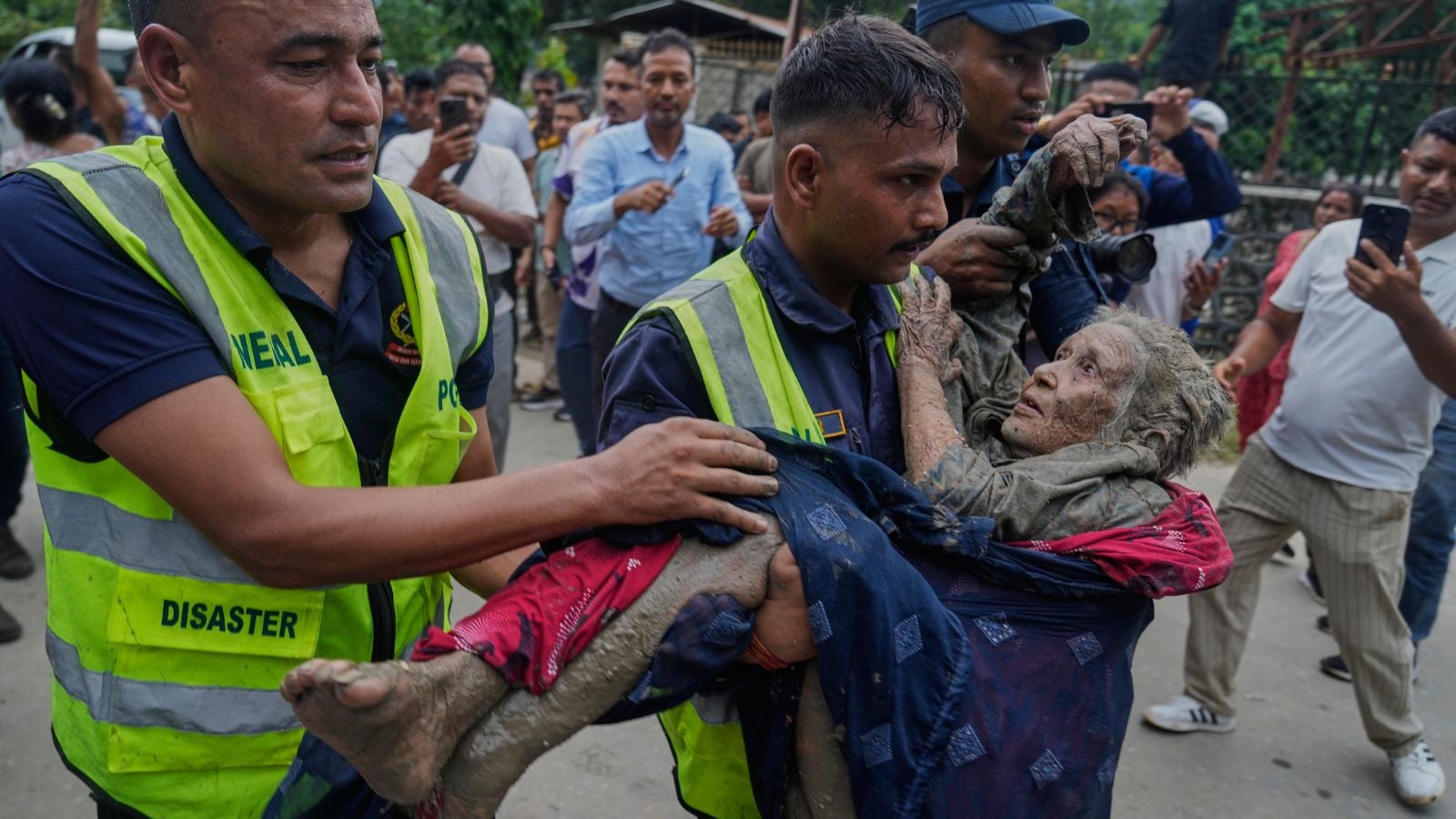
When an unseasonal cloudburst hits, like the catastrophic floods and landslides that paralyzed parts of the country recently, the warning time is measured in minutes, not hours. A family sleeping in a stone-and-mud hut near a roaring stream has precious little time to grab an ox, a bag of rice, and a child before the hillside collapses.
In these moments, the invisible machinery of the state becomes painfully visible.
Where are the early warning sirens? Are the weather stations powered and maintained, or did the battery die because a local committee forgot to allocate a twenty-dollar maintenance budget? Are the evacuation routes clear, or did a politically connected developer build a warehouse over the drainage path? Is the disaster relief fund sitting in a bank account in Kathmandu, tied up in triple-layered bureaucratic red tape while stranded villagers wait on roofs for a helicopter that might never come?
These are not theoretical policy questions. They are life-and-death variables in a cruel equation.
The old guard is watching closely. They are waiting for the rapper to trip. They are sipping tea in the courtyards of Patan, whispering about how street poetry does not translate to fiscal policy, how urban street fights do not prepare you for international climate diplomacy or negotiating disaster relief funds with the World Bank. They are hoping the floods wash away his credibility, proving that the system cannot be fixed by an outsider with a loud voice.
They misunderstand the hunger of a generation.
The young people who put Balen and leaders of his ilk into positions of authority are not expecting miracles. They know the Himalayas are crumbling. They know the global carbon footprint of Nepal is a rounding error compared to the industrial giants of the world, yet Nepal pays the steepest price for a crisis it did not create. They know the structural deficits run deep, carved into the very DNA of a post-conflict nation still trying to find its footing.
What they want is not perfection. They want effort that feels honest. They want leaders who sweat, who show up in the mud with muddy boots instead of stepping out of a bulletproof Land Cruiser with a designer umbrella held by an aide. They want a government that treats a landslide not as an act of God to be shrugged off with a prayer, but as a logistical failure to be investigated, mitigated, and prevented next time.
Consider the metaphor of the engineer.
Before he ever touched a rhyming dictionary, Balen studied structural engineering. He spent years looking at load distributions, shear forces, and the way concrete behaves under stress. He understood that a building does not collapse because of a single bad brick; it collapses because the overall design ignores the fundamental laws of physics.
Society is no different.
The political infrastructure of Nepal has been overloaded for generations. It has been subjected to earthquakes, civil war, political instability, and now, the compounding brutality of climate change. The old foundations are cracked. The mortar is crumbling.
You cannot fix that with a catchy slogan or a well-timed press release. You have to get your hands dirty. You have to dig down into the cold, wet earth, find where the rot begins, and rebuild it from the bedrock up, even if the work is unglamorous and nobody is filming it for social media.
The rain continues to fall over the Kathmandu Valley. The lights of the city flicker against the darkening hills, tracing the contours of a sprawling, chaotic metropolis that refuses to stop growing. Somewhere out there, in a government office lit by emergency generators, a former rapper is staring at radar maps, watching the red blobs of storm cells creep across the border from India.
The microphones are gone. The crowd is silent. There is only the roar of the river, the weight of the mountains, and the test that decides whether the song was worth singing at all.