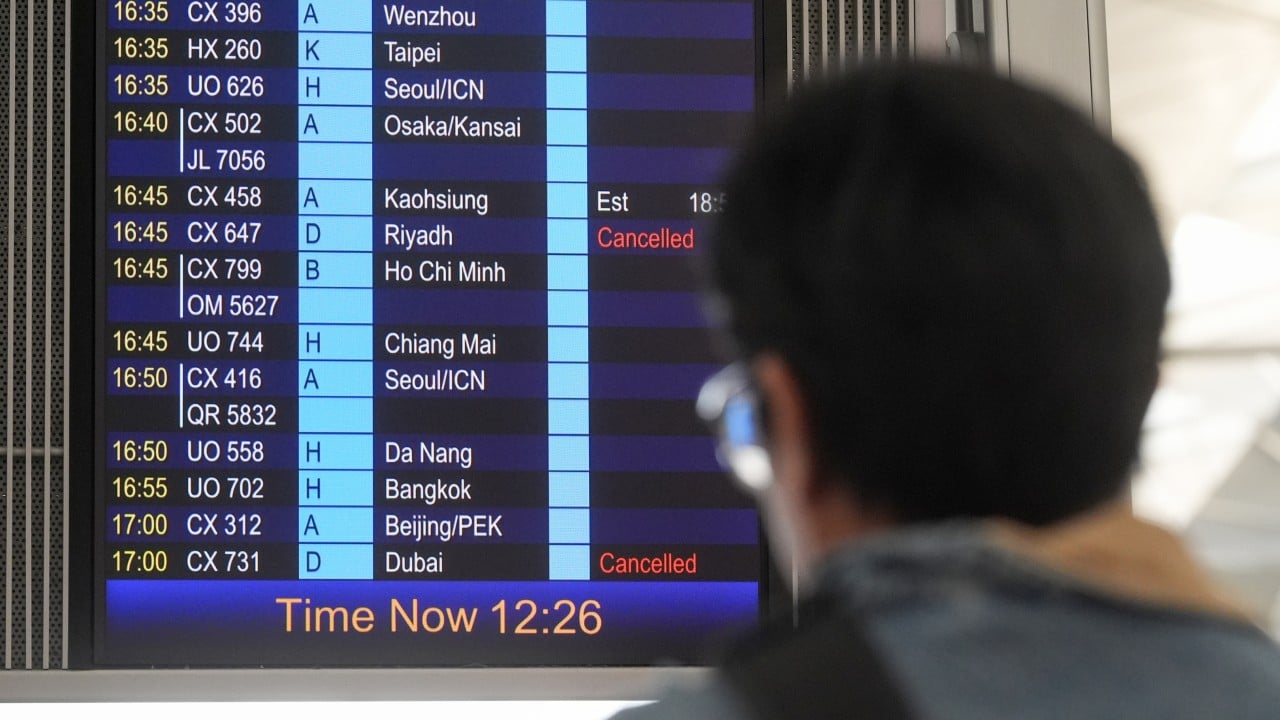
The air inside Dubai International Airport doesn’t feel like air. It feels like a product—chilled, filtered, and scented with the faint, expensive musk of duty-free oud and high-end espresso. For the thousands of travelers pulsing through its terminals every hour, it is a transit hub. For a growing cluster of stranded Hongkongers, it has become a purgatory.
Imagine a man named Adrian. He is not a real person, but he carries the very real weight of the three hundred people currently watching their battery percentages tick down in terminal lounges across the Middle East. Adrian was supposed to be home two days ago. He has a performance review on Monday in a glass tower in Central. His cat is being watched by a neighbor who only agreed to stay until Friday. His reality is now a flickering blue monitor that keeps whispering the same word: Cancelled.
The logistics of global travel are a delicate clockwork. When a gear jumps in the Middle East—due to sudden airspace closures, regional instability, or the abrupt rerouting of international corridors—the echoes are felt instantly in the wallets and heartbeats of those caught in the crossfire.
The Mathematics of Desperation
When a flight is scrubbed, the initial reaction is usually a spike of adrenaline. You rush to the counter. You join the queue. You believe, perhaps naively, that being first in line matters. But as the hours stretch into a second day, that energy curdles into a heavy, rhythmic exhaustion.
The numbers are cold. A single wide-body jet carries roughly 350 passengers. When three flights are grounded, over a thousand people are suddenly competing for a handful of standby seats on the next available departure. This is not a fair fight. It is an algorithmic lottery where the winners are determined by frequent flyer status, ticket class, and the sheer luck of being at the front of a digital refresh cycle.
Consider the financial hemorrhage. A last-minute economy seat from Dubai or Doha to Hong Kong, if you can find one, can easily swing from $6,000 to $25,000 HKD. For a family of four, that isn't just a travel hiccup. It is a wiped-out savings account. It is the price of a car or a year of university tuition, paid out in a moment of panic on a cracked smartphone screen.
The Invisible Stakes
We often talk about "stranded travelers" as if they are merely inconveniently placed. We ignore the invisible threads connecting them to their destinations. Among those waiting in the Middle East are people carrying more than just carry-on luggage.
There is the daughter trying to return for a funeral, watching the window of a final goodbye slowly creak shut. There is the small business owner whose inventory is stuck in a warehouse because the person with the signing authority is sleeping on a row of metal chairs in Terminal 3.
The psychological toll is a slow erosion. In the first twelve hours, you are an adventurer with a story to tell. By hour forty-eight, you are a ghost in a shopping mall. You start to resent the people walking briskly toward their gates. You watch the luxury watch displays and the mountains of gold jewelry in the duty-free section with a sense of profound absurdity. All the wealth in the world surrounds you, yet you cannot buy the one thing you need: a trajectory.
A Fragile Connection
Hong Kong is a city built on the premise of movement. Its identity is inextricably linked to the ease with which its people traverse the globe. When that movement stops, a fundamental part of the Hong Kong psyche begins to fray.
The current situation in the Middle East highlights a terrifyingly simple truth: our connectivity is a privilege, not a right. We have grown used to the idea that the world is a small, accessible map. We click a button, we board a tube, and we emerge on the other side of the planet. But that map is drawn over a landscape of shifting geopolitics and fragile corridors.
When those corridors close, the geography of the world reasserts itself with a vengeance. Suddenly, the six thousand kilometers between Dubai and Chek Lap Kok feel like an ocean that cannot be crossed. The digital age promised us the death of distance, but for those sleeping on their coats in a desert airport, distance has never felt more alive.
The Sound of a Refresh
The most haunting sound in an airport isn’t the roar of engines. It is the collective, soft thwip of hundreds of fingers swiping down on smartphone screens, refreshing airline apps in unison. It is a silent prayer to a server farm in some distant city, begging for a green checkmark or a "Confirmed" status.
Stranded travelers describe a phenomenon of "gate drifting." You find yourself walking toward the gate where your flight was supposed to be, just to stand in the space. You look for staff who might have a secret update, a hidden stash of seats, or even just a crumb of empathy. Usually, you find overworked ground crew who are just as trapped in the bureaucracy as you are.
They offer meal vouchers. Seven dollars for a sandwich that costs twelve. A bottle of water. A thin, scratchy blanket that smells of industrial laundry detergent. These are the bandages offered for a wound that requires surgery.
The Weight of the Return
Eventually, the planes will fly. The backlog will clear. The "Adrian" of this story will eventually feel the humid, heavy air of Hong Kong hit his face as he steps out of the airport into a waiting taxi. He will pay the neighbor, feed the cat, and apologize to his boss.
But something changes when you are truly stranded. The next time you book a flight, you won’t just look at the price or the layover time. You will look at the map. You will see the borders, the flight paths, and the precariousness of the lines connecting A to B. You will remember the feeling of being a non-citizen of a terminal, a person whose entire life was reduced to a booking reference number that wouldn't validate.
The lights in the terminal never turn off. They stay at a permanent, aggressive noon, erasing the transition of days and nights until time itself becomes a flat, gray sea. You wait for the one notification that matters, the one that tells you that you are no longer a guest of the airport, but a person with a home.
Behind every "cancelled" status on a flight board is a person whose life has been placed on an indefinite pause. We like to think we are the masters of our journeys, but sometimes, we are just passengers waiting for the world to let us move again.
The screen flickers.
The finger swipes down.
The circle spins.