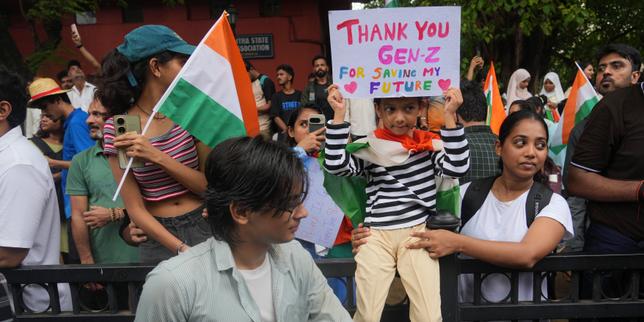
Foreign commentary loves a neat, exotic storyline. Western desks look at South Asia through a sepia-toned lens of ancient traditions colliding with modern friction, desperate to find the next big youth uprising that will shake a regime. They read about youth movements nicknamed after insects—the "cafards" or cockroaches—and immediately reach for tired templates of Arab Spring style revolutions.
It is lazy journalism. It is worse than that; it is a fundamental misread of how power, ambition, and generational momentum actually operate in contemporary India. For a different look, consider: this related article.
The conventional narrative insists that an organized, radicalized cohort of young citizens is rising up to fracture Narendra Modi’s political dominance. Analysts point to joblessness, digital mobilization, and street protests as the ingredients of an impending collapse. They treat youth discontent as a monolith.
They are wrong. Similar insight on this matter has been published by Associated Press.
Youth frustration in India is real, but it is not translating into a unified ideological crusade to unseat the current administration. Instead, it is atomized, transactional, and deeply entrepreneurial. The kids on the street do not want to overthrow the system; they want a better seat at the exact same table.
The Myth of the Monolithic Youth Revolt
Let us dismantle the core fallacy: the idea that young Indians share a collective political consciousness opposed to the ruling party.
When you look at demographic data across Uttar Pradesh, Maharashtra, or Bihar, you see a massive cohort aged eighteen to thirty facing genuine economic pressure. Official metrics on employment tell a story of fierce competition for government posts and underemployment in the private sector. Western outlets see this pressure cooker and assume an explosion is inevitable.
I have spent years watching political consultants and foreign correspondents project their own ideological desires onto foreign soil. They look for the "resistance." They want heroes and villains.
The reality is far more clinical. Young Indians are not ideological purists. They are pragmatic operators navigating a hyper-competitive meritocracy. The same young person protesting an exam irregularity on Tuesday will happily vote for developmental governance on Sunday because their primary concern is upward mobility, not abstract democratic theory.
Contestation exists, yes. But it is decentralized, issue-specific, and remarkably devoid of the grand ideological anchors that foreign analysts project onto it. Calling them cockroaches or treating them as a cohesive insurgent army is a projection of wishful thinking from observers who miss the baseline motivations of the demographic.
The Economics of Aspiration Versus Protest
To understand why this youth wave will not topple Modi, you have to look at the shifting nature of economic aspiration.
Traditional protest movements rely on shared deprivation creating shared solidarity. In India today, digitization has created a hyper-individualized race for status. The gig economy, digital content creation, startup culture, and localized entrepreneurialism have fractured the collective grievance.
When a twenty-two-year-old in Tier-2 cities like Indore or Jaipur can build a digital storefront, trade micro-stocks, or hustle for freelance gigs, their horizon changes. They are not waiting for a revolution; they are building side hustles.
[Traditional Grievance] ---> [Individual Digital Hustle] ---> [Pragmatic Alignment]
This creates a paradox for opposition parties. You cannot organize a sustained political movement against an incumbent when your target demographic's primary energy is absorbed by micro-capitalism. The hustle culture eats political radicalism for breakfast.
Modi’s machinery understands this transactional reality better than anyone else. Infrastructure delivery, digital public goods like UPI, direct benefit transfers, and targeted welfare have institutionalized a direct line between the state and the citizen. The youth do not rely on local middlemen to access resources anymore. That digital plumbing has bypassed traditional political patronage networks.
When you remove the middleman, you remove the traditional grievance vector that local opposition movements used to exploit.
The Opposition Trap
The fundamental weakness in the anti-Modi youth narrative is the complete bankruptcy of the alternative.
You cannot beat something with nothing. The opposition parties attempting to harness youth anger are relics of dynastic politics, offering tired slogans from the past century to a generation plugged into global real-time information flows.
Young Indians see through the hypocrisy instantly. They spot the contradiction between elite politicians lecturing about equality while practicing hereditary nepotism. The mismatch between what the opposition preaches and how they operate internally is glaring.
When the alternative to a dominant leader is a coalition of fractured regional barons holding onto fading influence, young voters make a cold calculation. They choose stability and national projection over chaos and coalition paralysis.
That is not blind devotion. That is risk management.
The Uncomfortable Truth About Digital Mobilization
Western observers love to credit social media algorithms with sparking uprisings. They see a viral hashtag or a trending protest video and declare a paradigm shift.
It is a surface-level diagnosis.
Digital networks amplify noise far more effectively than they build institutions. A viral moment of youth anger can paralyze a news cycle for forty-eight hours, but it leaves no infrastructure behind. It lacks the staying power of a deep-rooted organizational apparatus.
The ruling party’s digital wing is not just a reactive PR machine; it is a persistent, data-driven narrative engine that operates year-round, long after the cameras leave the protest site. While opposition-leaning youth groups organize episodic outbursts, the incumbent builds permanent digital communities anchored in identity, national pride, and economic hope.
You cannot out-tweet a disciplined ground operation backed by state resources and relentless execution.
Why the Current Strategy Fails
If you are waiting for a youth-led movement to crack the foundation of the current Indian political setup, you will be waiting indefinitely.
The strategy of banking on youth unemployment as a silver bullet for regime change ignores how human psychology responds to scarce resources. Under severe competition, people become more protective of stability, not more reckless. They fear disruption because they have too much to lose in the scramble.
The commentators writing these breathless articles about impending youth revolutions are projecting Western campus politics onto a developing superpower. They want India to fit their neat ideological categories.
It does not.
India’s youth are rewriting the rules of political engagement, but they are doing it through pragmatism, digital hustle, and transactional voting. They are not falling for romanticized rebellions because they are too busy trying to win the game as it is currently played.
Stop looking for the spark that will burn the house down. The kids are too busy remodeling the kitchen.