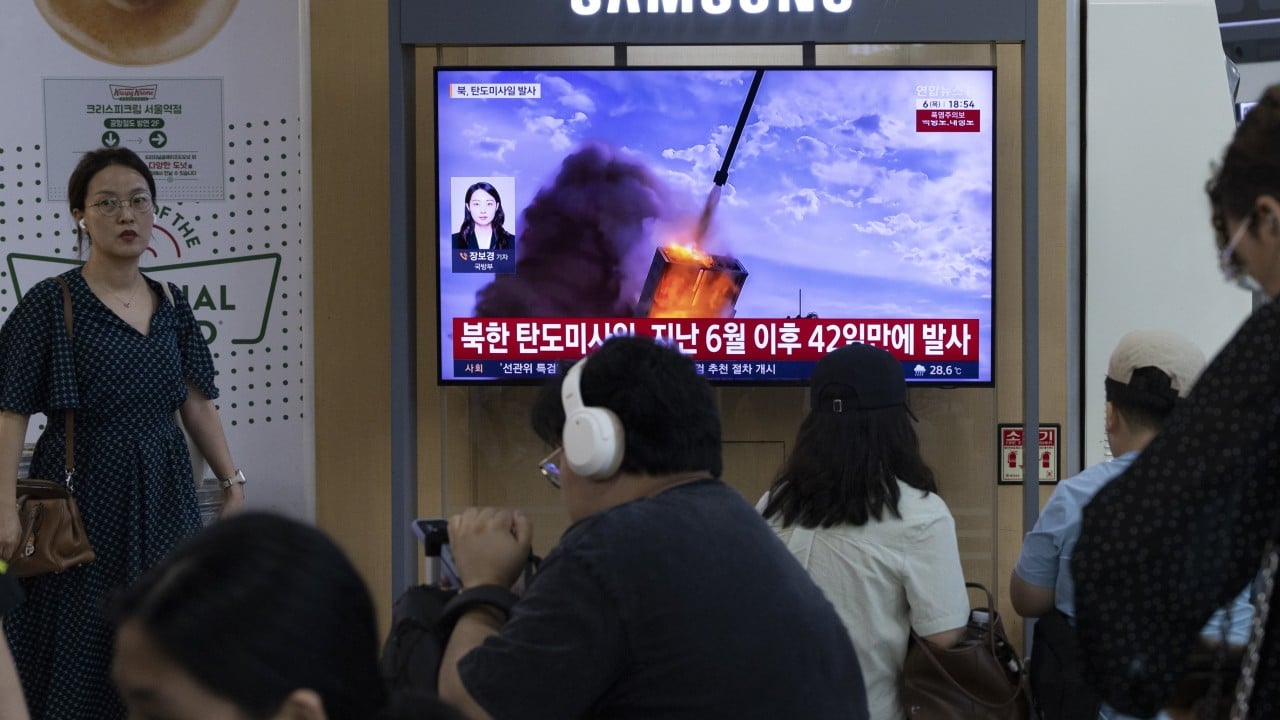
Dawn in Seoul arrives with a particular kind of grey. It is not the soft, cinematic mist of poetry books, but a heavy, functional shroud born of rising concrete, exhaust, and the quiet breathing of ten million souls waking up to another Tuesday. Min-jun stands by his kitchen window on the fourteenth floor, a ceramic mug of steaming barley tea warming his palms. He listens.
Down on the street, the subway doors slide shut with their familiar pneumatic sigh. Traffic pulses along the expressway, a steady ribbon of red and white taillights. Everything is ordinary. Perfectly, stubbornly ordinary.
Then, a low murmur rolls across the city's digital nervous system.
Smartphones buzz in unison. Not a single phone, but thousands. A national alert banner flashes in sharp, urgent red across pocket screens. It is a text message from the government, stripped of pleasantries and bureaucratic cushion. North Korea has fired an unidentified projectile off its eastern coast.
Min-jun looks down at his tea. The surface of the liquid doesn't ripple. The world does not end. The subway cars keep moving. But the air in the room suddenly feels thinner, stripped of oxygen by a silent weight that descends every single time the sky becomes a question mark.
We live in an era where geography is often measured in milliseconds and launch telemetry. We talk about ballistic missiles, trajectories, ranges, and payloads as if they were abstract variables in a high-stakes geopolitical equation played out in sterile conference rooms. But equations do not have heartbeats. Missiles do not land in spreadsheets. They land in oceans that fishermen navigate, in airspaces shared by commercial airliners, and in the collective consciousness of a populace that has learned to live with a loaded gun pointed at its backyard for seventy years.
Consider what happens next in living rooms from Mapo-gu down to the southern port of Busan.
Conversations pivot instantly. Morning small talk about weather or office politics evaporates. Colleagues at a downtown tech startup stare at a browser tab refreshing a live feed from Seoul's joint chiefs of staff. They are waiting for numbers. Was it short-range? Medium-range? Did it arc high into the stratosphere before plunging back down into the cold waters of the Sea of Japan, or did it trace a flatter, more menacing line?
Every launch is a message written in fire.
To understand the rhythm of tension on the Korean Peninsula, one must abandon the illusion of sudden surprise. This is not a sudden storm out of a clear blue sky. It is a climate. Generations have grown up memorizing the sound of air-raid shelter signs, participating in civil defense drills where children march in single file into concrete basements, and watching news anchors report on military provocations with the weary professionalism of weather forecasters predicting rain.
Yet familiarity does not breed safety. It breeds a different kind of exhaustion.
When military analysts in Washington or Tokyo look at an "unidentified projectile," they see data points. They run radar tracks. They calculate burn times and apogees. They debate whether this latest test is a technical milestone for solid-fuel engines, a response to joint military exercises, or a domestic signal designed to project strength inward to a starving population.
But for the shopkeeper in Sokcho, gazing out toward the northern horizon where the demarcation line cuts through land and water alike, the analysis is visceral. It is about the price of real estate, the hesitation of foreign investors, and the unspoken, nagging question that everyone thinks about but rarely speaks aloud: Will today be the day the threshold is crossed?
The architecture of modern deterrence rests on a terrifying paradox. Both sides are locked in an embrace of mutual caution, built upon mountains of conventional and strategic weaponry. Every rocket lofted into the upper atmosphere is an argument in a deadly dialogue, a way of shouting across a chasm without picking up a telephone.
Diplomacy has stalled and restarted so many times that the tracks are worn smooth. Summits with handshakes and bright lights give way to stony silence, which gives way to the roar of a rocket engine on a desolate launchpad near the coast.
Night falls over Seoul. The grey morning has given way to a neon dusk. Skyscrapers blaze with corporate logos, casting long, electric reflections on the asphalt. Min-jun walks home from the subway station, stepping past couples sharing street food and students laughing over shared textbooks.
The alert on his phone has long since faded into the notification history. The headlines on international news sites have already begun to shift downward, replaced by earnings reports and celebrity gossip. The world has moved on to the next crisis, the next election, the next breaking story.
The projectile is gone, swallowed by the sea.
Yet the horizon remains where it was—split open, waiting for the next whisper of fire.


