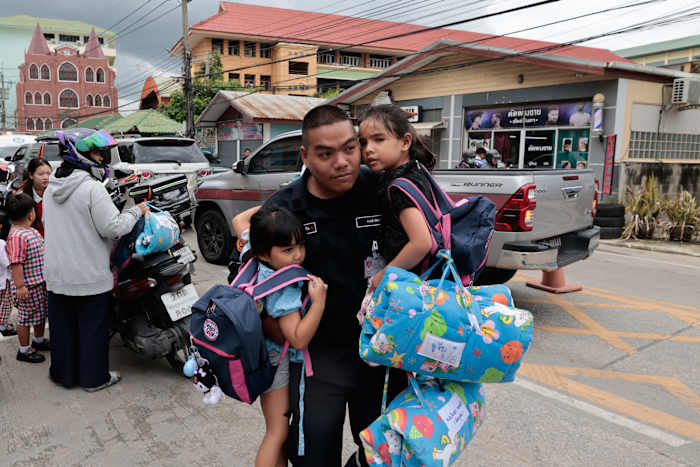
Morning in the outer arteries of Bangkok rarely begins with silence. It arrives in waves of sound: the sharp, metallic whine of two-stroke motorcycle engines, the rhythmic clatter of street-vendor woks, and the low, heavy hum of commuter traffic inching along concrete overpasses. The air always tastes faintly of exhaust and charcoal.
Except for the mornings when the world breaks.
Two recent bursts of gunfire near the capital changed the baseline music of daily life. They punctured the urban rhythm, leaving behind a cold, heavy stillness that no amount of morning traffic could drown out. Two deadly shootings within close proximity to the nation’s political and economic heart struck a nerve. They forced a quiet, terrifying realization into the public consciousness: the safety net had frayed.
In response, the Thai government ordered an immediate, sweeping review of its gun control laws. Bureaucrats gathered in air-conditioned rooms. Spreadsheets opened. Statistics blinked from high-resolution monitors.
Yet, numbers on a screen fail to capture the sound of a classroom going utterly dead silent. They do not measure the weight of an empty chair at a dinner table. To understand why this legislative pivot matters, we have to look past the bureaucratic jargon and step directly into the lives of the people who walk these streets every single day.
The Anatomy of an Ordinary Morning
Consider Somchai, a fictional shopkeeper whose real-world counterpart exists on every corner of the capital. (This hypothetical scenario illustrates the daily reality of urban vulnerability.) Somchai runs a modest open-front noodle shop just thirty minutes outside central Bangkok. He wakes at four. By five, the broth is simmering, infused with star anise, cinnamon, and pork bones. By six, the school uniforms arrive—neatly pressed white shirts and dark skirts, worn by children laughing over shared iced teas.
Somchai does not think about national firearms policy while he slices tender pork belly. Why should he? Thailand is a country celebrated for its warmth, its smiles, and its deep cultural aversion to open confrontation.
Yet, beneath that cultural veneer, a dangerous undercurrent has been growing. It is a quiet convergence of legal accessibility, black-market leakage, and online subcultures trading in weapons and violence. When gun laws are lax or poorly enforced, safety becomes an illusion maintained only by luck.
And luck runs out.
When the news alerts flashed across smartphone screens detailing the twin tragedies near Bangkok, Somchai stopped chopping. He looked out at the children eating their noodles. The laughter felt brittle suddenly, like dry leaves underfoot. He realized, with a sickening drop in his stomach, that the sanctuary of his neighborhood was porous.
The Policy Labyrinth
To grasp the magnitude of the government's current review, we must confront the uncomfortable mechanics of how firearms enter circulation in Southeast Asia's second-largest economy.
Statistically, Thailand possesses one of the highest rates of gun ownership in the region. Many weapons are legally acquired for personal protection, sport, or agricultural defense. But the dividing line between a legally registered firearm and an illegal weapon traded in the shadows has always been dangerously thin.
Consider how the system leaks.
- Legal permits can sometimes be obtained through loopholes, lax background checks, or administrative oversights.
- Factory-made firearms occasionally slip out of official supply chains into the black market.
- Modified blank-firing guns—easily converted into lethal weapons using basic tools—have flooded online marketplaces, evading traditional customs checks.
For years, the policy response was reactive. A high-profile incident would occur. Officials would express shock. Promises of reform would echo through the press boxes. Then, the news cycle would shift, the momentum would dissipate, and the status quo would quietly reassert itself.
The Thai government's recent directive signals a desperate pivot away from this cycle of complacency. Prime and ministerial voices have called for tightening background checks, strictly auditing existing licenses, cracking down on online trafficking of modified blanks, and recalling weapons from owners who pose a proven danger to society.
It is a monumental task. It requires untangling decades of administrative inertia, confronting powerful vested interests, and closing digital-age loopholes that nineteenth-century laws never anticipated.
Walking the Tightrope of Reform
Change is rarely comfortable. When a state moves to restrict access to tools of destruction, it triggers fierce pushback from lawful gun owners who argue that punishing responsible citizens does nothing to stop criminals who ignore the law entirely.
There is a raw, honest truth in that argument that cannot be simply dismissed. A criminal does not apply for a permit. A disturbed individual bent on destruction does not care about licensing fees or registry updates.
This is the central paradox of gun control that haunts lawmakers from Bangkok to Chicago. If you tighten the screws too much, you alienate hunters, sport shooters, and business owners who rely on self-defense in isolated areas. If you keep them loose, you leave the back door wide open for tragedy.
To navigate this tightrope, the government’s review cannot rely solely on bans and restrictions. It requires a holistic cultural shift. It demands investment in mental health infrastructure, early intervention programs for troubled youth, and ruthless law enforcement targeting the illicit networks that supply the black market.
We have to admit something difficult: the state failed to protect those victims near Bangkok. Acknowledging that failure is the mandatory first step toward redemption.
The Invisible Stakes
Why does this matter to a traveler sipping coconut water in Silom, or a corporate worker rushing to an office in Sukhumvit, or a mother packing lunchboxes in Nonthaburi?
Because safety is the invisible oxygen of modern life. You do not notice it until it is gone.
When gun violence shatters the fragile peace of a community, the shockwaves travel outward. Tourism stutters. Foreign investment hesitates. Citizens eye strangers on the skytrain with a new, guarded suspicion. The social contract—the unspoken agreement that we can walk our streets without fear of sudden, catastrophic violence—is breached.
When the government orders a gun control review, it is not merely updating a regulatory handbook. It is attempting to stitch that social contract back together.
The process will be messy. It will face bureaucratic delays, political posturing, and fierce public debate. Critics will say it is too much. Victims' families will say it is not nearly enough.
Yet, the alternative—returning to the comfortable slumber of indifference—is no longer an option.
The Final Chord
Evening returns to Bangkok. The air cools just enough to make the city bearable. Neon signs flicker to life along the canals, casting long, bruised ribbons of pink and green across the dark water.
In a quiet apartment overlooking the Chao Phraya River, a mother sits at her kitchen table, staring at a completed homework assignment left behind by a child who will never grow up to finish high school. No government decree, no policy review, and no legislative amendment can rewrite that loss.
Across the city, in government offices, the lights burn late into the night. Papers rustle. Keyboards click. The heavy machinery of state reform grinds forward, slow and reluctant, trying desperately to catch up to a reality that has already broken our hearts.
The smoke clears. The city breathes. And the work begins.