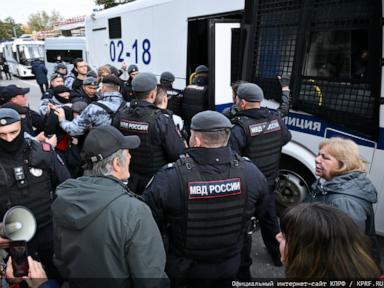
Dozens of demonstrators were detained in central Moscow during a rally organized by the Communist Party of the Russian Federation, a political faction that has long operated as the designated opposition within the Kremlin's tightly managed political architecture. The sudden police intervention against a party traditionally viewed as compliant highlights a shifting tolerance threshold within the state apparatus. Observers and political analysts note that even loyalist factions face tightening constraints as authorities move to suppress any unauthorized public assembly, regardless of its ideological alignment or historical loyalty to the ruling establishment.
The arrests occurred near the center of the Russian capital where party members and supporters had gathered to lay flowers and stage a public demonstration. According to statements released by the Communist Party leadership, law enforcement officers intervened swiftly, detaining numerous participants and several prominent figures associated with the movement. The heavy-handed response stunned organizers who anticipated a degree of institutional immunity given the party's status in the State Duma, where it functions as the primary systemic alternative to United Russia.
Understanding this sudden friction requires examining the fragile equilibrium that has defined Russian domestic politics for decades. The Communist Party occupies a unique niche within the political ecosystem. It provides a pressure valve for voters dissatisfied with the ruling party, channeling anti-establishment sentiment into institutional politics rather than disruptive street movements. In exchange for this stabilizing role, the party receives state-sanctioned media access, legislative representation, and a degree of latitude in its public rhetoric. However, that arrangement comes with unwritten boundaries. Public gatherings that slip outside official coordination or threaten to mobilize genuine, unscripted political energy are treated with immediate suspicion by security services.
The crackdown exposes the vulnerability of systemic opposition in an increasingly authoritarian climate. When the state prioritizes total control over public space, traditional privileges extended to loyalist factions can evaporate overnight. The Communist Party leadership finds itself in an awkward bind. To maintain its core base of older, nostalgia-driven voters, it must periodically project strength and criticism of economic hardships. Yet any display of real grassroots mobilization triggers alarms within the presidential administration, which views all unmanaged crowds as potential security risks.
Security apparatuses in Moscow operate under a mandate that leaves little room for nuance. The Federal Security Service and the Ministry of Internal Affairs view public order through a zero-tolerance lens. A gathering of fifty people can transform into a headline-generating security incident if the optics disrupt the carefully curated image of national unity. By hauling away veteran party members and local activists, authorities sent an unmistakable signal to every political faction in the country. No organization, no matter how cooperative or institutionalized, is exempt from the iron rule prohibiting independent public mobilization.
The fallout from these detentions extends far beyond the immediate legal troubles of the arrested individuals. It forces a reassessment within the Communist Party ranks regarding their long-term utility to the regime. If participation in systemic politics no longer guarantees immunity from police vans, the incentive to play by the Kremlin's rules diminishes. At the same time, the party lacks the structural capacity or the inclination to launch an open revolt, meaning it will likely issue formal protests, demand explanations from the prosecutor general's office, and ultimately fall back into line.
For the broader political landscape, the incident underscores the narrowing margins of acceptable public discourse in Russia. The space for tolerated dissent is contracting into near-total invisibility. As the state tightens its grip on domestic stability, even the illusion of a vibrant, multi-party opposition is proving difficult to maintain. The arrests in Moscow are not merely a local police action against a group of demonstrators; they are a symptom of a political system that can no longer afford even its most loyal critics speaking out of turn in the public square.