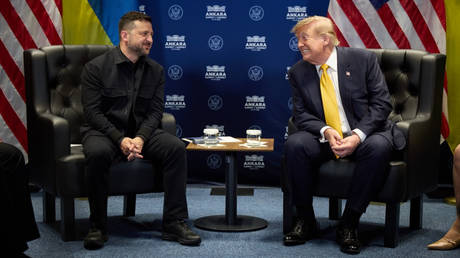
Foreign policy rarely shifts through quiet diplomatic notes or carefully scrubbed communiques. It moves through abrupt, jarring demands made behind closed doors, away from the television cameras of international summits. When reports surfaced that Donald Trump had urged Ukrainian President Volodymyr Zelenskyy to fly directly to Moscow for a face-to-face summit with Vladimir Putin, the immediate reaction in Kyiv was absolute fury.
To the administration in Kyiv, the suggestion was not merely an undiplomatic gesture. It was an insult wrapped in political theater. Yet behind the theater lies a stark, unvarnished reality about how the White House intends to wind down Europe's bloodiest conflict since 1945. Washington is no longer pretending that a total military victory on Ukraine's terms remains a viable objective. Instead, the diplomatic machinery is shifting toward forced compromise, and the messaging coming out of American intermediaries is designed to break Kyiv's psychological resistance to direct capitulation.
The proposal itself, floated during the United Nations General Assembly in New York, reveals the profound disconnect between American transactional politics and European existential survival. For Washington, the war is an administrative leak that needs plugging, a drain on resources and political capital that interferes with broader geopolitical balancing acts against Beijing. For Moscow, the demand that Zelenskyy come to the Russian capital is an old imperial play. It is a requirement designed to project submission, forcing an adversary onto home turf to visually cement a hierarchy of power.
Zelenskyy's explosive off-camera retort—telling reporters he would visit Moscow only "on a rocket"—was raw anger, but it was also a desperate defense mechanism. He understands the trap. Stepping foot in Moscow on Russian terms would mean walking into a political execution chamber. It would signal the total abandonment of Kyiv’s core narrative: that it fights an unprovoked aggressor as an equal sovereign state backed by international law.
The Architecture of Coercion
To understand why Washington would even float such a toxic proposal, one must look past the public posturing and examine the financial and military pipelines feeding the front lines. Ukraine is operating under immense structural strain. Public debt exceeds the size of the national economy, state budgets rely entirely on foreign life support, and the domestic mobilization pool is severely depleted.
When American envoys like Steve Witkoff and Jared Kushner travel to secret meetings in the Kremlin and subsequently brief Ukrainian leadership at isolated European airfields, they do not carry pleasantries. They carry ledgers. The underlying message delivered to Kyiv is blunt: the checks have limits, the patience of the American electorate has a hard ceiling, and the battlefield map is calcifying into a permanent loss.
The suggestion that Zelenskyy meet Putin in Moscow was a pressure test. It was designed to measure how much fight remains in the current Ukrainian leadership and to test whether Kyiv can be bullied into accepting territorial concessions before the end of the year. By tossing out extreme propositions, the White House establishes a baseline of absurdity, making subsequent demands—such as freezing the current front lines or ceding administrative control over the Donbas—look like reasonable compromises by comparison.
The Kremlin's Calculus of Humiliation
Moscow understands the utility of this American impatience. The Kremlin has consistently insisted that any high-level summit must happen on Russian soil, wrapped in Kremlin-provided security guarantees. This is not a logistical preference; it is a strategic requirement.
Vladimir Putin does not need a peace agreement right now because he believes time is working in his favor. The Russian defense industrial base has adapted to sanctions far more effectively than Western analysts predicted two years ago. Missile stockpiles are recovering, manpower is being replenished through lucrative contracting incentives, and political fatigue across Western Europe is fracturing the united front that Kyiv relies upon.
By demanding that Zelenskyy make the pilgrimage to Moscow, the Kremlin aims to achieve politically what its military failed to accomplish in the opening weeks of the invasion: the total humiliation of the Ukrainian state. A meeting in the Russian capital would transform the conflict from a war of national defense into a domestic political crisis for Kyiv. It would trigger an immediate backlash from Ukraine's nationalist and military hardliners, who view any engagement on Russian terms as treason.
The European Blind Spot
While Washington pushes for a rapid settlement and Moscow waits out the clock, European capitals find themselves sidelined, scrambling to maintain relevance in a negotiation framework dictated entirely by superpowers. European leaders understand that a frozen conflict on their eastern border leaves the entire continent vulnerable to future Russian coercion. Yet Europe lacks the military independence and the fiscal unity to present a credible counter-strategy.
When diplomats whisper about trilateral formats or technical-level working groups meeting in neutral venues like Switzerland or Turkey, they are papering over a profound structural vacuum. Neutral venues imply a balance of power that simply does not exist on the ground. The military initiative remains constrained by shortages, communication disruptions on the front lines, and the quiet tightening of restrictions on advanced satellite and drone capabilities provided by Western partners.
The Breaking Point Ahead
The fallout from the leaked Bloomberg report goes far beyond a diplomatic faux pas. It exposes the reality that Ukraine’s partners are actively planning for the endgame, and that endgame does not include the recovery of all lost territories.
Zelenskyy’s administration is caught in an impossible bind. To reject American pressure outright risks losing the financial and intelligence lifelines that keep the state functioning. To accept American pressure means signing off on a partition of the country that will destroy the political legitimacy of the current government.
The demand to travel to Moscow was never a serious diplomatic roadmap. It was a signal flare indicating that the rules of the game have changed. The illusions of total victory are being stripped away one harsh meeting at a time, leaving behind the cold mechanics of power politics where smaller nations are expected to absorb the cost of great power fatigue. As the diplomatic pressure intensifies ahead of upcoming international summits, the question is no longer whether Kyiv will negotiate, but how much of its sovereignty it will be forced to leave on the table.


