The coffee was still hot when the sound started. It did not sound like thunder. Thunder rolls across an open sky, wide and majestic, shaking windowpanes before dying away in a lazy rumble. This was different. This was a tearing sound, heavy and low, like the tearing of thick canvas stretched to its absolute breaking point, followed immediately by a rhythmic, bone-deep thumping that made the floorboards chatter against the nails.
Mateo didn't wait to finish his cup. He stepped out onto the narrow front porch of his hillside home overlooking the eastern perimeter of Santiago, squinting against the slate-gray morning drizzle. Up above, where the green foothills of the Andes usually sharp-clipped the skyline against the clouds, the mountain looked wrong. The familiar geometry of scrub brush and jagged rock had smeared. A brown tongue of earth, slick and glistening with slurry, was sliding down the ravine with terrifying composure.
Gravity does not negotiate. It simply collects what is owed.
We live our lives under the quiet assumption that the earth beneath our feet is a permanent stage. We pave it, we build apartment blocks upon it, we draw blue lines of commerce across its contours, and we forget that mountains are not monuments; they are slow-motion avalanches waiting for a trigger. In Chile, that trigger is almost always water—too much of it, falling too fast, in places where the soil has forgotten how to drink.
Consider what happens when an atmospheric river stalls against a high-altitude wall of stone. The air warms. The snowpack, which should stay frozen and locked in place until spring melt, turns to slush. Then comes the rain. Not a gentle drizzle that feeds the garden, but a heavy, relentless hammering that saturates the loose scree clinging to the canyon walls. The soil becomes heavy. It turns to soup. And then, quite suddenly, the friction gives out.
By the time the wall of mud hit the valley floor below Mateo’s perch, it had gathered the weight of an oncoming freight train.
Down on the main thoroughfare, traffic had slowed to the miserable crawl familiar to anyone commuting through a modern metropolis in a storm. Commuters checked their phones, tapped fingers against steering wheels, and stared blankly at the red taillights of the car ahead. Among them was a public transit bus, idling with its interior lights casting a pale yellow glow against the rain-streaked windows. Passengers sat inside, tired, half-asleep, wrapped in heavy coats, lost in the private worlds of morning routines.
They had no idea that the hillside above them had broken loose.
In events like these, the human mind struggles to assign appropriate urgency. We are conditioned to expect disasters to announce themselves with sirens or flashing lights, giving us ample time to calculate an escape. But a debris flow offers no preamble. It arrives as a thief in the night, stealing momentum, metal, and breath in a single compressed second.
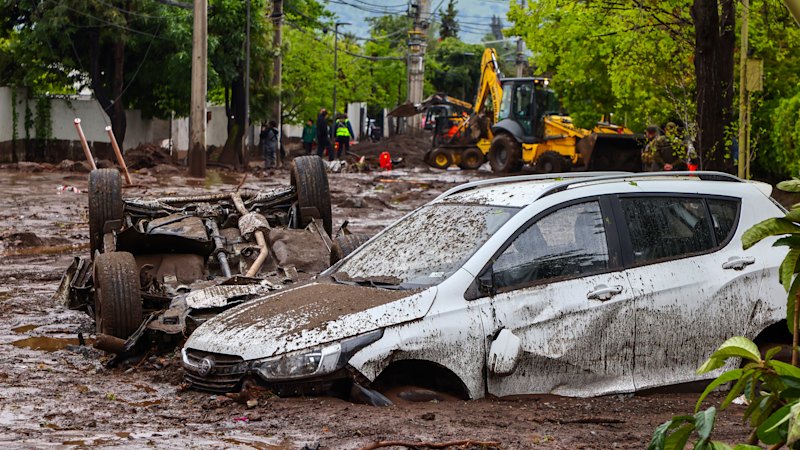
When the slurry crashed across the roadway, it acted less like water and more like wet concrete poured in a fury. It did not flow around obstacles; it picked them up. Sedan, SUV, transit bus—they became buoyant toys in a tide of liquefied stone. Mateo watched from his elevated vantage point as the headlights of the trapped vehicles suddenly pitched upward, danced crazily for a heartbeat against the dark wash, and then vanished beneath the brown surge as if swallowed by a giant throat.
The silence that followed the initial impact was heavier than the mud itself.
Emergency responders arrived with the grim efficiency born of tragic familiarity. Santiago is no stranger to the wrath of its magnificent, terrifying neighbor. The Andes tower over the city like a sleeping titan, providing life-giving water through glacial melt while continuously threatening destruction through aluviones—the sudden, violent mudslides born of deforestation, urban expansion, and extreme weather fluctuations.
Rescue workers waded into chest-deep slurry, their flashlights cutting erratic beams through the driving mist, searching for pockets of air inside submerged cabins, listening for the faint rap of a knuckle against glass. Every yard of mud cleared felt like moving a mountain with a teaspoon. Statistics would later record the tonnage of earth moved, the number of vehicles dragged hundreds of meters off course, and the miracle that the casualty count was not tenfold higher. But statistics are cold armor against the memory of a morning turned upside down.
We build our cities in the shadows of giants because beauty and water live there. We pave over ancient drainage paths because land is scarce and dreams are heavy. But every time the rain turns the mountain to mud, we are reminded of a humbling, unalterable truth.
The earth always wins in the end. We merely rent the space between storms.