The rain in the mountains does not fall as drops. It falls as weight.
You learn this early if you live in the folds of the Japanese archipelago, where the earth is never entirely still, always holding its breath beneath a thick quilt of cedar and cypress. Water arrives by the ton, driven sideways by winds that scream off the Pacific, turning dry creek beds into roaring flumes of gray mud within minutes. By the time the sky breaks open completely, the air smells of crushed pine and wet stone—the ancient scent of a world undoing itself. For an alternative look, check out: this related article.
Typhoon Dujuan did not arrive with a theatrical flourish. It crept in like an uninvited guest who had overstayed his welcome in the lower atmosphere, heavy with moisture and thick with intent. By the time the storm warnings began blinking red on television screens across Tokyo and the rural prefectures, the soil was already saturated. It had nowhere left to go.
Consider a hypothetical home nestled into a slope in Kanagawa, though it could just as easily be anywhere along the spine of the country. A single-story wooden house, generations old, smelling of tatami and old tea. Inside, the sound of the rain is absolute. It drums a frantic rhythm against the glass until the glass itself seems to hum. The inhabitants—an elderly couple who have weathered dozens of these tempests—sit quietly over green tea. They have seen typhoons before. They know the drill: shutter the windows, stock the pantry, wait for the fury to spend itself. Related analysis on this matter has been published by The New York Times.
Except this time, the mountain itself decided to move.
Landslides do not announce themselves with a polite knock. They arrive with a deep, subterranean groan, a sound that vibrates through the soles of your feet long before your eyes register the darkness collapsing against the windowpane. It is the sound of millions of tons of earth realizing it no longer has anything to hold onto.
When the mud wave hit, it moved with terrifying speed. In the span of a heartbeat, four lives were erased from the census registers of Japan, swallowed by the very slopes that had sheltered their families for decades. Rescue workers arrived later, boots sinking ankle-deep into slurry that smelled of rot and fresh stone, digging through the wreckage with shovels and bare hands while the sky continued to weep.
Statistics are cold things. Four dead. Dozens injured. Evacuation orders issued for hundreds of thousands. Numbers function as armor, protecting our minds from the raw, jagged edges of reality. But behind every digit in a casualty report is a pair of shoes left by the door, a half-finished book on a nightstand, a pot of tea growing cold on the stove.
Why do these disasters feel increasingly personal, even when viewed from thousands of miles away?
Because we all live on slopes of one kind or another. We build our lives atop foundations we assume are permanent, trusting the concrete, the zoning laws, the historical averages. We look at the map and see lines; nature looks at the map and sees gradients. When the rain falls faster than the earth can drink it, gravity reasserts its ancient monopoly.
Typhoon Dujuan serves as a brutal reminder of an old, uncomfortable truth: safety is an agreement, not a guarantee.
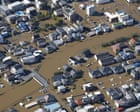
In the wake of the storm, the immediate response follows a familiar, rehearsed choreography. Sirens wail. Emergency broadcasts cut through the static. Volunteers in bright orange jumpsuits wade through knee-deep water, hauling inflatable rafts through residential streets that have abruptly transformed into brown rivers. The infrastructure holds where it can, and fails where the pressure exceeds human engineering.
Yet, the most profound story of these disasters is not found in the wreckage, but in the hours immediately following, when the rain finally relents and the clouds begin to tear apart, revealing patches of bruised blue sky.
People step out onto their porches. They look up at the stripped, bleeding face of the mountain where trees now lie tangled like broken matchsticks. They do not curse the sky. They do not scream at the wind. They pick up push brooms. They begin the heavy, quiet labor of washing the mud from the thresholds of their homes, bucket by bucket, gallon by gallon.
It is a humbling spectacle of resilience, stripped of bravado.
We are creatures of the edge, living on the thin green crust of a restless planet that occasionally remembers how to shake us off. The rain will return. The typhoons will form over the warm waters of the south, gathering their skirts of cloud and wind, marching inexorably toward the coast. The mountains will continue to weather, grain by grain, slide by slide.
And somewhere in the dark, beneath the steady drip of water from a ruined eaves trough, a hand reaches down to sweep the debris away, preparing to build again.