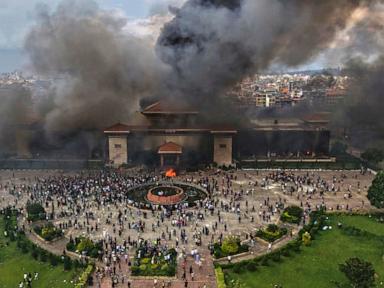
The tea in Kathmandu is always served too sweet, thick with buffalo milk and cardamom, drunk from small glasses that burn your fingers if you hold them wrong. In the old days, before the smoke cleared from the streets, that sweetness tasted like victory. People stood in crowds three deep outside tea stalls, watching small black-and-white televisions flicker with the faces of men who promised that the long winter was over. They had chased out the old guard. They had written words on paper about a new dawn.
Then the rain came.
Not the gentle, rhythmic monsoon that poets write about, but a dark, bruising deluge that turned the mountain passes into chutes of grey slate and slate into liquid glass.
Imagine waking up to find that the floor of your kitchen is no longer wood or tile, but a cold, sliding paste of your own garden. This is not a metaphor. For thousands of families in the valleys and the low-slung plains of the south, the monsoon of recent weeks did not arrive as weather. It arrived as an eviction notice served by gravity.
To understand what happened next, you have to understand the shape of a fragile state trying to stand upright while its knees are shaking. Nepal spent the better part of the last year locked in a slow-motion political wrestling match. Cabinets rose and fell like tide pools. Coalitions formed out of bitter necessity and dissolved over breakfast. While lawmakers argued over portfolios and procedural votes in chambers paneled in dark wood, the rivers were quietly filling up with silt.
Governments are abstract things until your roof leaks. Then they become very concrete, or very absent.
When the cloudbursts hit, the new administration found itself tested not by a vote of no confidence on the parliament floor, but by the sheer, unyielding physics of mud. Consider the Trishuli River. To look at it from a safe distance is to see a ribbon of churning chocolate; to stand beside it when the banks give way is to realize that water can behave like a hammer. Bridges that took decades to finance were snapped like dry twigs. Roads carved into the flanks of the Annapurna foothills simply vanished, leaving behind grey scars where asphalt used to meet sky.
And here lies the crucible for the administration.
When you inherit a country that has barely caught its breath from months of political turbulence, you do not get a honeymoon. You get a crisis. The prime minister’s office, newly occupied and still smelling of fresh paint and nervous sweat, suddenly had to pivot from coalition math to search-and-rescue logistics. Helicopters—old Russian-built machines that sound like ironmongery shaken in a bucket—began thrumming over the valleys at dawn, hauling people off rooftop islands while the brown water swirled around their ankles.
Why does this matter beyond the borders of the Hindu Kush? Because Nepal is the canary in the coal mine for a dozen developing democracies across the globe. It is a place where the machinery of modern governance is perpetually being built while the house is already on fire.
Let us walk down to the lowlands for a moment. The Terai. The flat, fertile plains bordering India where the heat sits on your shoulders like a wool blanket. Here, the rivers do not rush; they spread. They bleed out across paddy fields that were supposed to yield golden grain this autumn.
Sunil, a forty-two-year-old schoolteacher whose name I use to hold the weight of a hundred identical men I met along the highway, stood knee-deep in what used to be his grade-four classroom. The desks were piled in a corner like broken matchsticks, smeared with a slick grey grease that smells faintly of dead fish and diesel.
"They told us things would change," he said, wiping sweat and silt from his forehead with the back of a bare arm. He wasn't angry. Anger requires energy, and survival takes it all. He was simply tired. "The politicians in Kathmandu, they talk about federalism. They talk about reform. But when the water comes up to the window frames, you cannot eat a constitution."
His words sting because they are geometrically precise.
The political upheaval that preceded these floods was supposed to fix the plumbing of the state. For months, citizens watched as factional leaders traded ministries like trading cards, paralyzed by ambition while inflation chewed away at daily wages. The public grew furious, not just with any single party, but with the entire idea of political theater. They forced a reckoning. They brought in new faces, younger blood, independents who swore they would do things differently.
And then the sky opened.
The test of a government is never what it promises on a dry Tuesday in May. The test is what it does when the bridges are down, the phone lines are dead, and the relief trucks are stuck twenty miles back because the tarmac has slid into the abyss.
In the capital, the response was frantic. Emergency meetings ran past midnight under the harsh glare of fluorescent tubes. Ministers who had never managed anything larger than a municipal ward found themselves coordinating with the military, dispatching medical teams to cholera-prone districts, and begging international donors for tarps and dry rations.
There were failures, of course. Bureaucracy moves at the speed of a glacier, even when houses are washing away. In some remote mountain hamlets, villagers waited four days before the first red rotor blade appeared over the ridge. Four days of drinking water from streams fouled by landslide runoff. Four days of rationing handfuls of parched rice while listening to the hills groan in the dark.
Yet, there was something else, too. Something stubborn and native to the place.
Nepalis have a long, bruised history of picking up the pieces themselves before the state even realizes they’ve fallen. Before the first official convoy rolled out, young people in Kathmandu—the same kids who had marched in the streets demanding better governance weeks earlier—were packing backpacks with instant noodles, water purification tablets, and sanitary pads. They set up collection booths outside grocery stores, working through the night to sort clothes and medicine.
They did not wait for authorization. They did not ask which party was in charge. They simply filled the vacuum.
This is the strange paradox of modern Nepal. The formal institutions of the state are fragile, often clumsy, and frequently compromised by old habits of patronage and delay. But the social fabric—woven from kinship, shared hardship, and an almost frightening level of resilience—is nearly indestructible.
The new government now faces a terrifyingly narrow window. If they can manage the relief effort transparently, if they can get rebuilding funds to the people in the mud rather than losing them in the labyrinth of administrative corruption, they might just earn the legitimacy they so desperately crave. They might prove that democracy is more than just a clever way to change the names on the office doors.
If they fail? If the relief is slow, corrupt, or inadequate?
Then the cynicism that fueled the earlier uprisings will return, this time with a darker, more dangerous edge. People will remember that while the politicians argued about relief packages, the river took their homes, their livestock, and their children's schoolbooks.
Standing on a ridge above the Sun Koshi River, looking down at the brown expanse where a village used to sit, the scale of the challenge feels almost Biblical. The hills are raw and bleeding. Every heavy cloud that drifts in from the south looks like an accusation.
And yet, down on the gravel track, a line of women in bright red and green saris are walking back toward the ruins of their homes, carrying bundles of dry wood on their heads. They are laughing about something—a small joke shared against the roar of the water.
The state is stumbling. The politicians are sweating over ledgers and relief budgets. But life, stubborn and unconsulted by the history books, refuses to stop moving. It simply picks up a shovel, walks back down to the water's edge, and starts again.