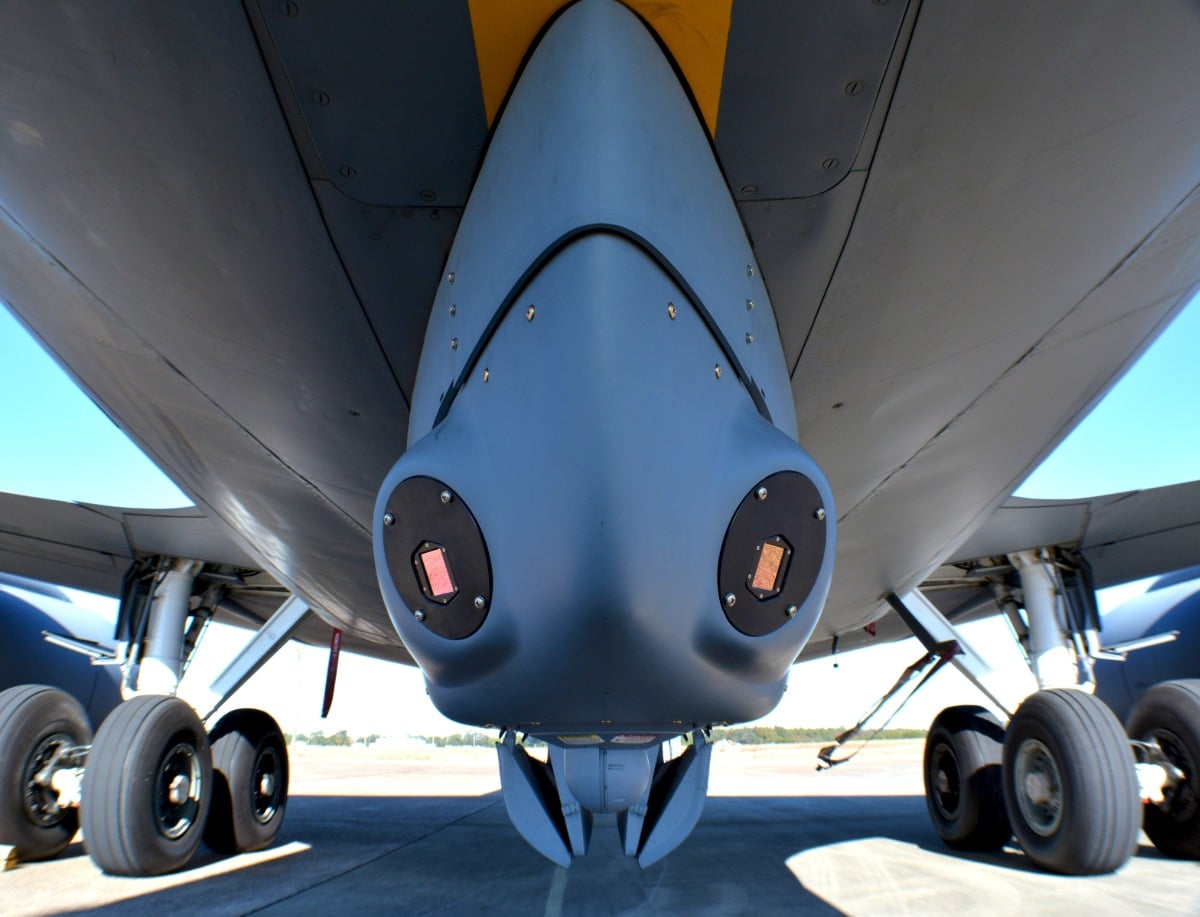
The U.S. Air Force is quietly moving to overhaul the missile defense systems protecting its transport and refueling fleets, a critical upgrade driven by a harsh reality. America's massive cargo planes and aerial tankers are sitting ducks in a modern conflict. For decades, these workhorses operated with impunity in permissive environments like Iraq and Afghanistan. That era is over. The Pentagon is now scrambling to install advanced Large Aircraft Infrared Countermeasures (LAIRCM) and next-generation electronic warfare suites across its transport inventory, aiming to shield these vital assets from sophisticated, heat-seeking anti-aircraft missiles.
But a deeper examination of the Pentagon's procurement strategy reveals a systemic flaw. Upgrading the hardware on individual airframes addresses the immediate symptom while leaving the broader operational vulnerability untouched.
The Reality of Peer Conflict
Air superiority is no longer guaranteed. In a hypothetical clash over the Taiwan Strait or Eastern Europe, the threat profile changes entirely. Chinese and Russian doctrine prioritizes "anti-access/area denial" (A2/AD) zones. These zones are blanketed by long-range surface-to-air missiles and interceptor aircraft designed specifically to hunt large, slow-moving targets.
A Boeing KC-46 Pegasus tanker or a Lockheed Martin C-130J Super Hercules has the radar cross-section of a flying apartment building. They are not stealthy. They cannot outmaneuver a missile traveling at Mach 4.
The Air Force's current upgrade path relies heavily on laser-based countermeasures. These systems work by detecting the launch of an infrared-guided missile, tracking the incoming threat, and firing a high-intensity laser beam directly into the missile’s seeker head to blind it. It is a technological marvel. Yet, it operates on a one-to-one engagement ratio. If an adversary saturates the airspace with multiple interceptors simultaneously, the onboard defense system faces mathematical defeat.
The Logistics Chokehold
Amateurs study tactics; professionals study logistics. This military adage has never been more accurate or more ignored. The entire American projection of power relies on a concept known as the "air bridge." Without continuous aerial refueling, fighter jets like the F-35 cannot cross the Pacific. Without strategic airlifters like the C-17 Globemaster, ammunition and armor do not reach the front lines.
An adversary does not need to shoot down every stealth fighter. They only need to kill the tankers.
By targeting the unstealthy support fleet, an enemy effectively grounds the entire combat air force. The current upgrade program treats each aircraft as an isolated island responsible for its own survival. This approach ignores the reality of networked warfare. If a tanker must constantly execute evasive maneuvers or rely on burning through finite laser-cooling agents, its primary mission fails. A tanker that is busy surviving is a tanker that is not refueling fighters.
The Problem with Integration
Upgrading legacy airframes is a mechanical nightmare. The Air Force inventory includes aircraft that have been flying since the Cold War alongside brand-new airframes. Fitting a standardized missile defense system across this disparate fleet introduces massive integration friction.
- Weight distribution: Adding laser turrets, sensors, and internal processors alters the center of gravity of the aircraft.
- Power requirements: Advanced electronic warfare suites demand immense electrical power, often requiring retrofitted generators that strain older engines.
- Software fragmentation: Merging decades-old avionics with modern digital architecture creates cyber vulnerabilities that adversaries can exploit.
These engineering hurdles mean the rollout of these defense systems will take years, leaving significant portions of the fleet vulnerable during the transition window.
The Cost of Survival
Money is finite, even for the Pentagon. Every dollar spent retrofitting a forty-year-old cargo plane with a multi-million-dollar laser system is a dollar diverted from next-generation platforms.
Defense contractors stand to make billions from these sustainment contracts. It is a lucrative business model that incentivizes prolonged upgrade cycles rather than clean-sheet designs. This creates a powerful institutional momentum to keep fixing old platforms rather than investing in low-observable, autonomous cargo networks that could inherently survive the modern battlespace.
The Distraction of Active Defense
Relying on active countermeasures creates a false sense of security among planners. A laser countermeasure is a final, desperate line of defense. It means the aircraft has already been detected, tracked, and fired upon.
True survivability in a contested environment requires passive defense and signature management. The Air Force has largely neglected this area for its support fleet. Simple measures, such as radar-absorbent coatings or infrared-suppressing engine nozzles, are often dismissed as too expensive or logistically burdensome for transport aircraft. This leaves the fleet entirely dependent on active technology working perfectly every single time.
A Broken Acquisition Model
The procurement velocity of the U.S. military is notoriously slow. By the time a missile defense system is approved, budgeted, tested, and fielded across the fleet, the threat matrix has already evolved.
Adversaries are already deploying multi-spectral seekers that combine infrared tracking with radar homing and optical guidance. A defense system designed to blind an infrared seeker is useless against a missile that switches to radar tracking in its terminal phase. The Air Force is locked into a cycle of reactive engineering, always building defenses for the last war's missiles rather than tomorrow's threats.
To fix this, the military must shift away from the paradigm of the invulnerable support aircraft. The future requires a decentralized architecture where fuel and cargo are distributed across smaller, cheaper, and potentially uncrewed platforms. Upgrading the missile defenses on a massive, legacy tanker is merely putting a shinier shield on a gladiator who is already surrounded. The Air Force must stop trying to make the un-survivable survive, and instead change the way it flies.