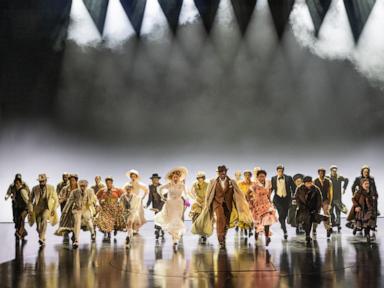
The velvet seats of a Broadway theater hold a peculiar kind of magic just before the lights go down. There is a low, collective murmur—the rustle of playbills, the clearing of throats, the faint scent of damp wool and expensive perfume. In the late 1990s, sitting in the newly minted Ford Center for the Performing Arts, that murmur felt different. It was charged.
When the first lone, syncopated piano notes drifted out of the orchestra pit, they didn't just start a show. They captured a century.
Terrence McNally, Lynn Ahrens, and Stephen Flaherty took E.L. Doctorow’s sprawling, kaleidoscopic novel and turned it into an anthem for an anxious modern age. Ragtime opened on Broadway in January 1998. It arrived with the thunderous weight of expectations, a multi-million-dollar budget, and a cast that seemed assembled by the gods of theater.
Now, nearly three decades later, the world that birthed it has shifted beneath our feet. Yet, the music hasn't stopped. If anything, the chords hit harder now than they did when the curtain first rose.
To understand why a musical about the dawn of the twentieth century still makes audiences weep in the twenty-first, you have to look past the marquee lights. You have to look at the three distinct Americas staring at each other across the footlights.
Three Worlds on a Collision Course
The brilliance of the narrative lies in its geography. It forces three entirely separate realities into a single, claustrophobic space.
First, there is New Rochelle. White. Wealthy. Smug. It is a world symbolized by Mother, a woman trapped in the amber of Edwardian privilege, and Father, a man who manufactures fireworks and patriotism. They live in a house with a wraparound porch where the automated pianos play comforting, predictable melodies.
Then, there is the Lower East Side. This is the domain of Tateh, an immigrant artist from Latvia who arrives with nothing but a silhouette cutter, a young daughter, and a desperate hunger for the American Dream. His world is gray, crowded, and smells of poverty and cabbage.
Finally, there is Harlem. Here, Coalhouse Walker Jr. plays a new kind of music. Ragtime. It is fierce, intoxicating, and completely unapologetic. Coalhouse has a Model T Ford, a pocket full of money, and a fierce pride that the world around him finds deeply dangerous.
Imagine standing on a street corner where these three forces collide. That is the engine of the show.
The story turns on a dime when Mother finds a Black newborn baby buried alive in her garden. Instead of calling the authorities to sweep the problem away, she chooses a quiet, radical act of empathy. She takes the baby and its unwed mother, Sarah, into her pristine home.
When Coalhouse tracks Sarah down, driving his shiny new car into the lily-white suburbs of New Rochelle, the fragile peace shatters. He isn't just looking for the woman he loves; he is claiming his right to exist in their world on his own terms.
The Anatomy of an Anthem
We live in a culture that consumes art like fast food. Shows open, close, and vanish from the cultural memory within a season. Ragtime defied that gravity because its creators understood something fundamental about human emotion: we do not connect with statistics; we connect with skin and bone.
Consider the song "Wheels of a Dream."
When Coalhouse and Sarah hold their infant son toward the sky, singing about an America that will find them equal, it is a moment of pure, soaring hope. The melody swells with a golden, cinematic grandeur. Audiences in 1998 lifted their chins, swept up in the promise of progress.
But watch that same scene today.
The warmth in your chest is suddenly accompanied by a cold knot in your stomach. You know what happens to Coalhouse. You know that his pride will be met with racist vandalism from a volunteer fire company, that his quest for justice will be systemic brick walls, and that his anger will eventually consume him.
The song transforms from a celebratory anthem into a devastating question mark.
This is not a historical artifact. The genius of Flaherty’s score is that it uses the syncopation of ragtime—a musical style defined by its off-beat rhythms, its tension between the steady left hand and the improvisational right hand—as a metaphor for America itself. The country is always fighting its own rhythm. It is always striving for harmony while living in deep, agonizing dissonance.
The Cost of the Ticket
There is a raw, uncomfortable honesty to the piece that makes it terrifying for modern theater companies to stage, yet utterly impossible to ignore.
During the initial Broadway run, the show was a massive, glittering spectacle. It featured a literal, working Model T Ford rolling onto the stage. It had a massive moving bridge that symbolized the divide between the social classes. It was grand, expensive, and epic.
But as the years passed, the show underwent a transformation.
Regional theaters and stripped-down revivals discovered something remarkable. When you take away the million-dollar set pieces, the heart of the story beats even louder. You don't need a real car to feel Coalhouse’s devastation. You just need an actor standing in the spotlight, his voice cracking under the weight of a dignity that is being systematically stripped away.
The show forces us to confront our own complicity.
When Tateh sells his soul to Hollywood to become a pioneer of the silent film industry, renaming himself "Baron Ashkenazy" to hide his Jewish roots, we cheer for his success. He escaped the tenements. He saved his daughter. But the narrative quietly asks us: what did he have to leave behind at Ellis Island to buy his way into the room?
When Mother realizes that her husband’s safe, predictable world is an illusion, she sings "Back to Before." It is a declaration of independence that rejects the nostalgic myth of a simpler time.
"We can't go back to before," she insists.
🔗 Read more: The Golden Ticket That Lost Its Shine
It is a line that echoes through decades. It speaks directly to our current cultural exhaustion, to that collective, unspoken yearning to return to some imagined past where everything made sense. The show gently but firmly reminds us that the past was never simple; it was just quiet because the people who were suffering hadn't yet found their voice.
The Resonance of a Broken Chord
Art doesn't solve problems. A musical cannot fix a broken justice system, heal racial trauma, or pave over the wealth gap that continues to widen with each passing year.
What it can do, however, is prevent us from becoming numb.
At the end of the night, when the final notes fade into the dark, the stage is populated by a new generation. The children of New Rochelle, Harlem, and the Lower East Side stand together. They are holding hands, looking toward a horizon that remains stubbornly unwritten.
It is an image designed to offer comfort, but it is a comfort bought with blood.
The lights come up. The audience blinks against the sudden brightness. People reach for their coats, their cell phones, their keys, stepping out into the cold night air of the city. They walk past the luxury apartments, past the homeless sleeping over subway grates, past the flashing sirens and the constant, relentless hum of a society still trying to find its rhythm.
The music follows them out into the street, shifting, unpredictable, and entirely unfinished.