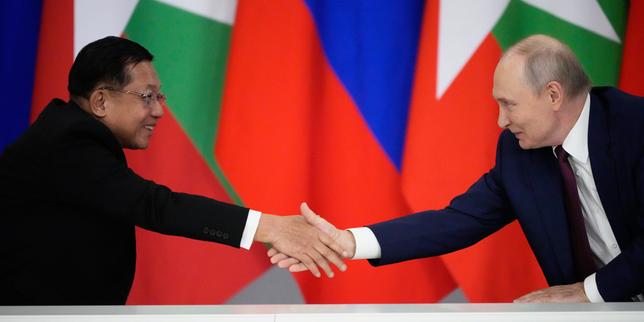
The current rapprochement between Myanmar and the Russian Federation is not a conventional diplomatic pivot. It is a calculated survival mechanism defined by the reciprocal exchange of legitimacy, military sustainment, and economic insulation. Senior General Min Aung Hlaing’s August 2026 visit to Moscow serves to finalize a transactional framework that bridges the isolation gap left by Western sanctions and regional diplomatic cooling.
The Triad of Exchange
The architecture of this alliance rests on three distinct pillars. Each functions as a pressure-relief valve for the State Administration Council (SAC) while providing Russia with a localized beachhead in Southeast Asia.
- Military Sustainment (Kinetic Utility): The Tatmadaw’s reliance on Russian air assets—specifically Mi-35 helicopters and MiG-29 fighter variants—is the backbone of its domestic counter-insurgency operations. The 2026 military cooperation pact secures a supply chain for maintenance and munitions through 2030, effectively guaranteeing the military government’s ability to project force against non-state actors.
- Diplomatic Normalization (Systemic Validation): By endorsing the Kremlin’s international positioning and securing Kremlin-level face time, the SAC bypasses the legitimacy vacuum created by the 2021 coup. The engagement functions as a hedge against the Association of Southeast Asian Nations (ASEAN) and Western diplomatic pressure, shifting the SAC’s international standing from pariah status to "strategic partner" within the Russian sphere.
- Economic Insulation (Financial Hardening): Two-thirds of current bilateral commercial transactions are now settled in rubles. This is not merely a preference; it is a structural necessity to mitigate the impact of the SWIFT exclusion and Western financial containment. By integrating with Russian financial mechanisms, Myanmar gains a bypass for capital flow that remains opaque to the global banking architecture.
The Mechanism of Energy and Infrastructure
The shift toward deeper energy cooperation represents a long-term strategic bet rather than an immediate economic boon. Myanmar’s objective—securing reliable energy sources and developing hydrocarbon reserves—aligns with Russia’s necessity to export expertise and equipment in sectors hampered by its own international sanctions.
The planned deep-water seaport and the ongoing development of nuclear energy capacity serve as high-capital, high-visibility projects. These are not intended for immediate ROI. They are "stickiness" assets designed to physically embed Russian state enterprises (like Rosatom) into the infrastructure of the Burmese state, ensuring that any future transition of power faces structural resistance from established Russian commercial interests.
Geopolitical Friction and Limitations
The relationship is not without structural bottlenecks. China remains Myanmar’s largest trade partner and the primary economic arbiter in the region. Russia provides political and military utility, but it lacks the geographic proximity and trade volume to replace Beijing’s influence.
The alliance operates within a narrow band of efficacy:
- Scalability: Russia’s domestic requirements—driven by its ongoing conflict in Ukraine—place a hard ceiling on the volume of military hardware it can reliably deliver to third-party states.
- Dependency Asymmetry: The SAC requires Russia more than Russia requires Myanmar. This creates a leverage imbalance where Naypyidaw must consistently signal alignment with Moscow’s global priorities—such as public endorsement of Russian foreign policy—to maintain priority access to Moscow’s limited military-industrial output.
Strategic Implications
The integration of Myanmar into Russian-led multilateral forums—and the potential trajectory toward BRICS membership—is a move to normalize the SAC’s rule in the absence of a domestic democratic mandate. This strategy avoids the "reform or collapse" trap by creating an alternative environment where legitimacy is derived from bilateral recognition rather than international consensus.
For the observer, the signal is clear: The SAC is no longer pursuing a return to the pre-2021 international order. It is committing to a permanent realignment. The strategic play for the SAC is to continue increasing the cost of regional instability for its neighbors by making Myanmar an indispensable node in the Russia-aligned authoritarian network. Any future diplomatic efforts by external actors that rely on traditional economic levers will likely fail, as the SAC has already successfully insulated its core operational capabilities from Western financial and diplomatic pressure points.