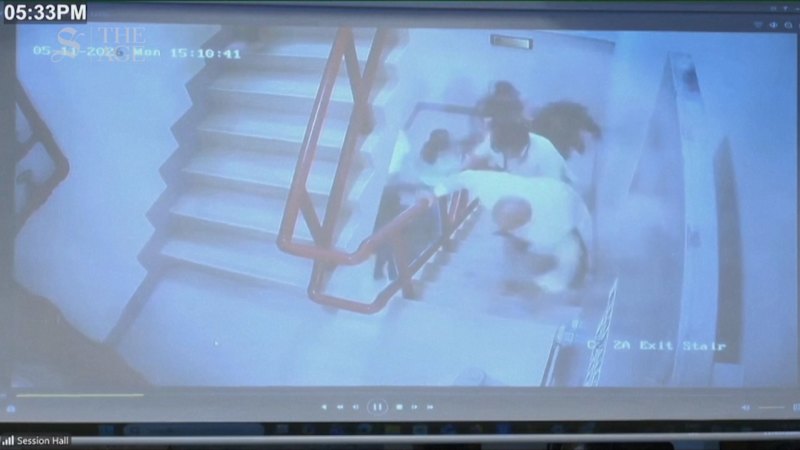
Grainy footage. Shaky cameras. Figures in jackets walking through a hallway with a sense of urgency. The headline practically writes itself: "Law Enforcement Agents Chasing Senator." It is the kind of clickbait that keeps the digital news cycle spinning, feeding a public appetite for high-stakes drama and institutional overreach.
But if you look at the footage and see a "chase," you are failing the basic test of critical observation. You are seeing what you have been conditioned to see by decades of cinematic tropes and lazy reporting. What the competitor calls a pursuit is actually a highly choreographed, bureaucratic dance that serves both the hunters and the hunted.
The Optical Illusion of Urgency
The "chase" of a high-profile Philippine senator isn't a scene from an action movie. It is a logistics exercise. In the world of high-level law enforcement, you don't "chase" a sitting legislator through a public building unless you want a PR nightmare or a constitutional crisis.
What the footage actually reveals is a breakdown in coordination, or more likely, a deliberate display of "effort" for the benefit of the cameras. Real arrests of political heavyweights happen in the quiet hours, behind closed doors, or through negotiated surrenders. When the cameras are rolling and agents are power-walking through a lobby, you aren't watching justice; you are watching a press release in motion.
We need to stop conflating movement with progress. Just because an agent is walking fast doesn't mean they are closing in on a criminal mastermind. Often, they are simply trying to reach a designated elevator before the media swarm cuts them off.
The Senator’s Playbook: The Victimhood Dividend
Let’s be honest about the other side of the lens. For a politician under fire, being "chased" is the greatest gift a law enforcement agency can provide. It validates the narrative of persecution. It transforms a complex legal battle involving subpoenas and affidavits into a visceral, easy-to-digest story of the "Big State" versus the "Lone Representative."
I have watched political consultants salivate over footage like this. They don't see a threat; they see a campaign ad.
- Step One: Leak the location.
- Step Two: Ensure the CCTV is operational and the footage is "retrievable."
- Step Three: Act surprised when the agents arrive.
When you see a senator moving quickly through a corridor with a trail of agents behind them, don't ask "Will they catch him?" Ask "Who leaked the flight path?"
The Institutional Failure of "Chasing"
If law enforcement actually wanted to secure a person of interest in a modern building, they wouldn't be "chasing" them through the front door. They would control the exits, disable the elevator banks via the fire control system, and wait.
The fact that we see agents trailing behind a target suggests one of two things:
- Incompetence: A complete lack of basic perimeter containment.
- Performance: A desire to be seen doing the work without actually facing the legal fallout of a premature or messy apprehension.
The "chase" is a tool for the agency to show the executive branch they are "trying," and a tool for the senator to show their base they are "fighting." It is a symbiotic relationship where the only loser is the viewer who thinks they are watching a genuine pursuit of justice.
Redefining the "People Also Ask"
The public usually asks: Why hasn't the senator been caught yet?
This is the wrong question. The real question is: What is being negotiated while this footage plays on a loop?
In the Philippines, as in many hyper-politicized environments, the "chase" is the buffer period. It is the time during which lawyers are filing last-minute injunctions, backroom deals are being struck regarding the conditions of detention, and the public’s emotional response is being monitored to see which way the wind blows.
Another common query: Is the law enforcement agency overstepping its bounds?
Usually, they aren't even stepping to the bounds. They are walking a very tight line of "visible compliance." They have a warrant, or a directive, and they must appear to be executing it. If they truly wanted to be "robust" (to use a word I despise), the target wouldn't even have time to make it to the hallway.
The Data of Disappearance
If you look at the history of high-profile political "escapes" or "chases" in the region, there is a statistical correlation between the amount of CCTV footage released and the likelihood of the person eventually being "invited" to a comfortable, negotiated surrender weeks later.
The more public the chase, the more private the resolution.
Imagine a scenario where a specialized unit actually wanted to apprehend a target without fanfare. You wouldn't see it on the evening news. You would see a brief statement the following morning. The existence of the footage is proof that the process has already been compromised by political optics.
Stop Reading the Script
We have become a society of "optical investigators." We look at a low-resolution video and think we are seeing the raw truth. In reality, CCTV footage is the most curated form of "reality" in the political sphere. It is selected, edited, and leaked with specific intent.
The competitor's article wants you to feel the adrenaline of the chase. They want you to take a side—either the brave agents doing their duty or the persecuted leader fleeing for his rights.
I am telling you to ignore the adrenaline.
Look at the timestamp. Look at the spacing between the agents. Look at the lack of urgency in the bystanders. This isn't a chase. It’s a parade.
Law enforcement doesn't chase senators; they follow the script written by the prevailing political wind. If the wind changes, the agents stop walking. If the wind blows harder, the senator stops running.
The next time you see a "dramatic pursuit" on your feed, remind yourself: the most important things in politics always happen off-camera. Everything else is just content.
Quit being a spectator in a theater you didn't buy a ticket for.
The agents aren't chasing a man; they are chasing a headline. And as long as you keep clicking, they’ve already caught you.