Jakarta is not building a supercarrier to rival the United States Navy, regardless of what breathless regional headlines suggest. The reality is more nuanced and arguably more dangerous for the status quo in the South China Sea. Indonesia is currently pursuing a massive expansion of its naval reach through Landing Platform Docks (LPDs) and multi-mission vessels that can function as "light" carriers for drones and helicopters. While the Philippines remains locked in a desperate, asymmetric struggle to defend its shoals with refurbished cutters, Indonesia is moving toward a blue-water force capable of projecting power far beyond its coastal base. This gap in naval hardware is not just a matter of budget; it represents a fundamental divergence in how the two largest archipelagos on earth plan to survive a conflict with a superpower.
The disparity is glaring. Indonesia’s naval roadmap, known as the Minimum Essential Force (MEF), has prioritized the domestic construction of large-deck amphibious ships. These vessels, such as the Sudirohusodo-class, are technically hospital ships or transport docks, but their massive flight decks provide a capability the Philippines currently lacks entirely. Manila is playing a game of maritime "whack-a-mole," reacting to incursions with a patchwork fleet. Jakarta, meanwhile, is building a foundation for sustained presence. For another perspective, see: this related article.
The Strategic Illusion of the Flat Top
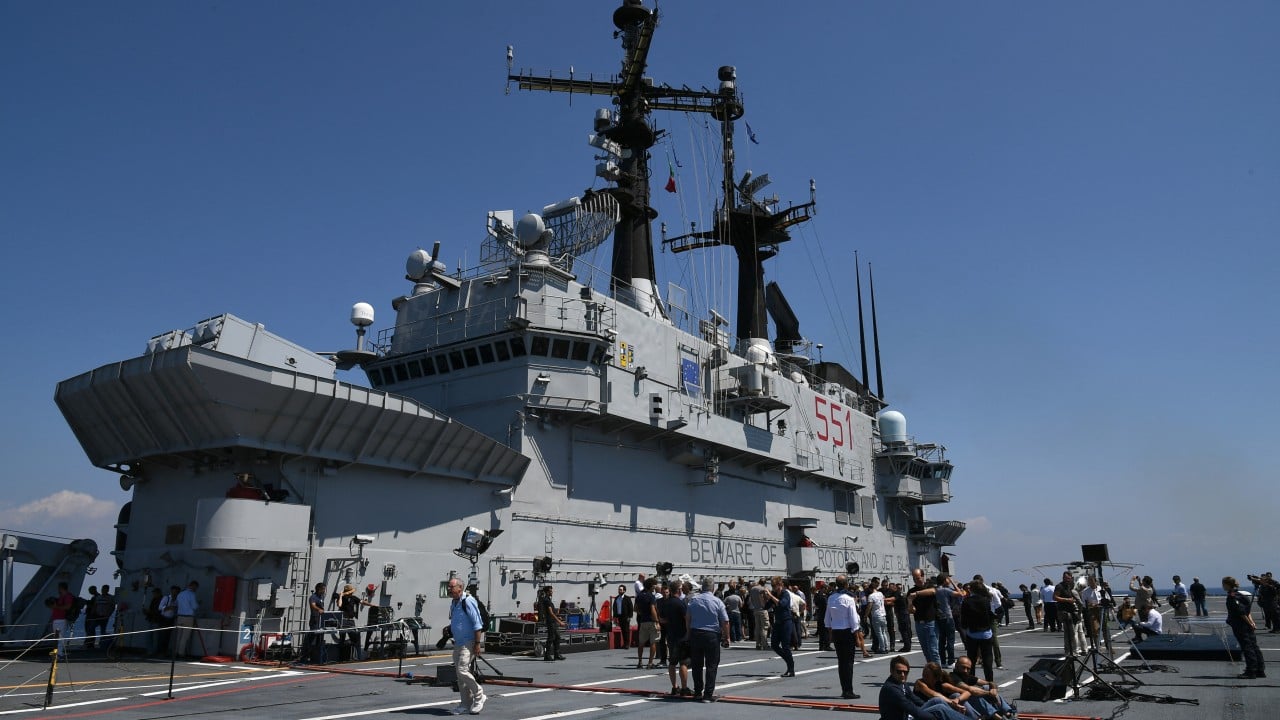
To understand why Indonesia is "getting an aircraft carrier" while the Philippines is not, one must look at the definition of naval prestige. Indonesia isn't buying a Ford-class behemoth. Instead, it is looking at the PPA (Pattugliatore Polivalente d'Altura) from Italy and larger LHD (Landing Helicopter Dock) designs that can operate a mix of manned and unmanned aircraft. This isn't about launching F-35Bs—at least not yet. It is about command and control.
A carrier, even a light one, acts as a floating nerve center. It allows a fleet to maintain a persistent "eye in the sky" via long-endurance drones. The Philippines, by contrast, relies on land-based surveillance or the occasional US P-8 Poseidon flyover. This means Manila is often blind to Chinese maritime militia movements until they have already occupied a feature. Indonesia’s shift toward large-deck vessels ensures they won't have that problem in the North Natuna Sea. Related coverage on the subject has been published by BBC News.
The "why" is simple. Indonesia views itself as a natural regional leader, the "Big Brother" of ASEAN. You cannot lead from a 40-meter patrol boat. The Philippines is focused on territorial defense, which is inherently reactive. Indonesia is focused on regional maritime sovereignty, which requires a visible, intimidating presence. This difference in philosophy dictates the procurement list.
Manila’s Budgetary Trap
The Philippines is not "losing" because of a lack of will. It is losing because of a lack of industrial depth and a historical obsession with internal insurgency. For decades, the Armed Forces of the Philippines (AFP) spent their meager pesos fighting jungle rebels rather than building a navy. By the time they looked toward the horizon, the South China Sea was already being paved over by Chinese dredgers.
Even with the Horizon 3 modernization program, the Philippine Navy is struggling to secure basic frigates. A light carrier or even a large LHD is a logistical nightmare they cannot yet afford. Beyond the hull's price tag, a carrier requires a carrier strike group. You need destroyers to protect it, submarines to scout for it, and a massive supply chain to keep it fueled.
Indonesia has spent the last twenty years building that ecosystem. They have a domestic shipbuilding industry, PT PAL, which builds LPDs under license and exports them to nations like the Philippines. This is the ultimate irony: the Philippines is buying its largest transport ships from the very competitor that is allegedly "outpacing" them. Jakarta has turned naval expansion into a profitable domestic industry; Manila has turned it into a recurring line-item debt.
The Drone Carrier Pivot
The most overlooked factor in this regional arms race is the rise of unmanned aerial vehicles (UAVs). Modern naval warfare is moving away from the "Top Gun" style of manned flight decks toward automated swarms. Indonesia is perfectly positioned to skip a generation of technology.
By building large-deck ships without the complex catapults or arresting wires needed for fighter jets, Indonesia can operate heavy-lift drones. These drones can perform anti-submarine warfare (ASW), electronic jamming, and precision strikes at a fraction of the cost of a jet wing. This is the "carrier" Indonesia is actually getting—a modular platform for robotic warfare.
The Philippines is attempting to counter this with land-based missile systems like the BrahMos. While the BrahMos is a formidable "sea-denial" weapon, it is a static defense. You cannot sail a missile battery to a disputed reef to assert your presence without firing a shot. Indonesia’s LPDs can hover on the edge of a conflict zone for weeks, launching drones to harass or monitor intruders. It is the difference between having a shield and having a long-reaching spear.
The Geography of Risk
We must look at the map to see why the urgency differs. The Philippines’ primary flashpoints, like Second Thomas Shoal, are incredibly close to the Chinese mainland’s "Great Wall of Sand." Any Philippine carrier would be a sitting duck for land-based Chinese DF-21 "carrier killer" missiles. For Manila, a large, expensive ship is a liability.
Indonesia’s interests in the North Natuna Sea are further south, on the very edge of China's "Nine-Dash Line." Jakarta has more "room to breathe" and more ocean to cover. For them, a mobile airbase makes sense because it can move between the thousands of islands in the archipelago, disappearing into the "noise" of commercial shipping before reappearing to enforce Indonesian law.
The Submarine Gap
A carrier is a target; a submarine is a threat. While the media focuses on the glitz of a flight deck, the real power gap lies beneath the waves. Indonesia has an active submarine fleet, including the Nagapasa-class (Type 209/1400) and plans for the advanced French Scorpène-class with Air-Independent Propulsion (AIP).
Regional Submarine Capacity Comparison
| Feature | Indonesia (Active/Planned) | Philippines (Active/Planned) |
|---|---|---|
| Total Hulls | 4 Active / 2+ Planned | 0 Active / 2 Planned |
| AIP Capability | Yes (Scorpène Evolved) | No |
| Local Maintenance | PT PAL Facilities | Minimal |
| Primary Mission | Sea Denial / Power Projection | Coastal Ambush (Theoretical) |
The Philippines has been talking about buying its first submarine for nearly a decade. Without a subsurface fleet, any large Philippine surface ship would be defenseless against the Chinese PLAN (People's Liberation Army Navy) attack subs. Indonesia’s investment in submarines gives their future "carriers" a fighting chance. It provides the "silent" protection necessary for the "loud" projection of a flat-top ship.
Geopolitics of the "Non-Aligned"
Indonesia plays a different diplomatic game. By maintaining a "free and active" foreign policy, Jakarta can buy hardware from everyone. They get jets from the US and France, submarines from Germany and Korea, and frigates from Italy. This diversified supply chain makes them harder to pin down.
The Philippines is locked into a Mutual Defense Treaty (MDT) with the United States. While this provides a security umbrella, it also limits their options. Manila’s naval strategy is essentially to act as a tripwire for American intervention. Because they expect the US Navy to do the heavy lifting in a high-intensity conflict, they haven't felt the existential pressure to build a self-sustaining blue-water navy. Indonesia knows no one is coming to save them. That realization is what builds carriers.
The Logistics of Maintenance
The "why" behind the Philippines' lack of a carrier also comes down to the unglamorous world of dry docks and steel. To maintain a 20,000-ton vessel, you need massive infrastructure. Indonesia has spent decades developing the Surabaya naval base into a powerhouse of Southeast Asian maritime engineering.
The Philippines lost much of its institutional knowledge when the US vacated Subic Bay in the 1990s. While Subic is seeing a revival with companies like Cerberus and HD Hyundai, the capability to independently maintain and repair a carrier-sized vessel is still years away. You cannot buy a navy off a shelf; you have to grow the engineers who can fix it when it breaks in a salt-water environment.
The Intelligence Asymmetry
Finally, there is the issue of Maritime Domain Awareness (MDA). A carrier is useless if you don't know where to send it. Indonesia is integrating its naval assets into a unified satellite and radar network. Their new ships are designed to plug into this grid.
The Philippines is still working on basic radio interoperability between its Coast Guard and its Navy. If Manila were gifted a carrier tomorrow, they would likely struggle to provide it with the real-time data needed to survive in the contested waters of the West Philippine Sea. The "carrier gap" is actually a "systems gap." It is a failure to integrate sensors, shooters, and commanders into a single cohesive unit.
Indonesia is not just buying a ship; they are building a system. The Philippines is buying ships, but they are still searching for the system.
The disparity in naval power between these two nations is the result of decades of differing priorities. One chose to build a domestic industry and a multi-layered fleet capable of independent action. The other chose to rely on a superpower ally and a reactive, shore-based defense. As the South China Sea warms up, the "flat top" in Indonesia's fleet will serve as a symbol of that independence. The lack of one in the Philippines is a symbol of a nation still trying to find its sea legs in a world where "tripwires" may no longer be enough.
Manila’s best hope isn't to copy Jakarta's carrier ambitions. It is to master the "small, fast, and many" approach—using swarms of missile boats and land-based batteries to make any incursion too costly for an aggressor. Trying to win a prestige war with a carrier they can't afford to lose is a recipe for disaster. Jakarta has earned the right to think big. Manila needs to think smart.