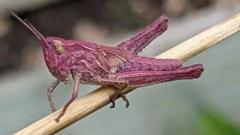
The coffee was still hot enough to burn when the world tilted slightly on its axis. It happened on an ordinary Tuesday morning, the kind where the damp earth smells of decomposing oak leaves and promise. A woman stood in her backyard garden, a pair of rusted pruning shears in one hand, tracking the slow, predictable movement of a morning beetle. Everything was green. The hostas were green, the creeping charley was green, and the dense lawn was a dull, mid-summer emerald.
Then, something moved near the base of the parsley.
It was a shock of pure, unapologetic color. Not the soft pastel of an early rosebud or the predictable orange of a migrating monarch butterfly. This was a striking, vibrant hue that belonged on a billboard in Tokyo or a flashing open sign in New York City.
A pink grasshopper.
To see one is to witness a glitch in the matrix of the natural world. Grasshoppers are supposed to be ghosts. They survive by becoming the background, blending into the tall fescue and the clover so entirely that you only realize they exist when they snap into the air like rubber bands. This creature had abandoned the rules of survival entirely. It sat on a serrated green leaf, glowing like a neon light tube in an empty field.
The Flaw That Becomes a Masterpiece
Most people look at the natural world and see a finely tuned machine where every gear turns with absolute precision. But nature is messy. It experiments. Sometimes, it makes a mistake that is so beautifully reckless it defies explanation.
The phenomenon is called erythrism. It is a rare genetic mutation, akin to albinism or melanism, that causes an overproduction of red pigments and a near-total suppression of dark ones. In the insect world, it is the ultimate evolutionary gamble.
Imagine playing a game of hide-and-seek where your life depends on remaining unseen, but someone forces you to wear a glowing safety vest. That is the daily reality of a pink grasshopper. Scientists estimate that the odds of a human being encountering one in their lifetime are somewhere around one in ten thousand. Some entomologists argue the numbers are even scarcer, because the math is heavily stacked against the insect from the moment it hatches.
Consider what happens next in the life cycle of a regular nymph. It molts, it eats, it turns the color of dry thatch or wet moss, and it lives long enough to lay eggs. But the neon stranger has no such luxury. To a passing robin, a blue jay, or a hungry garter snake, a pink grasshopper is not a biological marvel. It is a target. It is a brightly colored beacon moving across a green canvas, practically screaming to be eaten.
The fact that any pink grasshopper survives long enough to be spotted by a human being holding a garden trowel is a minor miracle. It means this tiny creature has dodged a thousand unseen deaths in the grass, surviving purely on luck and the occasional patch of similarly colored autumn blooms.
The Human Need for Wonder
When the homeowner knelt in the dirt to get a closer look, she didn’t see a pest. She saw a bridge to something older, a fleeting reminder that the world still holds secrets it hasn't fully explained to us. We live in an era where almost everything has been mapped, categorized, and monetized. We have satellites that can read the license plate on a car from orbit and algorithms that predict our deepest desires before we even feel them.
We are starved for mystery.
When we stumble across something that breaks the established patterns of our mundane routines, it shocks us out of our stupor. A rare insect found among the weeds becomes a viral sensation not because people are suddenly passionate about orthoptera, but because we desperately want to believe that magic can still happen on an ordinary Tuesday.
There is a strange vulnerability in admitting how much we need these small deviations. We build our suburban lives around predictability. We mow the grass to a uniform height, we plant our perennials in neat rows, and we spray chemicals to ensure that only the approved forms of life are allowed to exist within our property lines. We spent centuries trying to tame the wildness out of our backyards.
Yet, when a creature born of pure genetic defiance lands on a tomato stake, we drop everything to take a photograph. We want the wildness back, if only for a second.
The pink grasshopper sat perfectly still as the camera lens hovered inches from its delicate antennae. It didn't know it was an anomaly. It didn't know it was breaking the hearts of evolutionary biologists who wonder how its lineage continues. It simply breathed through the tiny pores in its abdomen, adjusted its powerful hind legs, and prepared for the next leap into the dangerous, unforgiving green.