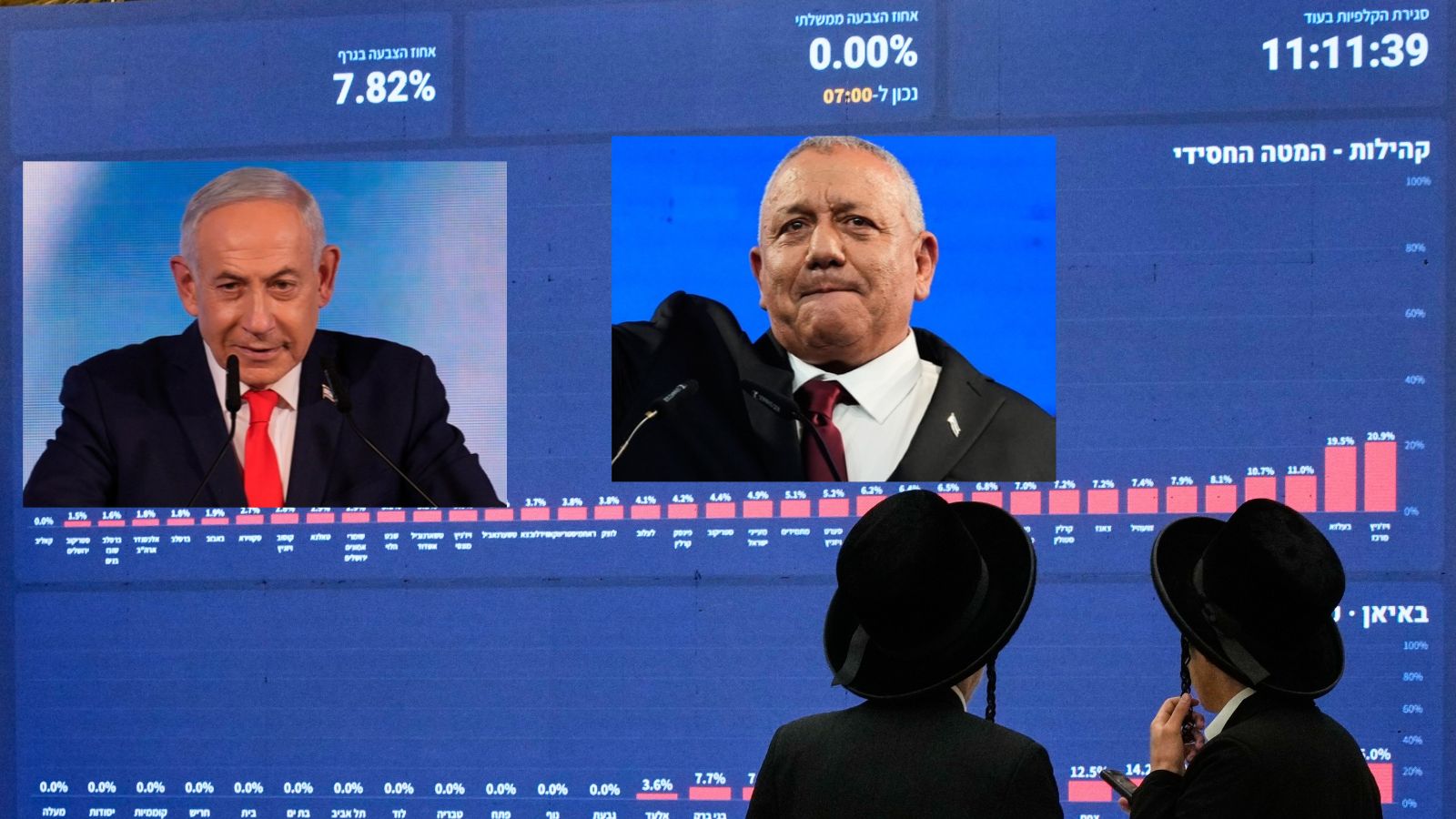
Israeli prime ministerial succession is not determined by head-to-head popularity polls; it is governed by coalition mathematics within a 120-seat unicameral parliament where a 61-seat threshold dictates executive survival. Comparing Benjamin Netanyahu and Gadi Eisenkot requires stripping away personality-driven media narratives and analyzing two competing institutional operating systems: Netanyahu’s transactional retention of a hardened ideological bloc versus Eisenkot’s attempt to assemble a broad, anti-incumbent consensus out of fractured centrist and right-leaning factions. The outcome hinges entirely on whether the opposition can solve its internal coordination failure before the next Knesset election cycle locks in seat distributions.
The Structural Constraints of the 61-Seat Threshold
Israel’s proportional representation system, featuring a single nationwide district and a 3.25% electoral threshold, creates a structural distortion that standard horse-race journalism routinely misses. Voters do not select a Prime Minister directly. They vote for party lists, and the President tasks the Knesset member with the highest probability of assembling a 61-seat majority with forming a government.
This institutional design produces three distinct operational realities:
- The Veto Power of Marginal Factions: Because neither Netanyahu’s Likud nor any single centrist party can achieve an outright majority independently, kingmaker status defaults to smaller parties that clear the 3.25% threshold. A party winning four or five seats extracts disproportionate policy and budgetary concessions because its defection collapses the coalition.
- The Wasted-Vote Penalty: If an ideological bloc fractures into multiple small lists and one falls below 3.25%, those votes are discarded entirely, artificially inflating the seat share of the surviving parties. Electoral victory often belongs not to the bloc with more raw votes, but to the bloc with superior list consolidation.
- Asymmetric Bloc Cohesion: Netanyahu’s right-wing and ultra-Orthodox (Haredi) bloc operates as a unified political cartel with aligned survival incentives. The opposition bloc, spanning secular centrists, soft-right defectors, left-wing Zionists, and Arab parties, suffers from severe ideological dispersion.
Understanding who becomes Israel's next Prime Minister requires evaluating Netanyahu and Eisenkot not as individual candidates, but as focal points for these competing coalition architectures.
Benjamin Netanyahu’s Incumbency Retention Mechanism
Netanyahu’s political durability rests on an institutional feedback loop that binds the survival of his coalition partners directly to his personal tenure. While critics frame his governance around legal survival or personal ambition, a strict structural analysis reveals a coldly rational distribution of political capital.
The Tripartite Coalition Lock
Netanyahu’s governing architecture relies on three distinct pillars, each bound to Likud through specific transactional mechanisms:
- The Likud Base: Maintained through institutional control of the party’s central committee and primary system, preventing internal challengers from building independent power bases without risking political exile.
- The Ultra-Orthodox Parties (Shas and United Torah Judaism): Bound to Netanyahu through budgetary allocations for religious institutions and legislative protection against mandatory military conscription. Because the opposition cannot offer equivalent guarantees without alienating its own secular voter base, the Haredi parties face a near-total lack of viable alternative coalition partners.
- The Religious Zionist and Far-Right Factions: Anchored by ideological alignment on West Bank settlement expansion, judicial overhaul, and maximalist security postures. Netanyahu functions as their primary diplomatic shield against international pressure, while they provide the parliamentary votes required to sustain his premiership.
This structure creates a high-friction exit barrier for Netanyahu’s allies. Defecting from the coalition does not merely end the current government; it risks handing executive power to an opposition bloc hostile to the core material and ideological interests of Haredi and far-right voters. Netanyahu’s primary vulnerability is not a sudden loss of personal charisma, but a rupture in the transactional equilibrium—specifically, if the Supreme Court or military necessity forces a conscription mandate that Likud can no longer block, thereby breaking the Haredi incentive structure.
Gadi Eisenkot’s Strategic Positioning and the Centrist Bottleneck
Gadi Eisenkot, former Chief of the General Staff of the Israel Defense Forces (IDF) and a key figure within the National Unity alliance alongside Benny Gantz, represents a fundamentally different political archetype. His appeal is rooted in institutional credibility, operational restraint, and consensus-building—traits historically rewarded by the Israeli electorate during periods of acute security exhaustion.
The General-Turned-Statesman Playbook
Israeli political history demonstrates a recurring pattern where former IDF Chiefs of Staff—such as Yitzhak Rabin, Ehud Barak, and Benny Gantz—enter politics as corrective counterweights to entrenched ideological leadership. Eisenkot’s operational profile differs from Gantz’s in subtle but critical ways:
- Doctrinal Clarity: As IDF Chief of Staff, Eisenkot authored the "IDF Strategy" document, codifying a pragmatic, force-application doctrine focused on deterrence and clear political end-states. In the political arena, this translates into a critique of Netanyahu’s tendency to defer strategic decisions in favor of tactical coalition management.
- Cross-Bloc Palatability: Unlike figures from the traditional left (such as Yair Lapid or Yair Golan), Eisenkot’s military pedigree grants him legitimacy among soft-right Likud voters who prioritize national security over ideological purity. To unseat Netanyahu, the opposition must peel away roughly four to six seats from the right-wing bloc; Eisenkot is structurally positioned to execute that extraction.
- Personal Sacrifice as Political Capital: Following the October 7 attacks and the subsequent war in Gaza, in which Eisenkot lost his son and nephew in combat, his public standing shifted from a technocratic former general to a figure of profound national gravitas. In Israeli political culture, shared sacrifice insulates a leader from standard partisan attacks regarding patriotism or security toughness.
The Coordination Failure
Despite Eisenkot’s individual polling strength—frequently outperforming Gantz in head-to-head suitability metrics—he faces a severe structural bottleneck: he does not control an independent party apparatus. Operating within a broader centrist framework means his path to the premiership requires resolving three sequential coordination problems:
- The Leadership Succession inside the Center: Eisenkot must either overtake Benny Gantz as the undisputed standard-bearer of their shared political vehicle or engineer a clean, non-destructive split that avoids cannibalizing centrist votes.
- The Lapid-Gantz-Eisenkot Trilemma: Yair Lapid’s Yesh Atid commands a disciplined organizational machine and a loyal secular base. Any coalition led by Eisenkot requires Lapid’s unconditional parliamentary backing without triggering ego-driven fragmentation during campaign season.
- The Arab Party Equation: Without the participation or external support of Arab-majority parties (such as Ra'am or Hadash-Ta'al), an anti-Netanyahu Zionist coalition must win at least 61 seats out of the roughly 108–110 seats contested by predominantly Jewish parties—a mathematical threshold exceeding 55% of the non-Arab vote.
The Four Variables Dictating the Next Premiership
To project the outcome of a Netanyahu-versus-Eisenkot contest, analysts must track four measurable variables rather than daily news cycles.
1. Soft-Right Voter Migration
The Israeli electorate exhibits remarkably low cross-bloc mobility. Most voters oscillate between parties within the same ideological camp (e.g., shifting between Yesh Atid and National Unity, or between Likud and Religious Zionism) rather than crossing the Netanyahu/anti-Netanyahu divide. Eisenkot’s viability depends entirely on his ability to convert disillusioned Likud voters—specifically secular, middle-class right-wingers alienated by Haredi draft exemptions and economic strain—into centrist voters. If these voters merely stay home rather than voting for an Eisenkot-led list, Netanyahu’s bloc retains a proportional advantage due to higher turnout discipline among Haredi and ideological right-wing constituencies.
2. The Haredi Conscription Fault Line
The exemption of ultra-Orthodox yeshiva students from mandatory IDF service is the single greatest structural threat to Netanyahu’s coalition. Following the massive manpower demands of multi-front military operations since late 2023, the economic and social cost of maintaining blanket exemptions has become unsustainable for Likud’s own secular-traditionalist base. If Netanyahu passes a watered-down draft law to appease Shas and United Torah Judaism, he risks bleeding soft-right voters to Eisenkot. If he fails to pass an exemption law and the state enforces conscription and cuts yeshiva funding, the Haredi parties lose their primary transactional reason for keeping him in office.
3. Opposition List Consolidation
In recent Israeli elections, the anti-Netanyahu camp repeatedly lost seats because small parties fell just below the 3.25% threshold, wasting hundreds of thousands of votes. Conversely, Netanyahu actively brokered mergers among fringe right-wing factions to ensure zero wasted votes on his side of the ledger. For Eisenkot to reach 61 seats, the opposition must enforce strict pre-election mergers—combining smaller left-wing, centrist, and anti-Netanyahu right-wing lists (such as Avigdor Liberman’s Yisrael Beiteinu and Naftali Bennett’s potential return vehicle) into a disciplined electoral front.
4. Security End-State Execution
Netanyahu’s political brand was historically built on the promise of managing conflict at a low cost while delivering economic growth and regional normalization. The catastrophic intelligence and operational failures of October 7 shattered that premise, creating a massive trust deficit. Netanyahu’s recovery strategy relies on projecting wartime indispensability and framing international diplomatic pressure as an existential threat only he can resist. Eisenkot counters this by arguing that tactical military achievements without a coherent diplomatic end-state—such as establishing a viable post-war governance mechanism in Gaza and securing normalization with Saudi Arabia—trap Israel in a perpetual war of attrition. The electorate’s verdict on whether security requires prolonged military control or a negotiated regional framework will determine which leadership model prevails.
Comparative Governance Models: Netanyahu vs. Eisenkot
Evaluating how each leader would govern reveals stark operational differences across institutional, economic, and security domains.
- Decision-Making Architecture: Netanyahu centralizes authority within the Prime Minister’s Office, bypassing formal cabinet deliberations and professional civil service advisories when they conflict with coalition survival. Eisenkot operates through institutional processes, prioritizing formal National Security Council assessments, IDF General Staff recommendations, and structured cabinet decision-making.
- Civil-Military Relations: Under Netanyahu, friction between the political echelon and the defense establishment has become an overt political tool used to deflect accountability for strategic failures. Under Eisenkot, civil-military alignment would be restored immediately, given his standing within the defense apparatus, though this carries the risk of groupthink if military perspectives dominate diplomatic planning.
- Judiciary and Governance: Netanyahu’s coalition remains committed to curbing judicial review to remove institutional checks on executive and legislative power. Eisenkot favors institutional stability, maintaining an independent judiciary, and advancing a formalized Basic Law framework to codify checks and balances without triggering constitutional crises.
- Economic Prioritization: Netanyahu’s current coalition directs substantial discretionary funds toward sectoral, non-productive constituencies (such as non-core-curriculum Haredi education) to maintain parliamentary loyalty, increasing long-term fiscal drag. An Eisenkot-led government, likely aligned with centrist and fiscal-conservative right-wing partners, would pivot toward high-tech sector stabilization, defense-industrial reinvestment, and labor-market integration policies.
Limitations of the Challenger Thesis
Assuming Eisenkot is a guaranteed successor to Netanyahu ignores severe operational risks inherent to his candidacy:
- Lack of Partisan Machinery: Unlike Netanyahu, who commands a decades-old grassroots network and local municipal infrastructure through Likud, Eisenkot lacks a dedicated field organization capable of maximizing voter turnout on election day.
- Coalition Heterogeneity: Assembling a 61-seat majority without Likud or the Haredi parties requires uniting figures with incompatible policy agendas—ranging from hawkish secular nationalists like Avigdor Liberman to left-wing social democrats like Yair Golan. Even if Eisenkot wins the mandate to form a government, governing with such a fragile ideological span invites rapid paralysis over West Bank policy, judicial appointments, and economic redistribution.
- The "Anyone But Bibi" Exhaustion: Previous attempts to govern solely on the basis of removing Netanyahu—most notably the 2021–2022 Bennett-Lapid government—collapsed within a year because anti-incumbency proved insufficient as a long-term governing ideology. Eisenkot must articulate a positive, durable governing platform rather than relying exclusively on fatigue with Netanyahu.
The Strategic Play for Israeli Opposition Leadership
If the anti-Netanyahu bloc intends to replace the incumbent government rather than repeat the cycle of inconclusive elections, it cannot rely on passive polling advantages or personal popularity. The opposition must execute a three-step structural realignment prior to the next election campaign:
- Execute an Early Centrist Consolidation: Gadi Eisenkot and Benny Gantz must formally resolve the top spot on the National Unity ticket at least six months before election day, elevating Eisenkot to the number-one position to maximize soft-right voter conversion while retaining Gantz as a senior defense and coalition negotiator.
- Establish a Binding Technical Bloc: National Unity, Yesh Atid, Yisrael Beiteinu, and any emerging center-right vehicles (such as a Naftali Bennett list) must sign a pre-election surplus-vote agreement and enforce strict threshold discipline, forcing any party polling below 4.5% to merge into a larger list so zero anti-Netanyahu votes are lost below the 3.25% cutoff.
- Commit to a Single-Issue Constitutional Mandate: Rather than attempting to resolve irreconcilable left-right disputes over final-status borders, an Eisenkot-led coalition must run on a tightly scoped, four-year stabilization contract centered on three deliverable pillars: passing a universal military and national service draft law, establishing a state commission of inquiry into the October 7 failures, and enacting basic term limits alongside judicial-legislative boundary rules.
Absent this structural discipline, Netanyahu’s superior cartel cohesion will allow him to convert a minority of the popular vote into another 61-seat parliamentary majority, regardless of his personal approval ratings.