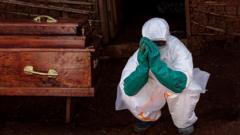
The headlines coming out of Central Africa look terrifyingly familiar, but the crisis unfolding right now is fundamentally different from past disasters. A massive surge of Ebola cases is tearing through the Ituri province of the Democratic Republic of the Congo (DRC) and spilling across the porous border into Uganda. The World Health Organization (WHO) has already logged hundreds of suspected cases and rising fatalities. Airport screenings are ramping up again, and regional panic is setting in.
But here is the detail most news reports are burying: the current crisis is driven by the rare Bundibugyo strain of the virus.
If you remember the massive 2014 West African outbreak or the 2018 DRC crisis, you might think the world already solved the Ebola problem. We have Ervebo, a highly effective, licensed vaccine manufactured by Merck. We have established treatment protocols. Unfortunately, none of those tools work effectively right now. Ervebo targets the Zaire strain, the most common variation of the virus. Against the Bundibugyo strain, it is virtually useless.
Right now, there are zero approved vaccines and zero approved therapies specifically designed to fight the Bundibugyo virus. Healthcare workers on the front lines are fighting completely blind, relying entirely on basic supportive care like fluids and blood pressure medication to keep patients alive.
The international community is scrambling to fix this. Independent expert panels convened by the WHO just fast-tracked a handful of experimental vaccines and therapies for immediate clinical trials. Global health groups are throwing millions of dollars at drugmakers to accelerate production. The race is on, but the reality on the ground means the world is facing a dangerous waiting game.
The Three Experimental Vaccines Racing to Clinical Trials
With no approved safety net, scientists are trying to build one in real-time. The WHO Technical Advisory Group on Candidate Vaccine Prioritization recently reviewed the global pipeline and highlighted three distinct vaccine candidates to push into human trials as fast as humanly possible.
The strategy relies on a mix of proven platforms and newer technology adapted from recent pandemic responses.
1. The IAVI rVSV Single-Dose Candidate
Developed by the International AIDS Vaccine Initiative (IAVI), this candidate is technically considered the most promising long-term option by global experts. It uses a replication-competent vesicular stomatitis virus (rVSV) platform. If that sounds familiar, it is because it uses the exact same underlying technology as Merck’s highly successful Ervebo vaccine.
Because it requires only a single dose, it is perfectly suited for "ring vaccination" strategies, where response teams vaccinate the entire social circle and community surrounding an infected person to choke off the virus’s path.
The massive downside? Speed. The WHO notes that it will take roughly seven to nine months before this candidate is fully ready to be deployed and assessed in a clinical trial. In a fast-moving outbreak, nine months is an eternity.
2. The Oxford ChAdOx1 Platform
A much faster option is coming out of the University of Oxford. Researchers there have adapted their ChAdOx1 viral vector platform—the exact same chimpanzee adenovirus technology used to create the AstraZeneca COVID-19 vaccine—to target the Bundibugyo strain.
Oxford has teamed up with the Serum Institute of India to prep for mass production. This candidate could be on the ground and ready for clinical testing in just two to three months.
However, the logistics are more complicated than a single-dose shot. While a single dose might offer quick, temporary protection for immediate contacts of a patient, experts believe a two-dose schedule will likely be required to give durable, long-term immunity to high-risk individuals like frontline nurses and doctors. Furthermore, scientists are still rushing to finish gathering the necessary animal data to confirm its safety profile before sticking it into human arms.
3. Moderna's mRNA Initiative
The Coalition for Epidemic Preparedness Innovations (CEPI) just committed up to $60 million to jumpstart production for a third wave of vaccines, with the lion's share going to Moderna. This initiative will fund the preclinical and early clinical development of an mRNA-based Bundibugyo vaccine.
While mRNA technology allows for incredibly rapid design and scaling, it is still in the early stages for this specific pathogen. CEPI’s funding is designed to move the vaccine through early phase testing and secure manufacturing pipelines, ensuring that if the outbreak persists into late 2026, a high-tech manufacturing fallback exists.
The Medical Stopgaps Being Deployed Immediately
Vaccines are great for stopping the next wave of infections, but they do nothing for the hundreds of people currently fighting for their lives in overstretched medical wards. Because vaccines take months to test, the WHO is simultaneously greenlighting the experimental use of existing therapeutics.
A few specific treatments are being prioritized for clinical trials among confirmed Bundibugyo cases right now:
- MBP134: A monoclonal antibody cocktail developed by Mapp Biopharmaceutical that has shown strong cross-reactive potential against multiple strains of Ebola in laboratory settings.
- Maftivimab: A component of Regeneron’s approved Ebola treatment. Supplies are already being moved onto the ground in the DRC so doctors can use them in controlled studies immediately.
- Remdesivir and Obeldesivir: Gilead Sciences’ antivirals are being pulled into the mix. Remdesivir is being looked at as an active treatment, potentially paired in a combination therapy with monoclonal antibodies. Obeldesivir, an oral antiviral, is being prioritized as a post-exposure preventative drug for people who know they have been exposed to a confirmed case.
Why Containment on the Ground Is a Logistical Nightmare
If the science is moving quickly, the reality on the ground in Central Africa is doing everything it can to slow it down. It is easy to look at a list of experimental drugs and feel optimistic, but deploying them in eastern DRC is an operational nightmare.
First, consider the regional instability. The Ituri province and surrounding areas are plagued by active conflict, armed militia groups, and massive population displacement. It is incredibly difficult to run a meticulous, multi-month clinical trial when patients are fleeing violence and medical teams require armed escorts to reach remote villages.
Second, contact tracing for an oral preventative drug like obeldesivir requires pinpoint accuracy. You have to find every single person an infected individual interacted with over a three-week period. In a region with weak public health infrastructure, limited roads, and deep-seated community mistrust of outside medical authorities, effective contact tracing is nearly impossible to maintain. Frontline workers are reporting severe shortages of basic protective gear like gloves and masks. They are running out of the bare essentials before they even get a chance to worry about high-tech experimental drugs.
Finally, the geographic reality is dangerous. The outbreak has already trickled into Uganda, and health officials warn that it is a matter of time before it hits South Sudan. Once a highly lethal hemorrhagic fever gets a foothold in a region with virtually no functioning public health system, containment strategies completely break down.
What Needs to Happen Right Now
We cannot wait for a perfect, peer-reviewed vaccine to magically appear on the market next year. The current outbreak is outpacing global response efforts, meaning international agencies and regional governments have to alter their strategy immediately.
If you are a public health stakeholder, a non-governmental organization worker, or an industry donor, the immediate priorities must shift away from standard operational procedures.
- Fund the Production Risk Immediately: Gavi, the Vaccine Alliance, recently unlocked $50 million through its First Response Fund. Up to $40 million of that is earmarked purely to de-risk manufacturing. This money must be used to fund "at-risk" production. Manufacturers need to start building stockpiles of the Oxford and IAVI candidates right now, before the clinical trials even finish. If we wait for trial data to print before building factories, the outbreak will be completely out of control by the time the doses arrive.
- Prioritize Local Infrastructure Over Novel Meds: An experimental monoclonal antibody is useless if a clinic doesn't have clean needles, running water, or basic personal protective equipment (PPE). International donors need to flood the Ituri province and Ugandan border clinics with basic medical supplies to lower the baseline mortality rate while the trials get organized.
- Establish the CORE Trial Protocol: Local health authorities in the DRC and Uganda must work directly with the WHO to implement the pre-designed CORE clinical trial framework. This allows doctors to administer experimental drugs like MBP134 and remdesivir ethically to dying patients while simultaneously gathering the data required to prove whether the drugs actually work.
The global health apparatus was caught flat-footed by the Bundibugyo strain because it assumed the Ebola problem was solved. It isn't. The coming weeks will determine whether the fast-tracked vaccine pipeline can outrun a neglected virus.