The kettle was still warm when the brick smashed through the living room window.
It is a sound that stays with you. Glass doesn't just break; it explodes under the force of hatred. In a terrace house off the Donegall Road in south Belfast, a family from Sudan was about to pour tea. It was August 2024. Within seconds, the warm, familiar smells of home were replaced by the sharp, metallic tang of fear and the freezing night air rushing through shattered double glazing.
They did not stay to pack. You don't look for passports when the street outside is chanting for your blood. You grab the children. You run through the back door into the dark, leaving behind the life you spent years trying to build in a city that promised peace.
That night, they were not alone. Dozens of families across Belfast made the same choice. They fled.
The Illusion of Peace
For decades, the global narrative surrounding Belfast was one of triumph. The Good Friday Agreement of 1998 was hailed as the blueprint for ending intractable conflict. Billions in investment poured in. High-end coffee shops replaced fortified security checkpoints. Titanic Quarter rose from the industrial rust, a gleaming monument to a modern, European city.
But peace is not merely the absence of bombs.
While the city center flourished, the working-class neighborhoods on either side of the invisible sectarian divides remained largely forgotten. Decades of trauma don't vanish because a treaty is signed; they mutate. The territorial anxiety that once fueled conflict between Catholics and Protestants found a new target.
The statistics paint a grim, undeniable picture. Northern Ireland, a place with a population of just under two million, witnessed a terrifying surge in racially motivated hate crimes. Police Service of Northern Ireland (PSNI) data revealed that racist incidents overtook sectarian incidents in various parts of the city. In the year leading up to the 2024 violence, racisms-related offenses spiked by over 30%.
To understand why, you have to look at the geometry of a Belfast street.
Imagine a neighborhood where housing is scarce, the local school is underfunded, and the GP surgery has a six-week waiting list. Now, look at the flags flying from the lampposts. They aren't just fabric. They are territory markers. When minority families move into these areas—often because it is the only affordable housing available—they aren't viewed as new neighbors. They are viewed as invaders threatening a fragile equilibrium.
When the Screen Becomes a Match
The violence of August 2024 didn't spark in a vacuum. It was cultivated online, fed by a diet of digital disinformation that weaponized local anxieties.
Following a tragic stabbing incident in Southport, England, false rumors spread like wildfire across social media platforms. High-profile far-right figures, completely disconnected from the reality of life in Northern Ireland, used their platforms to claim that undocumented migrants were taking over local communities.
The algorithms did what they were designed to do. They amplified anger.
Consider what happens next: a young man sitting in a damp bedroom in Belfast spends hours scrolling through a feed telling him his culture is being erased, his job is being stolen, and his community is under siege. He doesn't check the data. He doesn't know that the total percentage of the population in Northern Ireland born outside the UK and Ireland is less than 7%. He just feels the rage.
When the call went out for "anti-immigration" protests, it wasn't just political activists who showed up. It was local paramilitaries.
In Belfast, illegal criminal gangs still exercise significant control over working-class estates. They saw an opportunity. By hijacking legitimate anxieties about public services, they reasserted their dominance. They pointed fingers at the local supermarket owned by a Syrian refugee, the computer repair shop run by a Nigerian businessman, and the homes of nurses working in the Royal Victoria Hospital.
The protests quickly dissolved into riots.
The Anatomy of an Exodus
The human cost of that week cannot be measured solely in damaged property, though the financial toll was heavy. It is measured in the quiet terror of families hiding in their own hallways.
A local community worker, who asked to remain anonymous for his own safety, described the systematic nature of the intimidation. It wasn't random. "They came with lists," he said. "They knew exactly which doors to kick. They knew which houses belonged to foreigners."
Think about the psychological weight of that realization. Someone you pass in the grocery store, someone who watches the same football matches as you, has been tracking where your children sleep.
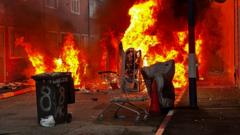
On the worst night of the violence, arsonists targeted a multi-cultural block of businesses. A cafe, a vital community hub where locals and newcomers shared stories over breakfast, was reduced to ash. The owner had spent his life savings to open it. As the flames tore through the roof, the crowd cheered.
That cheer is what broke the spirit of the neighborhood.
By midnight, the evacuations began. It wasn't organized by the state. It was a panicked, grassroots rescue operation. Anti-racism activists, church leaders, and terrified neighbors used their own cars to move people out of the targeted areas.
They packed cars in the dark, headlights switched off to avoid drawing attention. Children were told it was a game, a sudden midnight camping trip, to keep them from crying and alerting the mobs roaming the main roads.
More than 20 families abandoned their homes in a single 48-hour period. They were placed in temporary emergency accommodation, church halls, and the spare rooms of strangers.
The Cost of Silence
The morning after the worst of the rioting, the rain did what the police could not. It cleared the streets.
The physical debris was swept away by afternoon. Broken glass was shoveled into bins. Scorch marks on the tarmac were scrubbed. But the invisible scars remained.
For the people who fled, the question wasn't just where they would live next, but who they could ever trust again. The city they thought had moved past its dark history had shown them that the capacity for tribal violence was alive and well, it had simply found a new demographic to persecute.
The real tragedy of the Belfast riots is the silence that preceded them. For years, community leaders warned that anti-immigrant sentiment was being mainstreamed. They warned that hate crimes were being dismissed as low-level anti-social behavior. Their warnings were treated as exaggerations by politicians more concerned with constitutional squabbles than social cohesion.
When leadership fails, the vacuum is always filled by the loudest, most violent voices in the room.
The Sudanese family did not return to the terrace house off the Donegall Road. A few days after the attack, a removal van arrived accompanied by a heavy police escort. Their belongings—a sofa, a television, a box of children’s toys, and the unbroken pieces of their kitchen—were loaded into the back in broad daylight.
Neighbors watched from behind twitching curtains. Nobody came out to say goodbye.
The street is quiet now. The shattered window has been boarded up with a sheet of grey plywood. If you walk past it today, you wouldn't know that a family once lived there, that they laughed there, or that they poured tea there while the kettle was still warm. You would only see a blank space where a home used to be.