The smell hits you first. It is not the crisp, clean air of a British spring evening. It is sulfur. It is burning potassium nitrate and strontium, a thick, acrid fog that clings to the back of the throat and turns the streetlights into blurry, blood-red halos.
If you stood outside the Holte End, you could not see your own boots. But you could feel the ground shake.
For forty-two years, a silence hung over the trophy room at Aston Villa. It was a heavy, multi-generational quietness that outlived managers, owners, and the youth of the men who stood on chairs in Rotterdam in 1982. To be a football fan in this corner of the Midlands was to participate in a long, patient exercise in memory. You did not talk about the present. You talked about Peter Withe. You talked about Tony Barton. You talked about what used to be.
Then came the whistle in Athens. Then came the open-top bus.
The Weight of Forty-Two Winters
Consider a hypothetical supporter named Arthur. He is sixty-eight. His knees crack when he stands up too fast, and his season ticket has been paid for by direct debit for longer than the club’s star striker has been alive. In 1982, Arthur was twenty-four. He traveled to the European Cup final on a chartered boat, drank warm Stella Artois, and watched his team conquer Europe. He thought it was the beginning of an empire.
Instead, it was a high-water mark. The tide receded so far that, for a few dark years in the late 2010s, the club felt closer to extinction than excellence.
When Aston Villa secured the Europa League trophy, Arthur did not shout. He sat down on his sofa and cried quite quietly into a faded scarf. The modern sports media landscape likes to quantify success in millions of pounds, coefficient points, and Champions League qualification revenue. But those are spreadsheets. They are bloodless.
The real currency of football is the sudden, violent erasure of decades of disappointment.
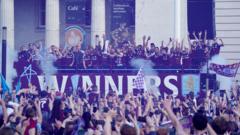
When the victory parade rolled out onto the streets of Birmingham, it was not merely an event for the local news capsule. It was a collective exhalation. An estimated one hundred thousand people squeezed into the narrow arteries surrounding Villa Park. They did not gather because they wanted to see millionaires wave from a customized Volvo chassis. They gathered to look at each other and confirm that the long wait was finally over.
Crimson Smoke and the Ghost of Rotterdam
The bus moved at a sniper’s pace. It had to. The tarmac had disappeared beneath a sea of human beings clad in claret and blue.
Then, the flares went off.
The use of pyrotechnics at football matches is technically illegal under British law, a detail that became entirely irrelevant the moment the front tires of the parade bus crossed into Witton. First came a single pop. A spark. Then, a bloom of thick, intense crimson smoke that swallowed the vehicle whole.
Within minutes, dozens of marine flares were lit simultaneously. The light they cast was not bright or celebratory in the traditional sense; it was visceral, theatrical, and slightly dangerous. The glare illuminated the faces of the players on the upper deck. These were young men from France, Spain, and South America, multi-millionaires who live in gated enclaves and communicate via slickly managed social media profiles. Yet, looking down into that ruby-tinted haze, their expressions shifted from standard PR smiles to genuine awe.
They were seeing something raw.
The smoke rose, mixing with the low-hanging rain clouds, creating an artificial twilight. From the middle of the crowd, the world shrank to a five-meter radius of noise and heat. You could hear the rhythmic thud of a bass drum. You could hear the old songs, resurrected with a ferocity that suggested they had been bottled up under high pressure for half a century.
We shall not be moved.
Just like the team that’s gonna win the European Cup...
The irony of singing about the European Cup while celebrating a Europa League trophy was lost on no one, yet ignored by everyone. It was the rhythm that mattered. The continuation of the lineage.
The Invisible Architecture of a Football Club
Every football club is a ghost story. The current squad is merely the latest group of actors occupying the costumes.
As the parade vehicle groaned past the statue of William McGregor—the Villa director who literally founded the Football League in 1888—the contrast between the ancient and the hyper-modern became impossible to ignore. This is a club that helped invent the structured game of football. For decades, that history felt like a millstone. It was a reminder of what the institution used to be, a standard that the modern iterations continuously failed to meet.
To understand why a mid-week parade caused an entire city to ground to a halt, you have to understand the specific ache of the English post-industrial city. Birmingham does not possess the global glamour of London or the media-darling status of Manchester. It is a city built on iron, brass, and hard work. Its victories are rarely loud.
When the team wins, the city feels taller.
On the top deck of the bus, the manager stood slightly apart from the players. He is a man known for his obsessive attention to detail, a coach who watches videos of throw-ins at three o'clock in the morning. His face, usually a mask of intense tactical calculation, relaxed into a smile. He understood what he had built. He hadn't just organized a defense; he had reconnected a severed wire between the past and the present.
The Morning After the Fire
By midnight, the smoke had cleared. The streets around Witton station were littered with the gray, spent husks of industrial flares, discarded plastic cups, and soggy program booklets. The one hundred thousand had dispersed back into the suburbs, back to their shifts, their mortgages, and their ordinary lives.
Arthur walked back to his car slowly. His coat smelled of sulfur. His throat was hoarse from singing songs he thought he had forgotten the words to.
The victory parade will be recorded in the record books as a simple fact: a celebration of a European trophy in May 2026. The television footage will show the bright red lights, the waving players, and the massive crowds. But the footage cannot capture the invisible shift in the city’s bones.
The forty-two-year silence is gone. In its place is something much louder, much hotter, and infinitely harder to extinguish.
As Arthur reached his vehicle, he looked back toward the stadium. The stadium lights were turning off one by one, plunging the grand old brick facade back into the darkness. But the air still smelled of saltpetre. The pavement was still warm. And for the first time in his adult life, he wasn't looking backward to find the glory.
He was standing right in the middle of it.