Wildfires don't just burn trees. They erase legacies. When a massive blaze tore through the scrubland of Western Australia recently, the stakes weren't just about property or timber. They were about a bird so rare most people have never seen one in the wild. I'm talking about the Western Ground Parrot, or Kyloring. Firefighters found themselves in a race against time, not just to stop the flames, but to save a handful of eggs that represent the fragile hope of an entire species.
It's easy to look at a wildfire and see a wall of heat. But look closer. Deep in the undergrowth, where the brush is thickest, these birds build their nests on the ground. That’s a death sentence when a fire front is moving at twenty miles an hour. Most animals flee. These birds, and specifically their unhatched young, don't stand a chance without human intervention. This wasn't just a routine rescue. It was a high-stakes heist against nature itself.
Why the Western Ground Parrot is a big deal
If you haven't heard of the Kyloring, you're not alone. It's one of the rarest birds on the planet. Estimates suggest there are fewer than 150 of them left in the wild. They’re cryptic, green-gold ghosts that live in the heathland. They don’t really fly high; they scurrying through the bushes. Because they nest on the ground, they're sitting ducks for feral cats and, more importantly, for the increasingly frequent fires hitting the Australian bush.
When the fire broke out near the Waychinicup National Park, conservationists panicked. This area is one of the last strongholds for the species. If this population went up in smoke, the Western Ground Parrot would likely move from "critically endangered" to "extinct in the wild." The firefighters on the ground weren't just spraying water. They were working with wildlife experts to locate known nesting sites before the heat became unsurmountable.
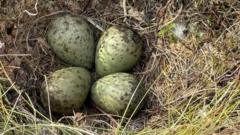
Finding a nest in the middle of a looming fire is like finding a needle in a burning haystack. These birds are masters of camouflage. Their nests are literally just little hollows in the dirt hidden by dense vegetation. You could walk right over one and never know it. But the team knew exactly where to look thanks to years of radio-tracking data.
The extraction under pressure
The rescue wasn't some slow, methodical scientific expedition. It was frantic. Smoke was thick enough to choke a horse. Ash was falling like snow. Fire crews provided a perimeter of water and flame retardant, creating a temporary "cool zone" so the eggs could be reached.
Experts carefully lifted the eggs from the warm earth. You have to realize how delicate this is. If an egg gets too cold, the embryo dies. If it gets bumped too hard, the shell cracks. They used portable incubators—basically high-tech suitcases that keep the temperature and humidity perfectly stable. They moved them out just as the wind shifted, sending the main fire line toward the very spot where the nest had been minutes before.
Honestly, the luck involved here is staggering. If the fire had started at night, or if the wind had been five degrees more to the west, we’d be talking about a tragedy instead of a rescue. It’s a reminder of how thin the line is between survival and extinction for these specialized creatures.
What happens when the smoke clears
Rescuing the eggs is only the first half of the battle. Now comes the hard part: captive rearing. These eggs were rushed to Perth Zoo, where specialists took over. Raising a Western Ground Parrot from an egg is incredibly difficult. We don’t have a "manual" for this because it’s so rarely done.
The staff has to mimic the exact conditions of the wild. They use tiny puppets or specialized feeding tools so the chicks don't imprint on humans. If a bird thinks a human is its parent, it'll never survive in the wild. It won't know how to find food or avoid predators. It's a 24-hour job.
- Temperature must stay within a fraction of a degree.
- Humidity levels are checked every hour.
- Feeding happens around the clock for the first few weeks.
This isn't just about these few eggs, either. It’s about the genetic diversity of the whole species. With only 150 birds left, every single gene matters. If these chicks hatch and thrive, they can eventually be released back into "safe" zones—areas that have been cleared of feral predators and have had controlled burns to manage the fire risk.
The problem with our current fire strategy
We need to be direct about this: our current way of managing wild spaces is failing these birds. We've suppressed fire for so long in some areas that when it finally hits, it's a monster. Or, conversely, we have too many "cool burns" at the wrong time of year, destroying the thick cover these birds need to hide from hawks and cats.
The Western Ground Parrot needs "old" heath—vegetation that hasn't burned in decades. But in a world getting hotter and drier, keeping a patch of land unburned for thirty years is nearly impossible. We're forcing these animals into smaller and smaller pockets of habitat. Then, when a lightning strike or a stray spark hits, it wipes out the whole neighborhood.
The rescue in Waychinicup was a miracle, but we can't rely on miracles. We need better habitat corridors. We need more aggressive predator control. And we need to realize that "conservation" now involves firefighters as much as it involves biologists.
The road ahead for the Kyloring
Right now, those eggs are under constant surveillance. If they hatch, it’ll be a massive win for the Department of Biodiversity, Conservation and Attractions (DBCA) and the partners involved. But the real work is making sure they have a home to go back to.
If you want to help, don't just look at the photos of the cute chicks. Look at the organizations doing the dirty work. Groups like Friends of the Western Ground Parrot are constantly raising funds for GPS trackers and habitat restoration.
You can make a difference by supporting citizen science projects or donating to specialized wildlife recovery funds. If we don't act, the next fire won't have a rescue crew standing by. We’re down to the wire. Every egg counts. Every nest matters. Stop thinking someone else will handle it.
Get involved with local conservation groups. Stay informed about controlled burn schedules in your area. Demand better funding for wildlife first responders. The firefighters did their part in the heat of the moment; now the rest of us have to do ours in the aftermath.