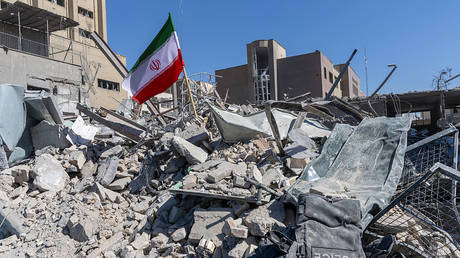
The air in Tehran doesn’t smell like revolution or geopolitics. It smells like diesel exhaust, roasting saffron, and the sharp, metallic tang of a city that never quite sleeps because it is always waiting for the other shoe to drop.
Farid sits in a small cafe in the North of the city, his thumb hovering over a cracked smartphone screen. He is twenty-four. He studies civil engineering. He should be worrying about his exams or the price of bread, but instead, he is watching a grainy video of a drone launch. To the analysts in Washington or Brussels, that drone is a data point in a shifting global order. To Farid, it is the sound of the world he was promised—a world of global trade and digital connectivity—slowly dissolving into the ether.
We have spent thirty years living inside a specific kind of dream. After the Berlin Wall crumbled, a consensus formed: the world would get flatter, the markets would stay open, and the old ghosts of total war were buried under a mountain of consumer electronics. This was the "post-Cold War order." It was a rigid, predictable architecture built on the idea that no one would be foolish enough to set the global house on fire because we all lived in it.
That house is currently engulfed in flames.
The End of the Long Peace
The conflict surrounding Iran is not merely a regional skirmish or another chapter in the endless book of Middle Eastern instability. It is the friction point where the old world dies. For decades, the United States and its allies maintained a hegemony that relied on a simple rule: if you break the international norm, you get locked out of the room. Sanctions were the padlock. Diplomacy was the key.
But what happens when the room itself starts to splinter?
Iran has spent years becoming a master of the shadow. While the West focused on high-tech carrier groups and precision-guided democracy, Tehran and its contemporaries looked for the cracks in the pavement. They found them in the Strait of Hormuz. They found them in the cheap, lawnmower-engine drones that can bypass a billion-dollar defense system. Most importantly, they found them in the realization that the "international community" is no longer a unified front.
Consider the Red Sea. A few years ago, the idea that a non-state actor could effectively throttle 12 percent of global trade with bolt-together missiles seemed like a fever dream. Today, it is a Tuesday. The cost of shipping a container from Shanghai to Rotterdam has tripled. Your coffee is more expensive. Your car parts are delayed. This is the invisible stake of the conflict. It isn't just about territory; it’s about the fact that the arteries of civilization are suddenly vulnerable to anyone with a GPS-guided hobby kit.
The New Gravity
We used to talk about "spheres of influence" as if they were lines on a map. They aren't. They are centers of gravity. For thirty years, the only gravity that mattered was Western. Now, a new mass is forming.
When Iran signs long-term strategic pacts with Russia or China, it isn't just a trade deal. It’s a declaration of independence from the post-Cold War ruleset. They are building a parallel reality—a "dark" economy where oil moves in ghost tankers, payments happen in currencies that don't pass through New York, and the traditional levers of power simply fail to find a grip.
It feels like watching a tectonic plate snap.
Think of a clock. For decades, the gears turned in one direction. Now, the teeth are grinding. The war on Iran—whether it stays in the shadows or breaks out into the blinding light of open combat—serves as the ultimate stress test for this new reality. If the old order cannot protect the shipping lanes, cannot enforce its sanctions, and cannot deter a middle-sized power from disrupting the global flow, then the old order doesn't actually exist anymore. It is just a memory.
The Human Cost of Abstract Strategy
Back in that cafe, Farid doesn't care about the BRICS alliance or the intricacies of the JCPOA. He cares about the fact that his VPN is failing. He cares that the software he needs for his degree is blocked by an embargo. He is a citizen of a country that is being used as a laboratory for the future of warfare.
The tragedy of the modern era is that we have become incredibly good at dehumanizing the consequences of our shifts. We speak in terms of "regime change," "asymmetric capabilities," and "strategic pivots." We forget that a "strategic pivot" usually involves a lot of people bleeding in places we can't find on a map.
The war on Iran is unique because it is the first potential great-power conflict of the AI age. This isn't the 1940s, where you had to move divisions of men across a desert. This is a war of bits and atoms. It’s a cyber-attack that shuts down a power grid in Isfahan followed by a drone swarm that hits a refinery in Abqaiq. It is fast, it is deniable, and it is terrifyingly efficient.
We are entering an era of "permanent volatility." There will be no more "Mission Accomplished" banners. There will only be a constant, low-grade fever of disruption.
The Myth of the Clean Break
There is a dangerous temptation to believe that if we just "solve" the Iran problem, we can go back to the way things were in 1999. That is a fantasy. The tools of disruption have been democratized. The secret is out: the global system is fragile.
If you take a hammer to a mirror, you don't get two mirrors. You get a thousand shards of glass.
The post-Cold War order was that mirror. It reflected a specific vision of the future—one that was democratic, capitalist, and largely peaceful. But that mirror was held together by the assumption that everyone wanted to be part of the image. Iran, and the powers backing it, have decided they would rather see their own reflection, even if they have to bleed to do it.
The stakes aren't just the price of oil or the survival of a specific government. The stake is the very concept of "global." We are witnessing the re-bordering of the world. We are moving from a single, integrated highway to a series of gated communities, each with its own guards, its own internet, and its own truth.
The Sound of the Shift
If you listen closely, you can hear the sound of the world changing. It isn't always an explosion. Sometimes, it's the silence of a cargo ship turning around. It’s the click of a bank account being frozen. It’s the sigh of a student who realizes his future has been traded for a seat at a geopolitical poker table he never asked to join.
We are currently in the transition phase. This is the messy, violent middle of the story. The old rules are dead, but the new ones haven't been written yet. We are making them up as we go, using blood and silicon as our ink.
Farid finishes his coffee. He looks out at the traffic of Tehran, a chaotic river of steel and ambition. He knows that somewhere, in a room with no windows, men are looking at satellite photos of his neighborhood and discussing "optimal strike windows." He also knows that halfway across the world, someone is looking at a chart of inflation and wondering why their life feels so much harder than it did five years ago.
Both of these people are victims of the same collapse. They are both trying to navigate a landscape where the landmarks have been moved in the middle of the night.
The turning point isn't coming. It happened while we were sleeping. The war on Iran is simply the first time we’ve had to wake up and look at the wreckage in the morning light.
He puts his phone in his pocket. He wonders if he will be able to finish his degree before the internet goes dark for good. He wonders if the people making the maps realize that the lines they draw are actually scars on the skin of the world.
The sun sets over the Alborz Mountains, casting long, jagged shadows across the city. They look like cracks in the foundation of the earth.