Darkness is rarely absolute. Usually, it comes cushioned by the ambient glow of streetlights, the steady hum of a refrigerator, or the stubborn blue light of a phone screen. We have engineered the night into submission. We have built cities that refuse to sleep, creating an artificial twilight that insulates us from the raw, indifferent architecture of the cosmos.
Until the shadow slips across the face of the moon.
Think back to the last time you stood outside in the cold without your coat just to stare upward. For me, it was a crisp Friday night three years ago, breath pluming in the air like smoke, listening to the neighborhood dogs howl at a celestial geometry they couldn't possibly understand. The air smelled of damp earth and woodsmoke. My fingers were freezing, but I couldn't look away.
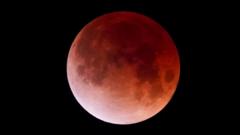
Friday brings another blood moon. Not just a distant, clinical alignment of planetary bodies, but a total lunar eclipse that turns the closest neighbor we have in space into a bruised, glowing ember.
Most astronomy guides will tell you the mechanics. They will use dry terms like umbra, penumbra, and Rayleigh scattering. They will give you exact timestamps down to the minute, advising you to step outside at midnight with a pair of binoculars and a cup of coffee. They treat the event like a train schedule.
They are missing the point entirely.
To understand why a blood moon matters, you have to abandon the spreadsheets and consider what happens to the human nervous system when the sky suddenly refuses to follow the rules. For thousands of years, a darkened moon was not a photo opportunity. It was a crisis. It was a tear in the fabric of the predictable universe. Our ancestors did not sip artisanal coffee on balconies; they beat drums, lit fires, and watched with bated breath to see if the light would return.
That primal unease hasn't vanished just because we invented calculus. It has merely gone dormant, buried beneath layers of modern comfort. When you watch the moon turn red, that old instinct wakes up. The hair on your arms lifts. The background noise of your daily anxieties suddenly sounds very small against the silent, heavy velvet of deep space.
Here is how the mechanics actually play out, translated from the cold physics textbook into reality.
The Earth slides directly between the sun and the moon. In a normal month, the moon coasts safely above or below our shadow, reflecting the sun's harsh white glare back at our retinas. But during a total lunar eclipse, our planet blocks direct sunlight entirely.
If you were standing on the moon looking back at Earth during this moment, you would witness the most magnificent sunrise and sunset happening simultaneously all the way around the rim of our globe. Every single sunrise and sunset on Earth, occurring all at once, casts its light into our shadow.
That filtered, amber-red atmospheric light stretches through our atmosphere, bends around the edges of the Earth, and paints the lunar surface. The moon turns red not because it is bleeding, but because it is bathing in the collective light of every horizon on Earth burning at once.
You are seeing every dawn and every dusk happening right now, projected onto the moon.
Let that sink in.
How do you actually see it without ruining the magic? You do not need a telescope costing thousands of dollars. In fact, optical gear often gets in the way by narrowing your field of vision too much. The best way to experience a blood moon is with the naked eye, standing entirely in the open where you can feel the vastness of the space around you.
Find a dark patch of earth. Turn off your phone. Let your eyes adjust to the dark for at least fifteen minutes—a biological necessity that most modern humans refuse to grant themselves. The stars will emerge, pinpricks of indifferent fire, snapping into focus as the ambient glare fades.
Watch the edge of the moon first. A tiny bite of shadow appears. At first, it is subtle, easily mistaken for a cloud or a trick of tired eyes. But it grows. The shadow creeps across craters and ancient seas of solidified lava, marching with the relentless, unhurried pace of orbital mechanics.
Then comes the transition. The white light dulls, shifting into a deep, velvety charcoal, before the copper and rust tones ignite.
By the time totality hits, the moon hangs there like a ripe peach suspended in ink. It looks three-dimensional in a way it rarely does. Normally, a full moon is a flat, blinding disk of brilliant white paper pasted onto the night. The eclipse gives it volume. You can see its roundness, its weight, its physical presence floating in the void.
People often ask if it is dangerous to look at a lunar eclipse. Unlike a solar eclipse, which can sear your retinas in seconds if you are careless, a blood moon is entirely safe to view directly. You are only looking at reflected sunlight filtered through our own air. There is no radiation to fear, no special glasses required. The danger is entirely psychological. The danger is that you might spend an hour standing in the cold and realize just how small your daily grievances are.
Consider what happens next in our hyper-connected, fast-paced lives. We will wake up Saturday morning, check our notifications, scroll through the blur of headlines, and rush off to brunch or errands. The red moon will be gone, swallowed by the relentless rotation of the Earth, sliding back into the category of trivia we file away in the back of our brains.
Yet something shifts when you witness it firsthand.
We spend our lives staring at screens that project light at us, demanding our attention, feeding our urgency. The moon demands nothing. It asks only that you pause, look up, and remember that you are riding a spinning rock through an incomprehensibly vast ocean of nothingness.
Friday night is coming. The shadow is already waiting in the wings. Step outside, leave the phone inside, and watch the sky catch fire.