The air always smells like ice and heavy oil before dawn breaks over the Gulf of Finland.
If you have ever stood on the flat, windswept docks of Ust-Luga when the winter fog rolls in from the Baltic, you know the particular silence of the place. It is a working silence. Massive container cranes loom like prehistoric skeletons against the gray horizon. Miles of welded steel pipe snake across the marshland, carrying the liquid wealth of a continent toward waiting tankers. Thousands of tons of fuel, chemicals, and compressed gas sleep quietly inside massive terminal complexes, trusting in thick walls, automated valves, and the sheer, cold distance between the Baltic coast and the rest of the troubled world.
Then, the sky tore open.
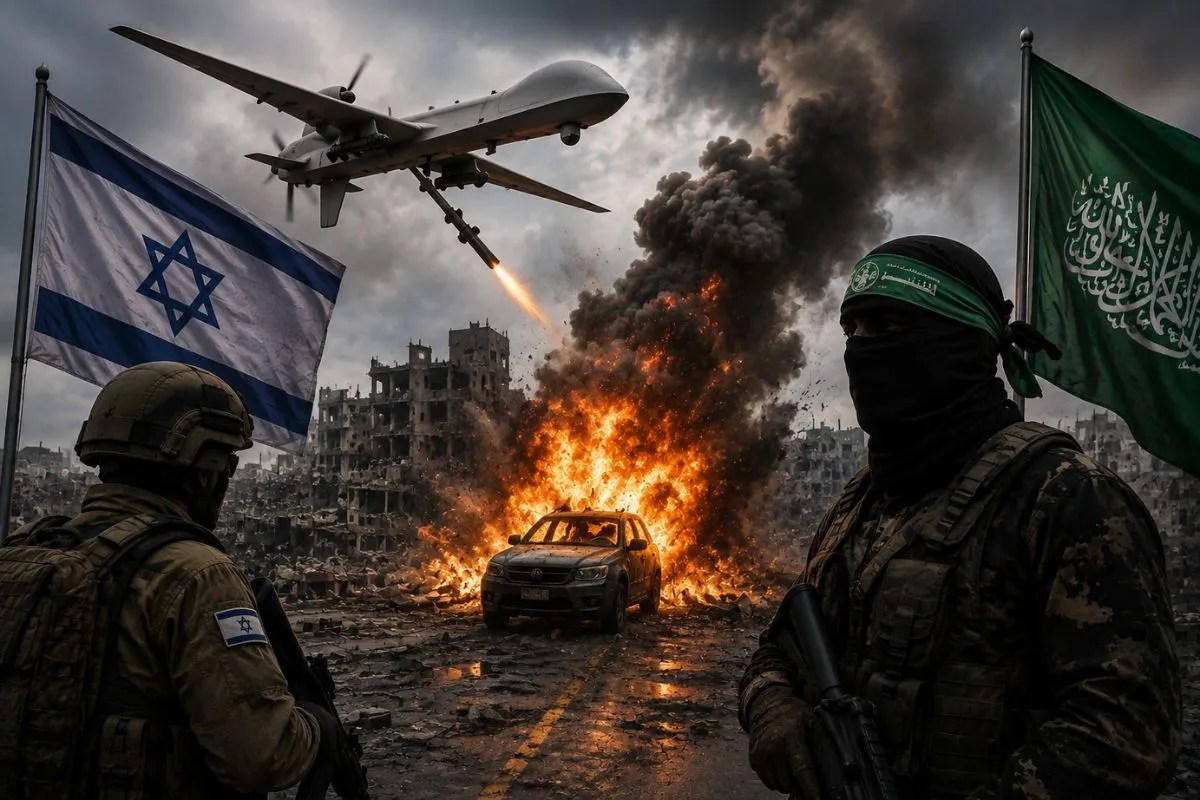
It happened in the deep hours, just before the first pale shift change. Drone strikes—precise, low-flying, and unannounced—punched through the night air above the Novatek fuel export terminal.
Fire.
Not the cozy, crackling fire of a winter hearth, but an industrial monster born of high-octane hydrocarbons. A roar that shook the windows in homes miles away. Within seconds, a towering plume of orange and black billowed into the stratosphere, turning the frozen night into a harsh, flickering daylight. Emergency crews scrambled, sirens wailed across the flat marshlands, and millions of dollars worth of refined energy went up in smoke, casting an eerie glow over the icy water.
Alexander Drozdenko, the regional governor, did what governors do when the invisible war finally crosses their doorstep. He issued statements. He confirmed the explosions. He noted that the gas-condensate plant was targeted, that the flames were tackled, and crucially, that no casualties were reported.
Pause there. Take a breath. No casualties.
It is a miracle wrapped in a statistic. In the dry language of morning news alerts, the absence of human injury is often treated as a bureaucratic footnote. A bullet dodged. A box checked. No casualties reported.
(To ground this in human reality, consider a hypothetical shift supervisor named Dmitri, who had just stepped into the central control trailer for a thermos of black coffee three minutes before the first impact. That coffee saved his life, keeping him out of the primary blast radius. Thousands of workers like Dmitri go to industrial hubs every day, trusting that geography will protect them from geopolitics.)
Geography is no longer a shield.
The Geography of Vulnerability
We forget how fragile the modern nervous system really is. We look at a map of global energy markets and see neat lines, color-coded arrows, and steady percentages. We talk about Brent crude, liquefied natural gas futures, and supply chain resiliency as if they were abstract mathematics played out by computers in sterile office towers in London or New York.
They are not. They are physical. They are iron, concrete, and fire.
Ust-Luga is not just a collection of storage tanks on a map. It is one of Russia's crown jewels for maritime energy export, a massive complex built at the cost of billions to bypass traditional transit routes through neighboring states. It handles millions of tons of oil products annually, feeding Asian and international markets. When a facility like this catches fire, the shockwaves do not just burn up fuel; they alter the economic gravity of the entire hemisphere.
Consider what happens next:
The terminal halts operations. Tankers linger offshore, idling in the freezing swells, their schedules thrown into chaos. Insurance rates for vessels navigating the Baltic Sea spike overnight. Markets twitch. Traders react. Somewhere thousands of miles away, a utility manager looks at a spreadsheet and realizes that the energy equation has just become a little more expensive, a little more terrifying, and a whole lot more uncertain.
This is the hidden cost of modern conflict. It does not just happen on active frontlines where trenches scar the earth. It ripples outward, traveling through invisible pipelines of supply, demand, and fear until it rattles the daily life of people who could not point to Ust-Luga on a classroom globe.
Why the Baltic Became a Powder Keg
To understand why a port on the Gulf of Finland is burning, we have to look backward.
For decades, energy was treated as a commodity separate from politics. Pipelines were built under the assumption that commerce would always outlast conflict. Energy was supposed to be the great stabilizer, a bridge of steel and revenue connecting nations even when diplomatic channels frayed.
That bridge has collapsed.
When traditional land routes and diplomatic agreements fracture, the theater of economic pressure expands. Critical infrastructure becomes the primary target because modern economies run on velocity. If you cannot move the fuel, the economy stalls. If you cannot export the product, the revenue dries up.
The drones that struck Ust-Luga represent a fundamental evolution in how distant wars are fought. They are relatively inexpensive, highly maneuverable, and capable of striking thousands of miles from their launch points. They strip away the tyranny of distance. A conflict that once required massive armies and prolonged campaigns can now reach across borders in a matter of hours, finding the exact weak point in a nation's logistical armor.
And the weak points are everywhere.
Modern civilization is built on extreme efficiency. We do not store years of fuel in our backyards; we rely on just-in-time delivery networks. A single tanker, a single refinery, a single export terminal represents a massive concentration of value and necessity. When you target that concentration, you create maximum psychological and economic impact with minimal physical expenditure.
The Human Core Beneath the Flames
It is easy to get lost in the macroeconomics of it all. Analysts will parse the quarterly export numbers. Pundits will debate the tactical implications of long-range drone technology. Stock markets will adjust, recover, and move on to the next crisis.
But go back to the docks.
Imagine standing on the shoreline of the Gulf of Finland as the smoke finally begins to thin, replaced by a bitter, chemical-laden mist. The workers return to the perimeter. They look at the scorched steel of the fractionation units. They smell the lingering stench of burnt condensate.
They are doing what humans have always done after a disaster: picking up the pieces, welding the pipes back together, and hoping the night stays quiet for at least a little while longer.
The fire at Ust-Luga was extinguished. The flames died down, the emergency alerts were canceled, and the governor's office released its final reassuring notes. But the air around the Baltic has changed. The invisible stakes have been revealed.
The next time you check the price at the pump, or read a fleeting headline about a distant explosion in a frozen harbor, remember the silence before the dawn. Remember that behind every line on an economic chart, there is a physical world of steel, ice, and human fragility waiting for the next shift to begin.
The smoke clears, but the horizon remains dark.