Fifty years is enough time for history to turn into myth, or for memory to curdle into routine.
In the autumn of 1976, the skies above Tehran did something that broke the local radar operators, scrambled military jets, and forced air force pilots to chase silent, luminous phantoms across the nocturnal horizon. It was an incident written off by skeptics as atmospheric refraction, filed away by governments as an unexplainable blip, and preserved in the collective psyche of the city as the night the heavens lost their predictable shape. For a different view, consider: this related article.
Then came last week.
To understand why a stationary smear of light hovering over the Iranian capital sent a fresh tremor through military command chains, you have to stand on a flat concrete rooftop in District 3 of Tehran at two in the morning. The air smells of dry dust, burnt gasoline, and the bitter trace of diesel exhaust that never quite lifts from the valley. Below, the city sprawls in a grid of amber sodium lights—a nervous organism of twelve million souls sleeping in fits and starts. Similar analysis regarding this has been shared by USA Today.
Look up.
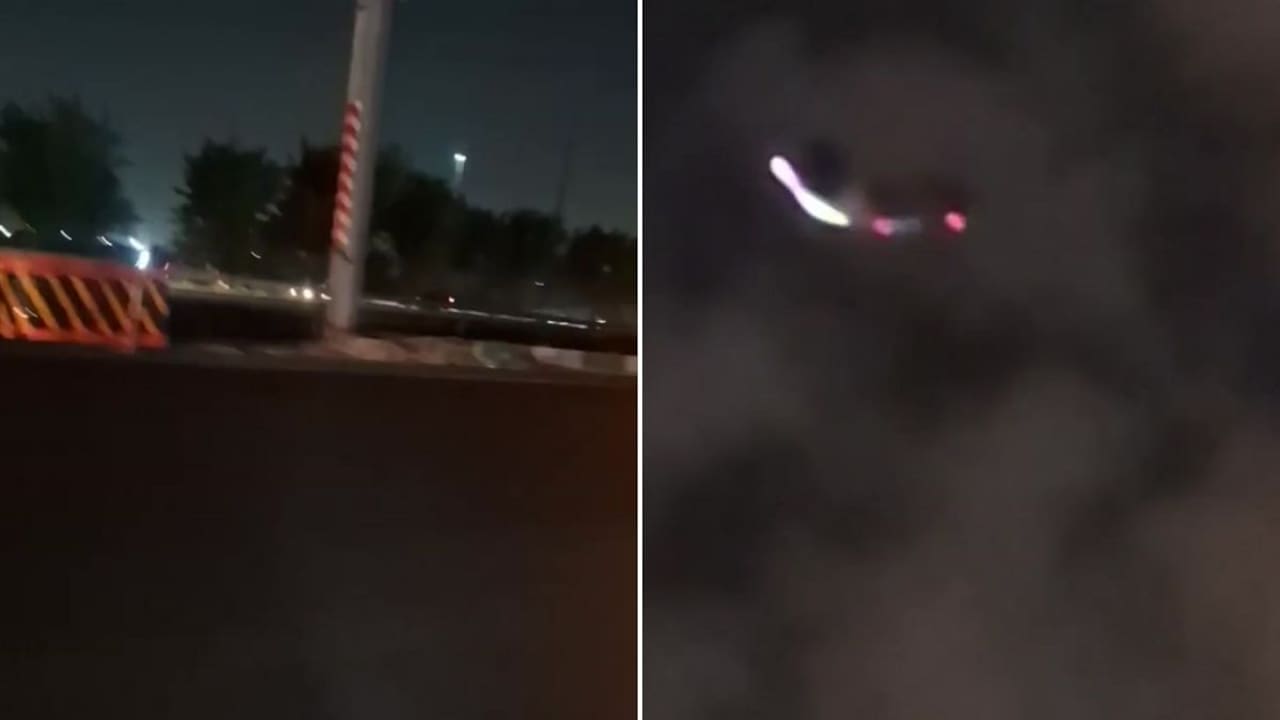
There is nothing supposed to be there except the usual constellations and the smear of industrial haze. Yet, suspended in the velvet dark, a silent pulse of amber and violet hangs motionless. It does not drift with the autumn wind sweeping down from the Alborz mountains. It does not blink with the regular cadence of an Airbus commercial descent into Mehrabad International Airport. It simply stays.
Weightless. Unbothered.
When military radar screens first picked up the signature, the operators didn't immediately talk about extraterrestrial visitors. That is a luxury reserved for late-night cinema. In a control room filled with cold coffee, fluorescent hum, and the low-frequency chatter of telemetry, an unknown radar return is a threat vector. It is a question mark written in blood and protocol.
Let us be entirely clear about what a modern airspace defense system actually is. It is not an omniscient eye of god; it is a cage of assumptions. It assumes objects have mass, burn fuel, generate heat signatures, and obey the stubborn, beautiful laws of aerodynamics. When an object appears on a scope that defies those assumptions—hovering without lift, accelerating from zero to supersonic velocities in the blink of an eye—the human brain experiences a peculiar kind of vertigo.
It is the vertigo of obsolescence.
Historians of the 1976 incident often focus on the scrambling of the F-4 Phantom jets, the sudden electrical failures in the cockpits as the pilots closed in on the glowing object, and the chilling official reports that followed. Those were the cold facts of a Cold War era. But the human element was always buried beneath the classified stamps. Imagine sitting in a cockpit over your own capital city, your instruments dying one by one, watching a silent ball of fire maneuver with casual disdain for the laws of physics that you spent your entire youth mastering. That is not just an encounter with a mystery; it is an encounter with absolute irrelevance.
Now, flash forward half a century.
The jets didn't scramble this time immediately. Instead, there was a heavy, suffocating silence in the communication channels. Social media footage began to bleed through the digital cracks before the state censors could catch their breath—shaky smartphone clips shot from balconies in Tajrish, showing a strange, pearlescent orb hanging over the silhouette of the Milad Tower.
People stopped on the sidewalks. Delivery drivers cut their engines. In a city that has weathered revolutions, economic collapse, and the visceral terror of air raids during the Iran-Iraq war, you learn to read the sky very carefully. A strange light isn't a curiosity here; it is an omen.
Why now? Why this exact coordinate on the globe, fifty years to the decade after the first great sighting?
Astrophysicists and meteorologists offer the standard comforts: rare inversion layers, classified drone testing by foreign adversaries, high-altitude atmospheric phenomena amplified by pollution particles. These explanations are neat. They fit neatly into folders marked Solved.
Yet, as anyone who has stood beneath that hovering anomaly will tell you, logic feels terribly thin when you are staring at an impossibility.
Consider what happens to a population when the inexplicable returns. We do not panic in the cinematic sense. We adapt. We stare up from our balconies, clutch our cheap plastic smartphones, and record the quiet defiance of the universe. We record it because recording it is our only defense against being erased by things we cannot control.
The object over Tehran last week eventually faded. It didn't streak across the sky like a falling star; it simply dissolved, photon by photon, until there was nothing left but the familiar, polluted smog of dawn creeping over the eastern peaks.
The radar screens went cold. The air traffic controllers poured fresh coffee. The morning traffic resumed its sluggish, honking crawl through the asphalt veins of the metropolis.
Fifty years from now, another generation might look up to find the sky playing the same trick again. They will check their instruments. They will argue over the telemetry data. And somewhere in the dark, beneath the amber glow of a restless city, someone will step onto a balcony, look up, and realize just how little we actually own the night.