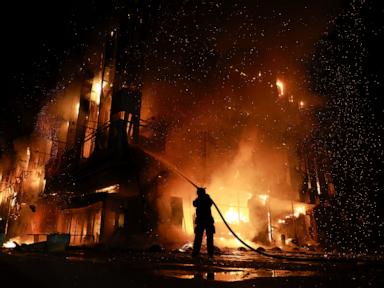
The air smells of burnt copper and old dust long before the first sirens tear through the dark.
For the people living in the southern reaches of Ukraine, the horizon is no longer a place where the sun simply rises. It is a shifting canvas of threat, painted in the orange glare of intercepted steel and the low, angry buzz of machinery that was never meant to bring anything good. When the drones come, they do not arrive in silence. They carry a sound like a lawnmower pushed through a speaker system, high-pitched and relentless, rattling windows and nerves in equal measure.
To understand what is happening now, you have to look backward by just a few hours.
The weekend did not start quietly. Far to the north, over the sprawling concrete and history of Kyiv, the sky became a buzzing hive. A barrage of one thousand drones—a staggering, almost incomprehensible saturation of the airspace—turned the night into a stroboscopic nightmare. Anti-aircraft batteries worked in searing bursts of white light. Shrapnel rained down on asphalt like metallic hail.
Military analysts call this volume of fire saturation. They speak in percentages, interception rates, and logistical vectors. They measure the cost in units and fuel consumption.
Down south, the metric is entirely different.
Here, the metric is the heartbeat of a child hiding beneath a kitchen table. The metric is the cracked plaster of a grandmother's bedroom ceiling.
When the southern city was slammed in the immediate wake of that northern onslaught, it was not a random coincidence of war. It was the brutal logic of displacement. Air defense batteries cannot be everywhere at once. Every missile launched to intercept a buzzing engine in the capital is a missile no longer sitting on a launcher fifty miles south. Modern conflict operates on a terrible ledger of scarcity, and the balance sheet is written in incoming strikes.
Consider what happens when the warning system fails even for a second.
Dmytro knows that silence. He is a retired electrician living in a modest two-story home with a roof patched twice this year alone. He keeps his boots by the bed, not because he plans on going anywhere, but because stepping on glass in the dark is a mistake you only make once.
"You learn to tell the difference," Dmytro says, his voice flat, stripped of panic by sheer repetition. "The drone sounds like a wasp trapped in a jar. When the pitch changes, you drop. You don't look out the window. You don't check your phone. You just wait for the thump."
The thump came at 2:14 in the morning.
It wasn't the biggest blast of the war. Not by a long shot. But it hit a substation, plunging three residential blocks into pitch darkness. Streetlights flickered out, leaving only the erratic, amber glow of burning brush down the block. In that sudden, suffocating dark, the city changed character. The modern world vanished. People became ghosts in their own hallways, guided only by the screen glow of cell phones held like candles.
This is the hidden cost of escalation.
We talk endlessly about strategy, about the geopolitical chess match playing out across Europe, about the numbers rolling off assembly lines in distant factories. We watch the headlines shift from one city to another as if moving pins on a map. But war is not a map. War is friction. It is the grit of drywall in your teeth. It is the unbearable weight of waiting to see if the water will still run in the morning.
When one thousand drones fill the northern sky in a single weekend, it represents an industrial-scale escalation. It means that the manufacturing lines are humming, that the supply chains of destruction are adapting, and that both sides are testing the absolute limits of electronic warfare and radar horizons. It is a terrifying display of modern technical capacity.
Yet, technology without humanity is just noise.
The southern city absorbed the rebound of that northern fury. It took the blow because the network was strained, because the shields were stretched thin across a thousand miles of contested frontier.
Dawn came slowly through a thick soup of smoke and autumn mist.
In the courtyard of an apartment block near the harbor, neighbors gathered around a crater no wider than a kitchen table. It was lined with charred earth and bits of twisted carbon fiber—the cheap, lethal anatomy of a long-range loitering munition. No one was shouting. No one was giving speeches. A woman in a heavy gray coat swept up shards of glass from her doorstep, her broom making a dry, rhythmic scraping sound against the concrete.
Across the street, a stray dog picked its way cautiously through the rubble, sniffing at the strange new landscape.
The sirens stopped hours ago. The smoke is beginning to thin, drifting lazily out toward the dark water of the river. But somewhere, miles away, a motor is starting up again.


