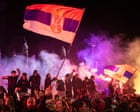
Cold rain in Belgrade smells like wet coal smoke and roasted chestnuts. When it falls on the cobblestones of Knez Mihailova Street in late November, it turns the gray stone into a dark mirror, reflecting the neon signs of betting shops, the blue flash of police cruisers, and the pale, exhausted faces of twenty-year-olds who should be studying for midterms.
Instead, they are holding cardboard signs soaked through at the edges.
If you listen to the standard political podcasts or read the dry dispatches from foreign policy desks, the fall of Slobodan Milošević in October 2000 looks like a tidy sequence of diplomatic checkboxes. Sanctions. NATO airstrikes. A rigged election on September 24. A general strike. Bulldozers rolling into parliament on October 5.
That version of history is clean, sanitary, and completely misses the point.
It misses the terror of waking up at three in the morning to a heavy knock on an apartment door, wondering if the men in the hallway are plainclothes state security or just a drunk neighbor. It misses the suffocating weight of a currency—the Yugoslav dinar—that once inflated so violently a loaf of bread cost billions, wiping out your grandmother’s life savings before she could walk to the market. Most of all, it misses the absurdity of what actually brought a ruthless, battle-hardened autocrat to his knees.
He wasn't defeated by an army. He was laughed out of power by kids armed with spray paint, theater tricks, and a black-and-white stencil of a clenched fist.
The Architecture of Fear
To understand how a group of university students dismantled one of Europe’s last strongmen, you have to understand the invisible cage Milošević built over thirteen years.
By 1998, Serbia wasn't merely an authoritarian state; it was a psychological pressure cooker. Having presided over the bloody breakup of Yugoslavia, four devastating wars, international isolation, and an economy hollowed out by cronyism, Milošević maintained control through a simple, brutal equation: fear plus apathy equals permanence.
The state controlled the major television networks, pumping out a steady stream of nationalist paranoia and painting every critic as a treasonous Western spy. When traditional opposition parties tried to rally the public, they bickered over egos, split into factions, and repeatedly walked into traps set by the regime. Adults—parents who had already watched their pensions evaporate and their sons drafted into hopeless wars—had grown numb. They whispered in kitchens with the radio turned up so neighbors couldn't hear.
Consider a hypothetical family living in a cramped concrete block in New Belgrade during the autumn of 1998. Let’s call the father Dragan, a retired mechanical engineer, and his daughter Elena, a sophomore studying literature at the University of Belgrade. For Dragan, survival meant keeping your head down. You didn't argue with the state; you endured it, like a harsh Balkan winter. To him, politics was a rigged casino where the house didn't just take your money—it broke your legs on the way out.
Elena, however, had grown up knowing nothing but the casino. Her entire adolescence had been defined by hyperinflation, travel bans, and isolation from the rest of Europe. She didn't have a pension to lose. She had a future that had already been stolen.
And when you have nothing left to lose, fear stops working as a leash.
In October 1998, Milošević passed a draconian university law stripping Serbian schools of their autonomy, firing independent professors, and censoring student newspapers. It was an administrative power grab meant to muzzle the last pocket of free thought in the country.
It turned out to be the match dropped into dry timber.
A Fist Without a Face
A dozen students gathered in a smoky Belgrade café and formed a movement they called Otpor!—Serbian for Resistance.
At first, they looked like every failed student protest before them. Just a handful of idealistic kids with no money, no television access, and no political backing. If they had followed the conventional playbook—electing a charismatic leader, holding long-winded speeches, and marching straight into riot police batons—they would have been crushed in a month.
They didn't.
Instead, the founders of Otpor made a series of counterintuitive decisions that turned traditional authoritarian repression against itself. Think of Milošević’s security apparatus as a heavyweight boxer trained to knock out a single, visible opponent. Otpor refused to step into the ring as one person. They designed themselves to be fog.
First, they abolished leadership. There was no president of Otpor, no central committee, no charismatic figurehead for state television to smear or for secret police to quietly "disappear." Every local chapter operated like an independent franchise. If police arrested five students in the city of Novi Sad, ten more printed flyers in Niš the next morning. You cannot decapitate a movement that has no head.
Second, they turned branding into a weapon. One of the founders, a graphic design student named Nenad Petrović, sketched a stark, minimalist clenched fist. It was bold, aggressive, and ridiculously easy to reproduce. With a piece of cardboard, a razor blade, and a can of black spray paint, anyone could stamp the Otpor fist onto a concrete wall in four seconds flat. Overnight, the symbol began appearing everywhere—on train cars, bridge pillars, government buildings, and eventually on seventy thousand T-shirts.
Walking through Belgrade felt like walking inside a visual echo chamber. You couldn't look at a bus stop without seeing that fist staring back at you. It told isolated, frightened citizens a silent, electric truth: You are not alone. We are everywhere.
The Trap of the Barrel
Humor is poison to a tyrant. Strongmen thrive on hatred because hatred confirms their power; they wither under ridicule because laughter makes them look small.
Otpor understood this instinctively. Rather than staging grim, confrontational marches that gave riot police an excuse to swing their truncheons, the students staged surreal street theater designed to force the regime into a lose-lose dilemma.
Picture a bright afternoon on Belgrade’s main pedestrian boulevard. A few students roll an empty oil barrel onto the pavement. Taped to the side of the barrel is a portrait of Slobodan Milošević. Beside it, they place a baseball bat and a small sign inviting passersby to drop a dinar coin into a tin can—and take a swing at the dictator's face.
Then, the students walk away and watch from across the street.
At first, shoppers hurry past, eyes darting nervously. Then a teenager steps up, drops a coin, and swings. CLANG. The hollow metal boom echoes off the buildings. Someone laughs. An elderly woman steps forward next, gripping the bat with both hands, and whacks the barrel. CLANG. Soon, a line forms down the block.
Now trace what happens next inside the local police precinct. The officers arrive to find a crowd laughing hysterically while taking turns beating an oil drum. There are no student organizers to arrest. No weapons. No speeches.
If the police do nothing, they allow public humiliation of the president in broad daylight. If they arrest the barrel—which they actually did, hauling the metal drum into the back of a police van on live foreign news cameras—they look like complete idiots.
This was Otpor’s signature tactic: dilemma actions. Every move forced the state either to tolerate defiance or to overreact so absurdly that it alienated ordinary citizens.
When police began arresting Otpor members—over two thousand students were detained, beaten, or interrogated between 1998 and 2000—the movement didn't retreat. They turned arrests into recruitment drives. The moment a student was dragged into a station, dozens of Otpor activists would surround the building, bringing food, calling local journalists, and singing songs until their friend was released. Getting arrested stopped being a badge of terror; it became a rite of passage, a badge of honor among Serbian youth.
Even the police began to crack under the absurdity. Imagine being a beat cop in a small Serbian town, earning barely enough to buy groceries, ordered to drag a nineteen-year-old girl into an interrogation room because she was wearing a T-shirt with a cartoon fist on it. Then imagine her mother showing up at the station door with a tray of pastries, asking the officers politely why they were beating her daughter instead of arresting the war profiteers driving luxury Mercedes-Benzes down the boulevard.
The psychological armor of the state was rusting from the inside out.
The Slogan That Broke the Spell
By the summer of 2000, Milošević made a fatal miscalculation. Confident that the fractured political opposition couldn't possibly unite against him, he called an early presidential election for September 24, expecting a routine, manipulated victory to legitimize another term.
Otpor wasn't running a candidate, nor did they endorse any single politician. They knew that Serbian voters were deeply cynical about career politicians. So the students launched two parallel campaigns that cut straight to the emotional bone of the country.
The first was aimed at apathy: "He's Finished" (Gotov je).
Three million stickers bearing those two words flooded Serbia. They were slapped over Milošević’s glossy campaign posters, stuck onto bus seats, glued onto bakery windows, and handed out at farmers' markets. Saying Gotov je shifted the public mindset from fearful resistance to inevitability. It whispered that the dictator wasn't an unstoppable monster anymore; he was a dead man walking, a relic whose expiration date had already passed.
The second campaign was aimed directly at the politicians themselves. Otpor leaders cornered the bickering heads of Serbia’s eighteen fragmented opposition parties and delivered an ultimatum backed by seventy thousand mobilized youth: unite behind a single presidential candidate, or face the full fury of the student movement in the streets. Under intense pressure, the opposition finally coalesced behind Vojislav Koštunica, a quiet, constitutional lawyer whom Milošević couldn't easily paint as a Western puppet.
Wait. Let’s pause and admit something honest here.
Looking back twenty-six years later, it is easy to romanticize those final weeks as an effortless triumph of youthful idealism. It wasn't. Inside the movement, panic and exhaustion were constant companions. Activists slept on office floors, survived on cheap cigarettes and Turkish coffee, and checked underneath their cars for explosives. Nobody knew for sure whether Milošević would order the army to open fire on crowds, just as he had sent tanks into neighboring republics a decade earlier. The line between a historic revolution and a bloodbath was razor-thin.
October 5
On September 24, 2000, Serbians went to the polls in massive numbers. By midnight, independent election monitors trained by Otpor and civic groups confirmed what the regime refused to admit: Koštunica had won outright in the first round.
Milošević claimed otherwise. His state election commission announced that neither candidate had cleared fifty percent, ordering a runoff election designed to give the regime time to stuff ballot boxes.
The fuse was lit.
Otpor immediately called for total civil disobedience. Coal miners at the massive Kolubara basin—the beating heart of Serbia’s electrical grid—went on strike, shutting down the country’s power supply. When riot police moved in to break the miners' blockade, twenty thousand citizens from neighboring towns marched through the mud to surround the police lines, locking arms with the workers. The police stood down.
On Thursday, October 5, hundreds of thousands of people from every corner of Serbia converged on Belgrade. Tractors, buses, trucks, and stolen construction equipment rolled past police roadblocks. A yellow wheel loader driven by a quarry worker named Ljubisav Đokić became the accidental tank of the revolution, smashing through the barricades outside the Federal Parliament while tear gas billowed across the square.
Inside the state television building—the propaganda engine that had poisoned the region for over a decade—broadcasts abruptly went dead.
Outside, the elite special police units, the Red Berets, rolled up in armored vehicles. For a breathless, terrifying minute, the square went quiet. The men in the armored cars had automatic weapons and orders to clear the streets. They looked out at half a million furious, unyielding citizens—including their own neighbors, cousins, and college-aged kids wearing black-and-white fist T-shirts.
Then, slowly, the commanders climbed out of their vehicles, took off their helmets, and shook hands with the protesters.
The machine had stopped obeying its operator. Thirty-six hours later, Slobodan Milošević appeared on television—pale, stumbling over his words—to concede defeat.
What Remains After the Tear Gas Clears
History rarely ends with the credits rolling. Serbia’s transition after October 2000 was messy, painful, and scarred by the assassination of reformist Prime Minister Zoran Đinđić in 2003, alongside decades of lingering corruption and democratic backsliding. Democracy, as Serbians learned the hard way, isn't a prize you win once in a street square; it is a house you have to sweep every single morning.
Yet the blueprint forged in those rain-slicked Belgrade streets changed the modern world. Otpor’s tactics—decentralized cells, nonviolent discipline, dilemma actions, and weaponized humor—went on to inspire youth movements from Tbilisi to Kyiv, from Cairo to Hong Kong.
They proved a truth that every autocrat spends billions trying to hide. Power doesn't actually sit inside a palace, a parliament building, or a television studio. It lives entirely inside the obedience of ordinary people.
And once a generation decides to stop being afraid—once they look at the emperor, grab a baseball bat, and start laughing at the empty metal barrel—no army on earth can put the crown back on his head.