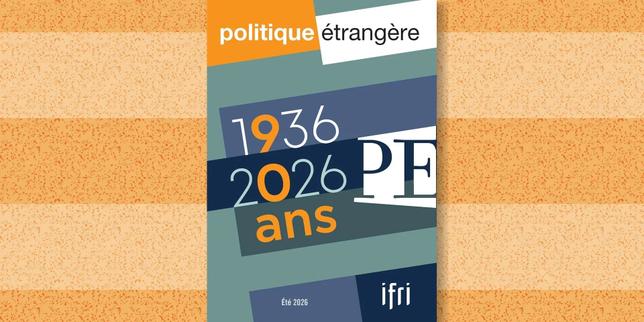
Foreign policy journals are dying an honorable, self-inflicted death. The celebration of the 90th anniversary of Politique étrangère, France's oldest international relations quarterly, perfectly illustrates the terminal malaise of the geopolitical establishment. The publication marked nearly a century of existence by releasing a special issue that intentionally blends traditional academic theorists with fiction writers and novelists.
The institutional consensus is cooing over this move. They view it as a brilliant, multidisciplinary triumph—a refreshing bridge between rigid data and human emotion. Meanwhile, you can read other stories here: The Unbroken Echo of a July Evening.
They are entirely wrong.
Merging novelists with geopolitical theorists is not an innovative strategy to understand a changing world. It is a desperate admission of intellectual bankruptcy. For nine decades, these grand journals have failed to predict almost every major geopolitical shift, from the collapse of the Soviet Union to the sudden rise of populist movements across the West. Now, instead of fixing their broken analytical models, they are outsourcing their thinking to fiction writers under the guise of "creativity." To understand the full picture, we recommend the excellent report by NBC News.
The Myth of the Literary Geopolitician
The establishment loves the idea that novelists possess a unique, prophetic sight into global conflict. They argue that literature captures the cultural anxieties and human variables that rigid state-centric data points miss.
This is a lazy defense mechanism designed to shield analysts from their own predictive failures. Geopolitics is not a subset of creative writing. It is the cold, hard calculus of resource scarcity, demographic shifts, geographic constraints, and military capabilities.
When a journal substitutes structural analysis for literary prose, it isn't broadening its horizons. It is actively degrading its utility. I have spent two decades analyzing state behavior, and I have never seen a diplomatic crisis resolved, or an economic sanction successfully modeled, by studying the narrative arc of a novel.
Think tanks and editorial boards are treating fiction as a shortcut to profound insight. The reality is far less glamorous. Fiction deals in the specific, emotional truths of individual characters. Geopolitics requires the brutal, detached assessment of state systems. Mixing the two does not create a sophisticated synthesis; it creates a muddy, unscientific mess that serves neither art nor policy.
Why the Institutional Models Are Broken
The "People Also Ask" sections of search engines are flooded with a predictable question: How do foreign policy experts predict international trends? The brutally honest answer is that they don't. The entire premise of the question is flawed because the industry rewards conformity over accuracy.
The traditional foreign policy journal operates as an echo chamber for a highly insular elite. The peer-review process, often lauded as the gold standard of academic integrity, acts as a filter that strips away contrarian thought. To be published in a legacy quarterly, an analyst must cite the accepted high priests of international relations theory—whether liberal internationalists or structural realists.
Imagine a scenario where a young analyst discovers an anomalous data point suggesting a sudden fracture in a long-standing alliance. If that finding contradicts the prevailing institutional doctrine, it face immense friction. It will be softened during peer review, buried in academic jargon, or rejected outright for lacking "theoretical grounding."
By the time an article passes through this institutional meat grinder, it is already obsolete. The world moves at the speed of fiber-optic cables; foreign policy journals move at the speed of academic tenure tracks. Adding novelists to the mix only slows down the process further, replacing outdated data with timeless, but functionally useless, metaphors.
The High Cost of Aesthetic Analysis
Let's look at the actual mechanics of this intellectual failure. Consider the historical track record of mainstream geopolitical analysis over the last thirty years:
| Historical Event | Institutional Prediction | The Reality |
|---|---|---|
| Post-Soviet Transition | Permanent integration of Russia into the Western economic framework. | Rapid descent into state-directed capitalism and revanchist militarism. |
| The European Integration Project | Perpetual erosion of national borders and the rise of a post-national identity. | Severe populist backlash and the re-emergence of hard border politics. |
| Global Supply Chain Optimization | Distributed, hyper-efficient manufacturing would guarantee global peace through interdependence. | Severe weaponization of supply chains and aggressive economic nationalism. |
In every single one of these instances, the failure did not occur because analysts lacked imagination or emotional depth. The failure occurred because they fell in love with their own aesthetic narratives. They preferred a clean, elegant story over the messy, contradictory realities of geography and human ambition.
Bringing novelists into the pages of Politique étrangère or any other legacy journal simply doubles down on this exact flaw. Novelists specialize in creating coherent, satisfying narratives. But reality is rarely coherent, and it is never satisfying. When policy elites read fiction to understand statecraft, they are indulging in confirmation bias, looking for poetic justifications for their own preconceived worldviews.
The Actionable Pivot: Brutal Realism Over Prose
If these legacy publications want to survive another ninety years without becoming completely irrelevant museum pieces, they need to stop hiding behind literary gimmicks. The solution isn't to make geopolitics more creative; it is to make it ruthlessly objective.
First, kill the anonymous peer-review system for policy commentary. It protects mediocrity and enforces a crushing intellectual monopoly. Replace it with a transparent accountability model where analysts are publicly judged on the accuracy of their past assessments. If an expert spends a decade writing flawed essays about state stability, their institutional standing should reflect that track record.
Second, aggressively diversify the intellectual pool away from elite universities and literary circles. Stop recruiting analysts who view the world through the lens of political science departments or creative writing workshops. Start recruiting supply chain logistics managers, energy traders, sovereign debt restructuring attorneys, and military logistics officers. These are the people who actually see the plumbing of the global system. They understand how power moves because they handle the friction points every single day.
Third, embrace structural uncertainty. Acknowledge that the world cannot be neatly categorized into a three-thousand-word essay that neatly wraps up with a policy recommendation. True analytical value lies in identifying vulnerabilities, mapping out worst-case scenarios, and challenging the comfortable assumptions of the ruling class.
The world is entering an era defined by hard power, resource competition, and demographic decline. These are stark, unforgiving realities. They cannot be softened by elegant prose, and they cannot be solved by literary metaphors.
Stop reading novels to understand the moves of nuclear powers. Turn off the institutional navel-gazing. The truth isn't found in a beautifully crafted narrative; it is buried in the dry, unglamorous data of global trade flows, industrial capacity, and ammunition production rates. Focus on the plumbing, or get swept away by the flood.