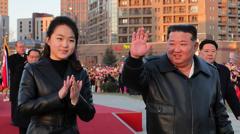
The visibility of Kim Ju-ae within the North Korean political apparatus is not a familial eccentricity; it is a calculated deployment of political signaling designed to stabilize the "Paektu Bloodline" against internal and external stressors. Analysis of North Korean leadership transitions reveals that legitimacy is a finite resource managed through three specific vectors: ideological purity, institutional endorsement, and military integration. While previous transitions—specifically from Kim Il-sung to Kim Jong-il—required decades of clandestine grooming, the accelerated exposure of Kim Ju-ae suggests a shift toward a preemptive legitimacy model.
The Legitimacy Architecture of the Kim Dynasty
To evaluate the probability of Kim Ju-ae’s succession, one must first quantify the components of North Korean sovereign authority. This is not a standard monarchical system but a "theocratic-military hybrid" governed by the Ten Principles for the Establishment of a Monolithic Ideological System.
- The Paektu Mandate: Authority is derived from an unbroken biological link to the 1930s anti-Japanese guerrilla struggle. Gender, while historically a barrier in Confucian-leaning structures, is subordinate to the "purity" of the bloodline.
- Institutional Anchoring: A successor must be embedded within the Workers' Party of Korea (WPK) and the State Affairs Commission (SAC).
- Military Hegemony: The "Songun" (Military-First) legacy requires the successor to be perceived as the commander of the nuclear deterrent.
The frequent presence of Kim Ju-ae at Intercontinental Ballistic Missile (ICBM) tests and military banquets serves to satisfy the third vector. By tethering her image to the Hwasong-17 and Hwasong-18 programs, the regime is effectively stating that the future of the nation’s security is synonymous with her personage.
Strategic Objectives of Early Exposure
The decision to reveal a potential successor at a pre-adolescent age serves several distinct functions that previous transitions lacked.
1. Risk Mitigation Against Leadership Vacuums
The health of Kim Jong-un remains a primary variable in regional stability. Early exposure creates a "buffer of recognition." Should a sudden transition be required, the domestic population and the political elite have already been conditioned to associate the child with the mantle of leadership. This reduces the friction of a sudden power hand-off and minimizes the window for a military coup or internal factionalism.
2. The Softening of the Nuclear Image
There is a deliberate contrast between the brutality of nuclear brinkmanship and the presence of a child. This juxtaposition serves a dual propaganda role: it humanizes the Supreme Leader as a "father of the nation" while simultaneously signaling that the nuclear program is a multi-generational commitment. The child represents the "generation of the nuclear era," signaling to the United States and its allies that denuclearization is not a negotiable outcome for any future leader.
3. Factional Alignment
By bringing the child into the public eye, Kim Jong-un forces the OGD (Organization and Guidance Department) and the military high command to publicly pledge loyalty. These public displays are recorded and archived, creating a digital and paper trail of fealty that would be difficult for any general to retract during a future power struggle.
Structural Constraints and Successor Friction
Despite the high-frequency signaling, several structural bottlenecks remain that could impede a smooth transition for Kim Ju-ae.
The Patriarchal Inertia
North Korea remains a deeply patriarchal society, influenced by traditional neo-Confucian values. While the Kim family has successfully overridden many social norms, the military elite—predominantly composed of elderly males—represents a significant cultural hurdle. For Kim Ju-ae to succeed, the regime must systematically rewrite the ideological textbooks to emphasize "Bloodline Over Gender." We are already seeing the beginning of this via the use of the term "Respected Daughter," a title previously reserved for the highest echelons of the WPK.
The Kim Yo-jong Variable
Kim Yo-jong, the leader’s sister, currently holds the role of "Regent-in-Waiting." She possesses the operational experience and political weight that a child lacks. This creates a potential divergence in the leadership path:
- Direct Succession: Kim Ju-ae moves directly into a senior party role upon reaching adulthood.
- Regency Model: Kim Yo-jong manages the state as a caretaker until Kim Ju-ae is deemed ready.
The friction between these two paths is the most likely source of internal destabilization. History shows that regents who taste absolute power are often reluctant to relinquish it. The current strategy appears to be a delicate balancing act, utilizing Kim Yo-jong for external "bad cop" diplomacy while positioning Kim Ju-ae as the internal "symbol of the future."
The Economic-Security Feedback Loop
The viability of any successor depends on their ability to manage the "Double Burden": maintaining a nuclear deterrent while preventing total economic collapse under sanctions.
- The Resource Allocation Problem: $R_{total} = M + S$, where $R$ is total national resource, $M$ is military expenditure (including the nuclear program), and $S$ is social/economic stability.
- The Successor’s Dilemma: As $M$ increases to ensure the "Military Hegemony" vector, $S$ inevitably decreases unless the state can bypass sanctions through illicit finance or increased Chinese patronage.
If Kim Ju-ae is to lead, the "Byungjin" policy (parallel development of the economy and nuclear weapons) must show tangible results for the Pyongyang elite. A successor who inherits a starving populace and a restless military is at a much higher risk of a "palace coup" than one who inherits a stable, albeit sanctioned, nuclear state.
Tracking the Transition: Indicators to Watch
To move beyond speculation, analysts must track specific metrics of institutional elevation. The transition is not confirmed by presence at a parade, but by the following bureaucratic shifts:
- The Creation of a Personal Secretariate: If a dedicated office is established for Kim Ju-ae’s affairs, it signals the start of formal administrative training.
- Formal Titles: Moving from "Respected Daughter" to "The Morning Star King" or "General" would indicate a finalized decision.
- Independent Public Appearances: When the child begins conducting "On-the-spot guidance" without Kim Jong-un present, the transition is effectively complete.
The current data points suggest that the regime is in the "Saturation Phase"—ensuring the face of the successor is inescapable. The next phase will be the "Administrative Phase," where she is given a seat on the Central Committee of the WPK.
The elevation of Kim Ju-ae is a defensive maneuver against the biological uncertainty of Kim Jong-un’s tenure. It is a strategic effort to lock in the dynasty’s survival through a multi-generational commitment to nuclear sovereignty. For external actors, the primary directive is to recognize that the Kim regime is no longer planning in five-year cycles, but in fifty-year dynasties. Engagement strategies that assume a leadership change will lead to liberalization are fundamentally flawed; the grooming of Kim Ju-ae is designed specifically to ensure that the core tenets of the Kim state remain immutable across the next century. Focus must remain on the durability of the regency structure and the potential for friction between the "Regent-in-Waiting" and the "Symbol of the Future."