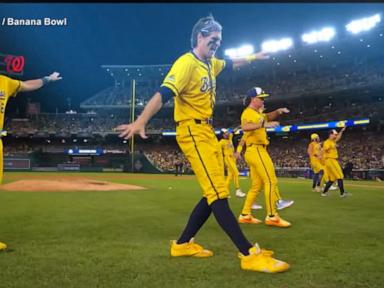
Every viral headline about the Savannah Bananas and the Banana Ball Championship League defaults to the exact same lazy narrative: stilt-walking pitchers, backflipping catchers, and choreographed dance routines. Sports media treats the product as a circus act that happens to use a bat and ball. That framing is not just reductionist; it is dead wrong.
The mainstream sports complex loves to dismiss Banana Ball as a glorified TikTok stunt because acknowledging its actual brilliance requires admitting that traditional baseball has spent decades ignoring its own structural rot. The genius of this format has nothing to do with men in kilts dancing in the outfield. It has everything to do with ruthless, aggressive pacing and an uncompromising rulebook that completely eliminates dead time.
Banana Ball Is Not Saving Baseball It Is Just Circus Peanut Entertainment
sports
The Savannah Bananas are taking a victory lap over their newly minted championship format, and the sports media is eating it raw. Headlines scream about a revolution, a savior for America's past time, an antidote to three-hour pitching-duel comas. Fans are treating every choreographed dance routine and inflatable-stilt walkout like a prophetic vision of what baseball needs to survive.
It is absolute theater masking a fundamental misunderstanding of why people actually love sports.
I have spent two decades watching promotions try to gimmick their way into cultural relevance. I watched the XFL try to put nicknames on jerseys while the play suffered. I watched minor league teams rebrand as hot dogs and pizza slices. And now we are looking at Banana Ball, a hyper-accelerated, rule-bending carnival act that treats baseball's actual mechanics like an inconvenience to be bypassed for TikTok views.
Here is the lazy consensus everybody accepts: traditional baseball is boring, youth attention spans are broken, and Jesse Cole invented the antidote by turning a nine-inning strategic chess match into a two-hour improv comedy show.
The consensus is lazy, and the premise is broken.
Baseball was never supposed to be fast, loud, or constantly stimulating. The genius of the sport lies entirely in its resistance to modern acceleration. It is an aerobic game of failure played out in vast, green spaces where time stretches and tension builds through silence, not despite it. When you strip away the walks, the defensive shifts, the strategic pauses, and the agonizing weight of a 3-2 count with two outs in the eighth inning, you do not fix baseball. You kill it and replace it with a completely different sport: professional kickball with higher production budgets.
Let us look at the mechanics of what makes Banana Ball actually function. The rules are designed explicitly to eliminate dead time. Walks count as sprints where every fielder must touch the ball before the runner stops. Fans can catch fly balls for outs. Games have a strict two-hour time limit. On paper, it looks efficient. In practice, it turns a game of microscopic margins and psychological warfare into a chaotic sprint where skill takes a backseat to spectacle.
Jesse Cole is a brilliant marketer, not a visionary custodian of sport. He looked at a declining attention span and decided to surrender to it completely instead of challenging the audience to appreciate depth. That is not innovation. That is capitulation.
The mainstream press loves to point to sellout crowds and viral clips as proof of a paradigm shift. But selling tickets to a traveling circus proves only that people like circuses. The Harlem Globetrotters sold out arenas for decades playing exhibition basketball with trick shots and confetti. Did anyone ever argue that the Globetrotters were saving the NBA? Of course not. Everyone understood they were an entertaining sideshow running parallel to the real sport.
The moment you start pretending that a game where fans can catch fly outs is the future of competitive athletics, you have lost the plot. Competitive integrity requires a level of standardization and solemnity that Banana Ball actively mocks.
Take the rule where a fan catching a fly ball results in an out. Think about that for a second. Imagine standing in the outfield of a high-stakes professional game, executing your defensive positioning flawlessly based on spray charts and wind patterns, tracking a screaming line drive into the gap, and having your career-defining play erased because a guy wearing a yellow kilt in the front row managed to secure the ball with a foam finger. That is not sport. That is a game show segment on a morning talk show.
Athletes are drawn to baseball because it is hard, lonely, and unyielding. The statistics do not lie. A hitter who fails seven out of ten times is an elite superstar making thirty million dollars a year. That baseline of inevitable failure creates a unique psychological pressure cooker. Banana Ball smooths down all those jagged, beautiful edges. It replaces genuine tension with manufactured hype.
If you want to fix the actual minor leagues or make the major leagues more engaging to a younger demographic, the solutions are already happening without turning the diamond into a vaudeville stage. Pitch clocks worked because they cut out dead time without altering the rules of engagement. Automated ball-strike systems reduce human error while preserving the sacred duel between pitcher and batter.
You do not need to introduce dancing umpires and mid-inning walk-off dance-offs to make people watch athletics. You need compelling narratives, accessible broadcast rights, and athletes who are allowed to show personality within the framework of a legitimate competition.
The Savannah Bananas are a brilliant entertainment business. They are crushing it financially, building a powerhouse brand, and bringing joy to thousands of families who just want a fun night out at the ballpark. More power to them.
Stop calling it the future of baseball.
It is professional wrestling with a Louisville Slugger, and pretending it represents the evolution of the game is an insult to every player who ever mastered the craft of hitting a 95-mile-per-hour slider on the black.
Baseball does not need to be saved by a gimmick. It needs to trust that the audience is still smart enough to appreciate a masterpiece that takes three hours to paint.