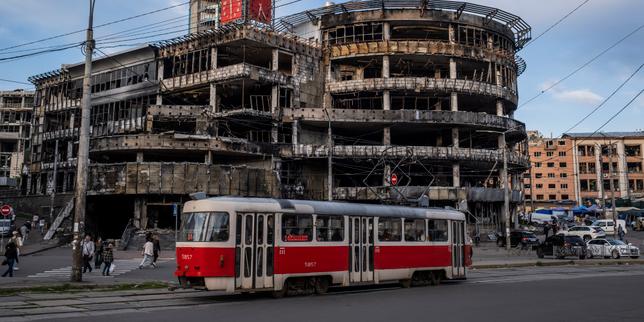
Every single morning, millions wake up to the exact same theatrical horror show. A headline drops about another barrage of Russian cruise missiles over Kiev, fuel depots igniting, shrapnel tearing through apartment facades, and eight more civilians rushed to emergency wards. The Western press treats these tactical updates as existential turning points. They breathlessly analyze air defense interception rates, drone trajectories, and the psychological resilience of a battered capital.
It is all a dangerous distraction.
While the media fixates on the fiery flashbulbs lighting up the night sky above the Dnieper River, a completely different war is being won and lost hundreds of kilometers away. The strikes on Kiev are not strategic masterstrokes designed to break a nation's spine. They are expensive, predictable pyrotechnics engineered for one specific audience: cable news producers in Washington, London, and Brussels.
Let us dispense with the lazy consensus immediately. The conventional wisdom claims that these relentless urban bombardments represent Moscow's primary mechanism of attrition—a desperate, brute-force attempt to freeze the civilian population into submission or force the government to sue for peace. Military analysts sitting in comfortable suburban think tanks pore over tonnage metrics and warhead payloads as if this were 1940 London during the Blitz.
It is not 1940. And treating modern kinetic strikes on capital cities as the core metric of conflict success reveals a staggering historical illiteracy.
The Economics of Exhaustion
Look at the brutal math of modern air defense and missile deployment. A single Russian cruise missile costs millions of dollars to manufacture, program, and launch. When it is intercepted by a Western-supplied surface-to-air battery over Kiev, the interceptor missile often costs multiples of that amount, while draining stockpiles that take defense contractors years to replenish.
On paper, this looks like a clever strategy for Moscow to bleed Western supply chains. But it ignores the fundamental law of diminishing returns in urban warfare. Hitting fuel reservoirs and commercial warehouses in a sprawling metropolis does not cripple a decentralized military supply chain. Modern logistics do not rely on static urban depots sitting in the crosshairs of satellite reconnaissance. They are distributed, modular, and mobile.
When a fuel depot burns in Kiev, it makes a magnificent spectacle for television cameras, but it barely registers on the operational readiness of front-line brigades fighting in the eastern steppes. It is tactical window dressing. By keeping the world's attention glued to the capital, Moscow successfully diverts strategic focus away from the attritional meat grinder consuming trenches, artillery barrels, and infantry reserves in the Donbas and Zaporizhzhia.
I have spent decades watching military commands and geopolitical analysts fall in love with the theatre of war while ignoring its boring, brutal plumbing. We prefer the drama of burning fuel tanks because it fits neatly into a twenty-four-hour news cycle. We recoil from the grim reality of artillery duels, electronic warfare supremacy, and industrial manufacturing capacity because those things cannot be neatly summarized in a breaking news banner.
The Flawed Premise of Air Dominance
People ask: Why can the capital's air defense not achieve total impenetrability? Why do eight people get injured in a residential district despite billions in advanced Western hardware?
The question itself is flawed. It assumes that air defense is an absolute shield rather than a localized economic filter. No capital city in the history of aerial warfare has ever achieved one hundred percent interception rates against a diversified saturation strike package combining ballistic missiles, cruise missiles, and loitering munitions. The laws of physics and geometry dictate that defense is always more expensive and complex than offense.
When commentators express shock that residential buildings are still struck, they betray a fundamental misunderstanding of how shrapnel and intercept debris work. An air defense missile intercepting a target at ten thousand feet does not make the threat vanish into thin air. It shatters it into thousands of high-velocity fragments that rain down unpredictably across heavily populated neighborhoods. The very act of defending a city from the ground introduces a secondary kinetic hazard to the streets below.
Yet, leaders keep pretending that the next tranche of missile defense systems will finally turn the capital into an impenetrable fortress. It is a comforting fiction. It allows politicians to pledge hardware that looks decisive on paper while avoiding the harder, unglamorous truths about industrial mobilization and manpower constraints on the front lines.
The Real Battlefield is Invisible
If you want to understand how this conflict actually ends, stop looking at the smoking craters in the suburbs of Kiev. Look instead at industrial manufacturing output indices, semiconductor black markets, electronic warfare spectrum dominance, and demographic depletion rates.
Wars of attrition are won by factories, not flashbulbs. They are won by the side that can sustain equipment losses and troop rotations without collapsing its domestic economy. While Western media counts the wounded civilians in the capital, defense planners in Moscow and allied capitals are running spreadsheets on steel production, propellant chemistry, and microchip procurement channels through Central Asian intermediaries.
The obsession with urban bombardments is a symptom of a broader psychological trap. Modern societies crave visible narratives. We need heroes defending the skyline and villains launching projectiles from the dark. We want our conflicts to resemble cinematic epics where the fate of the realm is decided by dramatic clashes at the gates of the capital.
Real warfare is far more mundane, and infinitely more terrifying. It is a slow-motion contest of economic stamina and institutional endurance.
What Actually Matters Now
Stop treating every missile strike on Kiev as a existential punctuation mark. Recognize it for what it is: a tactical distraction designed to manipulate political will thousands of miles away.
The resilience of a nation at war is not measured by how unscarred its capital's skyline remains. It is measured by the unglamorous, grinding capacity of its logistics networks to keep supplying exhausted soldiers in freezing trenches where no cameras are rolling.
The next time a breaking news alert flashes across your screen about burning reservoirs and injured civilians in the capital, remember that the war being fought there is a sideshow. The real outcome is being decided in places nobody is filming, by systems nobody is cheering for, through a process of slow, unrelenting arithmetic.
Do not look at where the explosions are happening. Look at who can afford to keep paying the bill when the smoke clears.