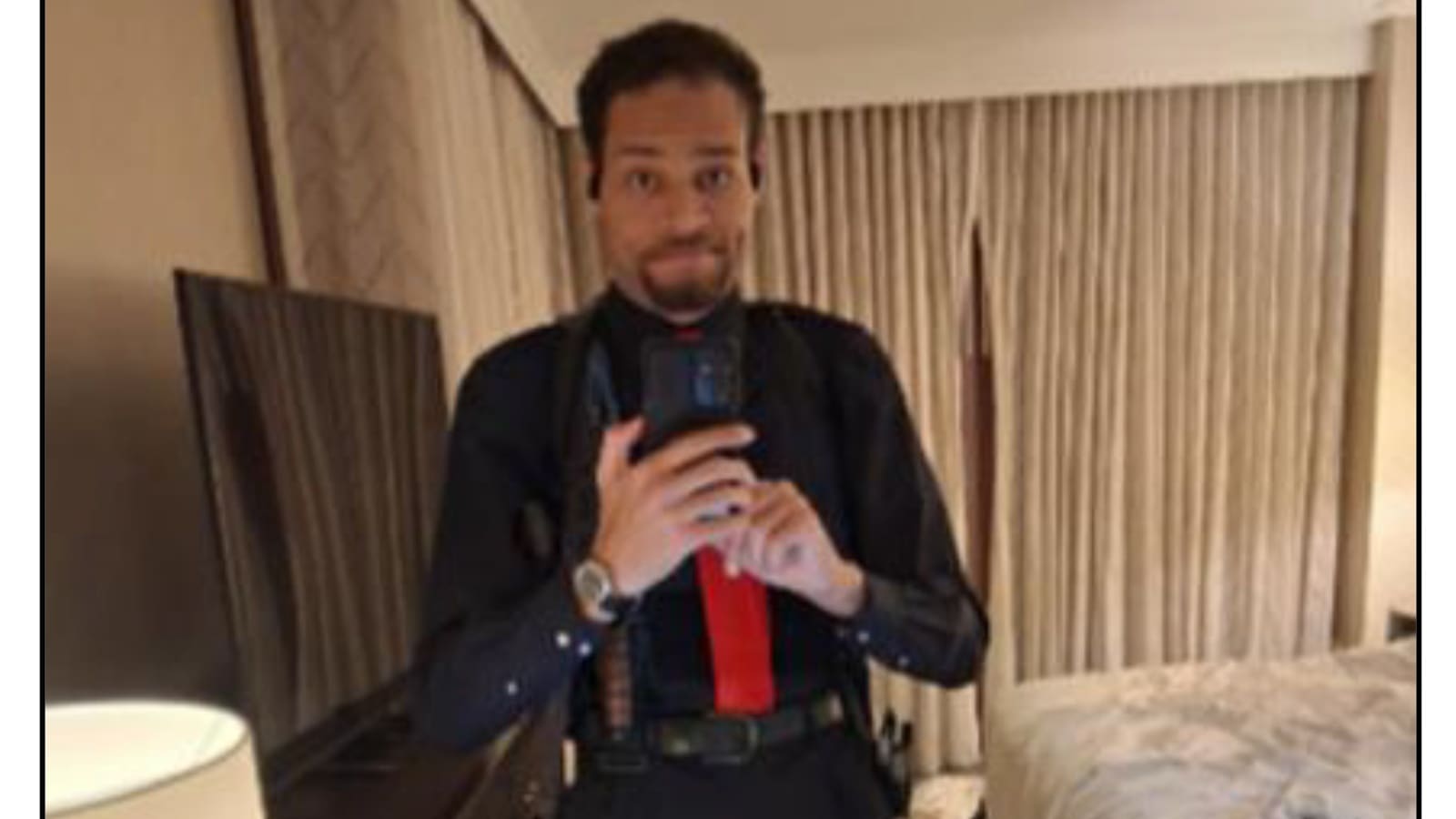
The security breach at the Butler, Pennsylvania, rally represents a systemic collapse of multi-tier perimeter defense. By examining newly released forensic imagery of the perpetrator, Thomas Matthew Crooks, we can reconstruct the timeline through a lens of tactical surveillance and pre-operational behavior. The perpetrator’s actions in the 48 hours preceding the event—specifically his presence at the venue and his documented self-surveillance in a nearby hotel—indicate a deliberate rehearsal phase rather than an impulsive act.
The Taxonomy of Pre-Operational Surveillance
Most security analyses categorize threat actors by intent; however, a more effective framework evaluates the Capability-Opportunity-Surveillance (COS) triad. The perpetrator’s selfies at a hotel near the rally site do not merely represent vanity; they are data points in a reconnaissance cycle.
- Site Familiarization: The assailant visited the site at least twice before the event. This allowed for the identification of "dead zones" in line-of-sight coverage.
- Visual Documentation: The use of a cell phone to record perspectives from elevated positions or nearby transit points serves as a "digital rehearsal."
- Anonymity Testing: By occupying a local hotel and moving in public spaces with high-profile equipment (like a rangefinder), the perpetrator was testing the friction of the local security environment.
The failure of law enforcement to interdict the subject despite multiple sightings—first as a suspicious person with a rangefinder, then as a person on a roof—reveals a breakdown in Communication Latency. In high-stakes protection, the gap between a "suspicious activity" report and "tactical intervention" must be near zero. In this instance, the latency was measured in minutes, which provided the window of opportunity for the engagement.
Architectural Vulnerabilities and Line of Sight Management
The geography of the Butler Farm Show grounds presented a specific set of geometric challenges that were poorly mitigated. Security perimeters are traditionally divided into three zones: the Inner Perimeter (the stage and immediate crowd), the Middle Perimeter (the secured venue grounds), and the Outer Perimeter (neighboring buildings and high ground).
The building utilized by the shooter, the AGR International complex, sat in a gray zone of the Outer Perimeter. It was identified as a potential threat but was not physically occupied or adequately overlooked by a dedicated counter-sniper element. This created a Critical Line of Sight (CLOS) Blindspot.
The Geometry of the Engagement
The distance from the rooftop to the podium was approximately 150 yards. In ballistics terms, this is a relatively short-range shot for a rifle equipped with an optic. The tactical error was not the inability to hit the target, but the assumption that the "outer" buildings were being monitored by local tactical teams. This assumption created a Responsibility Gap, where the Secret Service assumed local police had the roof secured, while local police were focused on crowd control or internal building security.
The lack of a unified command frequency meant that when local officers spotted the gunman on the roof, the information had to pass through multiple relay points before reaching the personal protection detail at the podium. Each relay point introduces a 2- to 5-second delay. In a ballistic event, 10 seconds is the difference between a successful evacuation and a casualty.
Behavioral Indicators vs. Passive Monitoring
The release of selfies taken by the shooter at his hotel highlights a recurring theme in modern domestic threats: the Digital Breadcrumb Trail. The perpetrator wasn't just a "lone wolf"; he was an active investigator of his own target.
- Rangefinder Utilization: The use of a laser rangefinder in a crowded environment is a high-signature behavior. It signals technical preparation.
- Elevation Seeking: Reports of the suspect looking at the roof and using a ladder to access it are clear indicators of intent that should have triggered an immediate "Red Code" or a temporary removal of the protectee from the stage.
- The Psychology of the Selfie: In this context, the images recovered from the phone suggest a desire for notoriety or a record of the "final hours." This is a common trait in mass shooters and high-profile assassins who view their actions as a performance.
Security protocols failed to transition from Passive Observation (watching for weapons) to Proactive Behavioral Analysis (identifying preparation markers). Monitoring for a gun is reactive; monitoring for the process of an attack is proactive.
Logistics of the Attack Cycle
The assailant’s logistics chain was short but efficient. He purchased 50 rounds of ammunition and a ladder on the day of the shooting. This suggests a compressed attack window. Long-term planning is easier to detect through intelligence gathering, but a rapid 24-hour escalation cycle bypasses many traditional law enforcement tripwires.
The weapon used was a legally purchased DPMS Panther Arms AR-15 style rifle. From a strategic standpoint, the weapon’s ubiquity allowed the shooter to transport it without drawing immediate, high-level suspicion in a region where firearm ownership is normalized. The failure was not the presence of the weapon, but the failure to secure the High-Ground Advantage.
Operational Failure Points
| Failure Category | Mechanism | Impact |
|---|---|---|
| Command | Lack of integrated radio channel | Information silos delayed response. |
| Tactical | Unsecured rooftop within 150 yards | Direct line of sight to the target. |
| Intelligence | Failure to act on "suspicious person" reports | The shooter was identified 30+ mins prior. |
| Technical | Lack of drone surveillance | A simple UAV would have spotted the shooter instantly. |
Structural Deficiencies in Protection Theory
The Secret Service uses a "concentric circles" theory of protection. This theory assumes that as a threat moves closer to the center, the density of security increases. However, the Butler event proved that a single hole in the outermost circle renders the inner circles irrelevant.
The shooter did not need to penetrate the crowd or the metal detectors. He exploited the Perimeter Porosity. In rural or open-air environments, the "Middle Perimeter" is often too large to guard physically. Instead, it must be guarded technologically. The absence of overhead surveillance (drones) or thermal sensors on nearby structures is a glaring technical oversight in a 2024 security environment.
Furthermore, the "slope" of the roof was cited by officials as a reason for not placing agents on that specific building. From a ballistics and tactical standpoint, this logic is flawed. If a surface is flat enough for a 20-year-old with no formal military training to traverse, it is flat enough for a trained observer or a remote camera system.
Intelligence Synthesis and the Myth of the Lone Wolf
Labeling an attacker as a "lone wolf" often serves as a bureaucratic shield to explain away intelligence failures. While the shooter may have acted alone, his actions followed a predictable, observable pattern of Pre-Incident Indicators (PIIs).
- Ideological Ambiguity: Unlike many political assassins, early reports suggest a lack of a clear, singular partisan motive. The shooter’s search history included both Trump and Biden, as well as the Democratic National Convention. This suggests a Target-Rich Opportunity mindset rather than a purely political one. He was looking for the most accessible high-profile target.
- Technological Competence: The improvised explosive devices found in his car indicate a secondary plan for mass casualty or a diversion. This elevates the threat level from a "disturbed individual" to a "tactical planner."
- Zero-Footprint Communication: By avoiding overt social media manifestos, the shooter stayed under the radar of federal monitoring programs. This necessitates a shift toward localized, physical surveillance of high-value event perimeters.
Technical Hardening of Political Events
To prevent a recurrence, the methodology of event security must shift toward Autonomous Perimeter Enforcement. Relying on local police—who have different training standards and communication hardware—to secure the most dangerous vantage points is an untenable strategy.
Modernizing the "Kill Zone" Buffer
The "Kill Zone" is the area where a shooter has a high probability of a lethal hit. In the age of high-velocity rifles and accessible optics, the Kill Zone has expanded to a 500-yard radius.
- Automated Rooftop Monitoring: Deployment of motion-sensing cameras on every structure within 1,000 yards.
- Unified Tactical Cloud: All law enforcement agencies on-site must be integrated into a single, real-time data stream where "suspicious person" reports are geolocated and pushed to every agent's headset.
- Aggressive Counter-Sniper Placement: Counter-snipers must be positioned to cover 360 degrees of high-ground, regardless of perceived roof "slopes" or weather conditions.
The selfies taken by the shooter are a chilling reminder that the modern assassin is often hiding in plain sight, documenting their own ascent to violence. The security apparatus must match this transparency with a granular, data-driven defense that prioritizes the structural and geometric realities of the terrain over the convenience of the perimeter.
The immediate requirement for the Secret Service is a move away from "security theater"—large numbers of visible agents—and toward "structural dominance." This involves the total control of all high-ground and the elimination of communication silos between federal and local partners. The Butler incident was not a failure of courage by the agents who shielded the former president; it was a failure of the architecture that allowed a shooter to gain a superior tactical position in the first place.



